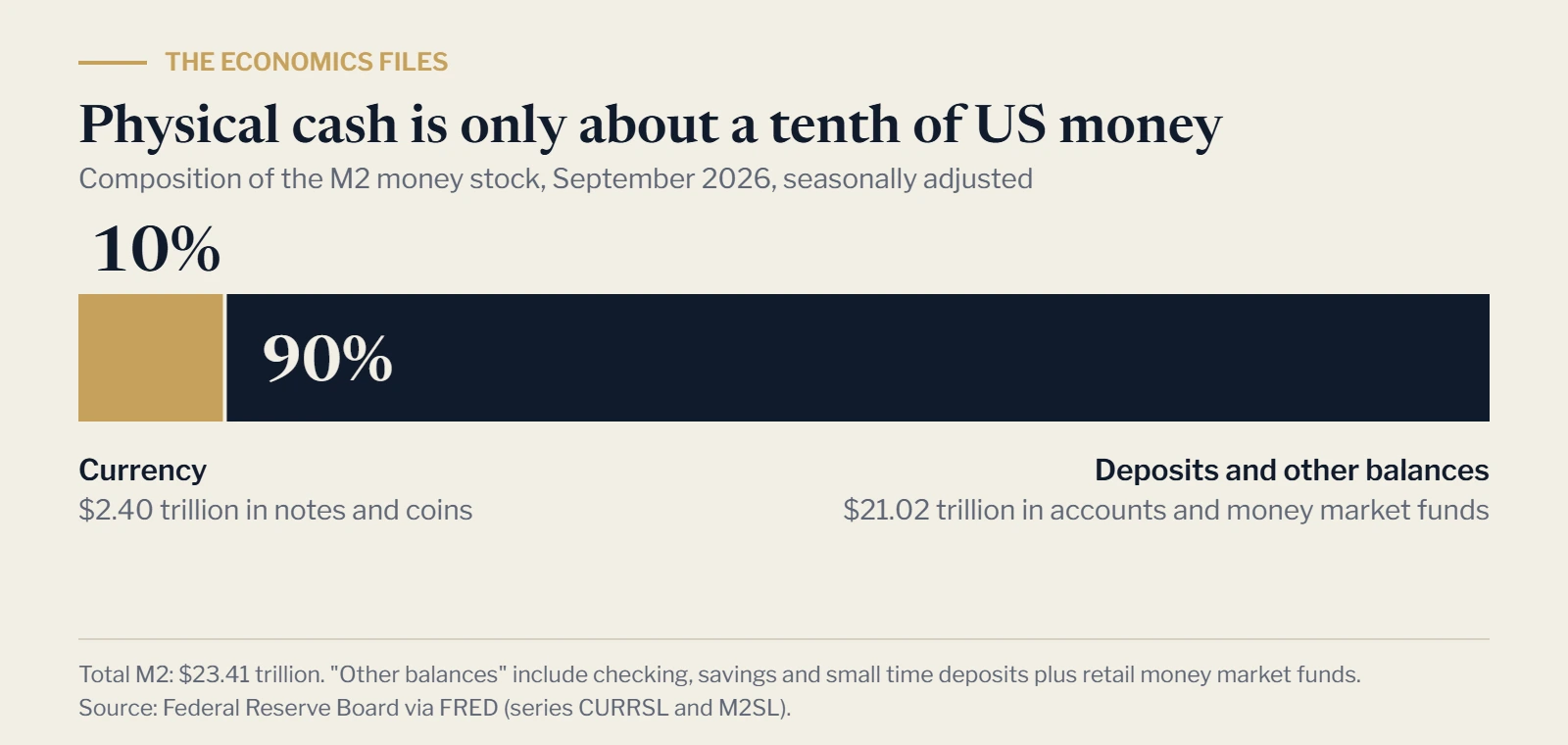
In September 2026, the US money supply measured by M2 stood at about $23.4 trillion. Only $2.4 trillion of it was physical currency. The other 90% existed as balances: entries in checking accounts, savings accounts and money market funds. The pattern holds elsewhere. The Bank of England estimated that 97% of the money held by the UK public at the end of 2013 was in bank deposits.
So where do all those balances come from? For most of them, the answer surprises people, including plenty who sat through an economics course: commercial banks create them when they make loans. This is the description given by central banks themselves, starting with a 2014 Bank of England bulletin and a 2017 Bundesbank report.
This explainer takes the question “How do banks create money?” step by step, using central bank sources and Federal Reserve data. It covers why the textbook account fails, what limits the process and why it matters for the wider economy.
The Textbook Story: Fractional Reserve Banking
Many introductory courses still teach a simple chain of events. A saver deposits $1,000 at a bank. The bank must hold a fraction in reserve, say 10%, so it lends out the other $900. The borrower spends it, the recipient deposits it at another bank, and that bank keeps $90 and lends $810. The process repeats.
Add up every round and the original $1,000 supports $10,000 of deposits, because 1 divided by a 10% reserve ratio is 10. In this account of fractional reserve banking, banks are middlemen between savers and borrowers, and the central bank controls the money supply by deciding how many reserves exist.
It is a tidy model. It also gets the order of events backward.
How Money Creation Actually Works
When a bank approves a loan, it does not take funds out of another customer’s account. It adds two entries to its own balance sheet. The loan is a new asset, because the borrower now owes the bank. A deposit of the same size appears in the borrower’s account as a new liability, because the bank now owes that balance to the borrower.
That deposit did not exist a moment earlier, and the borrower can spend it like any other money. In the Bank of England’s words, the lending bank “simultaneously creates a matching deposit in the borrower’s bank account, thereby creating new money.”
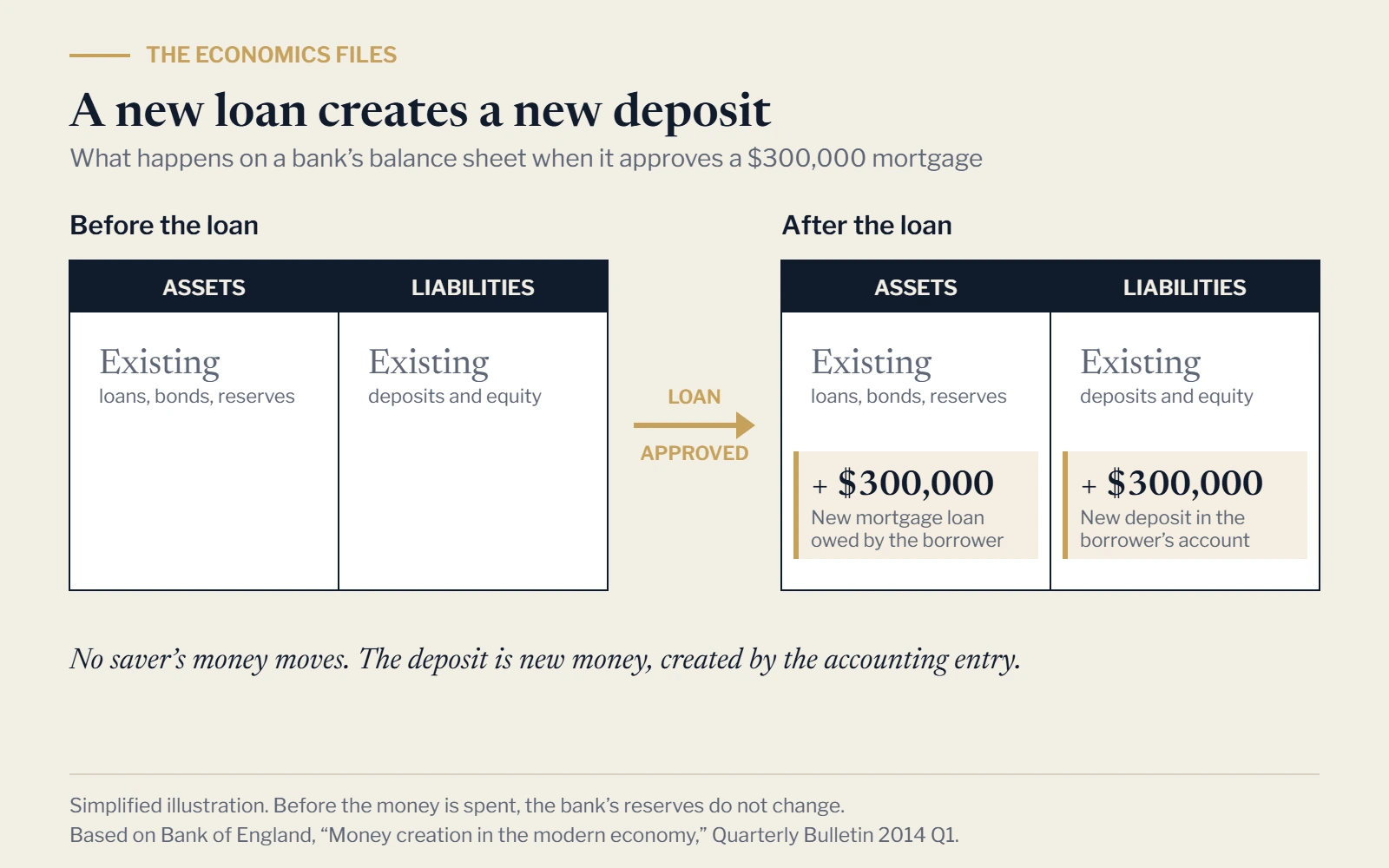
This is the core of money creation in a modern economy. Lending comes first and the deposit follows from it. The Bundesbank reached the same view in its April 2017 Monthly Report, which rejected the idea that banks can only lend out funds that other customers deposited earlier.
What Happens When the Borrower Spends the Money
Suppose the borrower uses the $300,000 to buy a house, and the seller banks somewhere else. The deposit moves to the seller’s bank, so the money stays in the economy. The lending bank, though, now has to settle that payment, and banks settle with one another in central bank reserves.
That is where reserves really come in. A bank’s ability to lend does not depend on already holding spare reserves or deposits, but it still has to fund the loans it makes so it can settle payments when the new deposits leave. In practice that means attracting deposits, borrowing in money markets or borrowing from the central bank, each at a cost. The Bundesbank spells out exactly this point.
Loan Repayment Destroys Money
The process runs in reverse too. When a borrower repays a loan out of a bank account, the deposit and the loan both shrink, and the money that was created disappears. The Bank of England’s example is a credit card: spending on the card creates deposits for the shops, and paying off the bill removes them again.
That is why the money supply can fall. US M2 averaged $21.6 trillion in 2022 and $20.9 trillion in 2023, a decline that came during the Federal Reserve’s sharp rate increases to bring inflation down. Money is not a fixed stock that only grows.
Why the Money Multiplier Breaks Down
If the textbook model were right, reserves would drive lending: add reserves to the banking system and loans and deposits would rise by a multiple. The years since 2008 ran that experiment on a huge scale.
In 2007, reserves held by US banks averaged about $43 billion. After the financial crisis and the Fed’s large-scale asset purchases, they averaged $2.7 trillion in 2014 and $3.9 trillion in 2021, roughly 90 times the 2007 level. Over the same period, total bank loans and leases grew from $6.1 trillion to $10.4 trillion, about 1.7 times. By 2025, reserves averaged $3.2 trillion and loans $12.9 trillion.
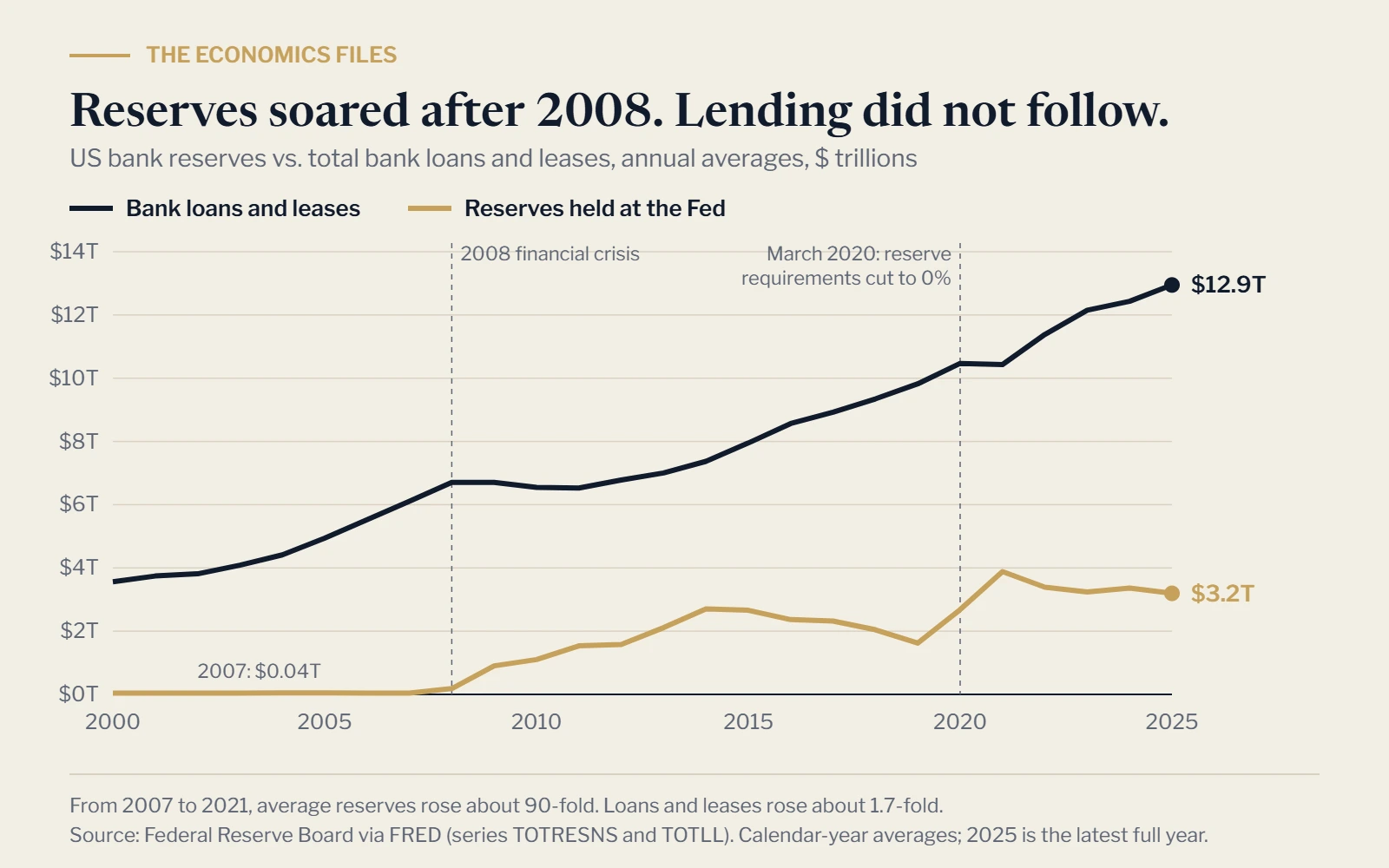
A money multiplier that worked as advertised would have turned that flood of reserves into an enormous lending boom. Nothing of the kind happened. Loans grew with what borrowers wanted and what banks judged profitable and safe. In fact, US loans and leases were lower in 2011 than in 2008, even as reserves climbed past $1.5 trillion. The Bank of England’s economists concluded that the quantity of reserves does not directly limit how much banks lend.
The Fed has since made the point in policy. It announced on March 15, 2020 that reserve requirement ratios would fall to zero, effective March 26, 2020, ending reserve requirements for all depository institutions. Under the textbook formula, a zero reserve ratio means dividing by zero. In the Fed’s explanation, reserve requirements simply no longer played a significant role, because it now runs monetary policy with ample reserves in the system.
What Limits How Much Money Banks Create
Banks cannot create money without limit. The Bank of England groups the constraints into three types.
Profitability, Risk and Regulation
Every loan has to earn more than it costs the bank to fund and the losses it expects. A bank that lends much faster than its rivals has to cut its loan rates, accept riskier borrowers or pay more for funding as its new deposits flow out to other banks. Capital rules add a firm limit: banks must hold equity against their loans, so reckless lending runs into regulators. The Bundesbank names the same brakes, the need to lend profitably along with micro- and macroprudential regulation.
What Households and Businesses Do With the Money
New deposits do not always stay in circulation. People and firms may use them to pay off other loans, which destroys money, or move them into investments that are not counted as money. Demand matters as well. A bank can only lend to people and companies who want to borrow at the rates on offer.
Interest Rates and Quantitative Easing
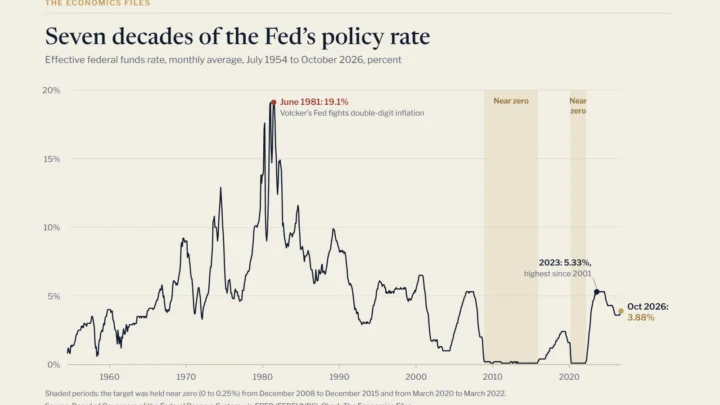
The central bank sets the outer limit. In normal times it does not ration reserves. It sets the interest rate on them, and that rate feeds through to what banks charge borrowers and pay depositors. When rates rise, borrowing gets more expensive, fewer loans are made and fewer new deposits are created.
When rates are already close to zero, central banks have turned to quantitative easing. The central bank buys government bonds, often from pension funds and insurers, and pays with newly created reserves. Because the sellers are not banks, the payment reaches them as new deposits at their own banks, so QE adds to the broad money supply directly. The Bank of England describes the result as deposits held in place of the government debt the investors sold.
Why It Matters
The answer to “how do banks create money?” changes how several economic stories read once you see banks as creators of money rather than conduits for savings.
Credit booms are also money booms. When banks compete to lend against rising house prices, they create the deposits that fund the next round of purchases. That feedback loop helps explain why housing bubbles can feed themselves, and why regulators watch the growth of bank lending so closely.
Paying down debt has the opposite effect. When households and companies cut their borrowing after 2008, the money that lending would have created never appeared, however many reserves the Fed supplied.
It also changes debates about “printing money.” Those arguments usually focus on central banks. Most new money, though, begins on commercial bank balance sheets, so lending standards, capital rules and interest rates do much of the work in deciding how much of it exists.
Key Takeaways
- Most money is bank deposits. Physical currency was about 10% of US M2 in September 2026.
- Banks create deposits when they lend and destroy them when loans are repaid.
- From 2007 to 2021, US reserves rose about 90-fold while loans rose about 1.7-fold, which the textbook model cannot explain.
- The real limits are profitability and regulation, the choices of borrowers and depositors, and the central bank’s interest rate.
Frequently Asked Questions
Do banks lend out their customers’ deposits?
Not in the way the phrase suggests. A new loan creates a new deposit for the borrower. Banks do still need funding, including customer deposits, to settle payments once that new money is spent and leaves for other banks.
Can banks create unlimited money?
No. Each loan has to be profitable and covered by capital, borrowers have to want the loan, and the central bank’s interest rate sets the price of credit across the economy.
Does the US still use fractional reserve banking?
Not in the legal sense. Reserve requirement ratios have been zero since March 26, 2020. Banks still hold large reserve balances, about $3.0 trillion in September 2026, because they need them to make payments and manage liquidity.
What happens to money when a loan is repaid?
When a borrower repays the principal, the deposit used for the payment is canceled along with the loan, so that money leaves the economy. Interest is different: it becomes bank income that can be paid out as wages and dividends or kept as capital. This is why the money supply can shrink when households and businesses pay down debt faster than banks make new loans.
Are bank deposits insured in the US?
Yes, up to a limit. The FDIC insures deposits up to $250,000 per depositor, per insured bank, for each account ownership category. Insurance exists because a bank keeps only a small part of its deposits as cash and reserves, so it could not pay every depositor at once if all of them tried to withdraw on the same day.
Sources and Method
- Michael McLeay, Amar Radia and Ryland Thomas, “Money creation in the modern economy”, Bank of England Quarterly Bulletin, 2014 Q1.
- Bank of England, “Money in the modern economy: an introduction”, Quarterly Bulletin, 2014 Q1.
- Deutsche Bundesbank, “The role of banks, non-banks and the central bank in the money creation process”, Monthly Report, April 2017.
- Board of Governors of the Federal Reserve System, “Reserve Requirements” and press release of March 15, 2020.
- Federal Reserve Board data via FRED: M2SL, CURRSL, TOTRESNS and TOTLL.
Method: annual figures are calendar-year averages of monthly or weekly Federal Reserve data, with 2025 the latest full year. The M2 breakdown uses seasonally adjusted values for September 2026, the latest available at the time of writing. Charts are by The Economics Files.