On August 24, 2026, nearly six months into the war with Iran, the US Treasury announced sanctions on more than 60 people, companies and ships, and warned that countries still doing business with Tehran could be punished too. Four years earlier, the United States and its allies had frozen about $300 billion of Russia’s central bank reserves within days of the invasion of Ukraine. Sanctions have become the tool governments reach for first when they want to pressure another country without going to war, or alongside it. So how do sanctions work, and do they achieve what governments want?
Short answer: Economic sanctions are restrictions a government places on trade or financial dealings with a country, company or person to change its behavior or limit its capabilities. They work by cutting the target off from markets, money and technology. The United States has unusual power here because most international payments run through dollars and US banks, so foreign firms usually comply with American sanctions to avoid losing that access. Sanctions often impose heavy economic costs, but they achieve their political goals far less often.
How Do Sanctions Work?
How do sanctions work in practice? A government decides that a country, company or individual is a threat, whether over war, terrorism, nuclear weapons, human rights or crime. It then uses its legal powers to restrict what its own citizens, banks and companies may do with that target. The aim is to raise the cost of the target’s behavior, to deny it resources, or to signal disapproval.
In the United States, most sanctions rest on the International Emergency Economic Powers Act of 1977, which lets the president declare a national emergency and block transactions in response to an unusual foreign threat. Congress also passes sanctions laws directly. In the European Union, sanctions are adopted by the Council and require the unanimous agreement of all member states, which is why a single government can delay a package. In July 2026, the EU failed to approve its latest Russia package ahead of a key deadline. The United Nations Security Council can impose sanctions that bind all member countries, but its permanent members can veto them.
Comprehensive and targeted sanctions
Sanctions range from broad to narrow. Comprehensive embargoes, like the long-standing US measures on Cuba and Iran, ban almost all trade with a country. Targeted sanctions aim at specific people, companies, ships or sectors. Since the 1990s, governments have shifted toward targeted measures, partly because broad embargoes on Iraq in the 1990s caused severe humanitarian harm. The Global Sanctions Data Base, which records 1,547 sanctions cases from 1950 to 2023, shows the share of trade sanctions falling and the share of financial and travel sanctions rising.
Financial Sanctions: Why the Dollar Matters
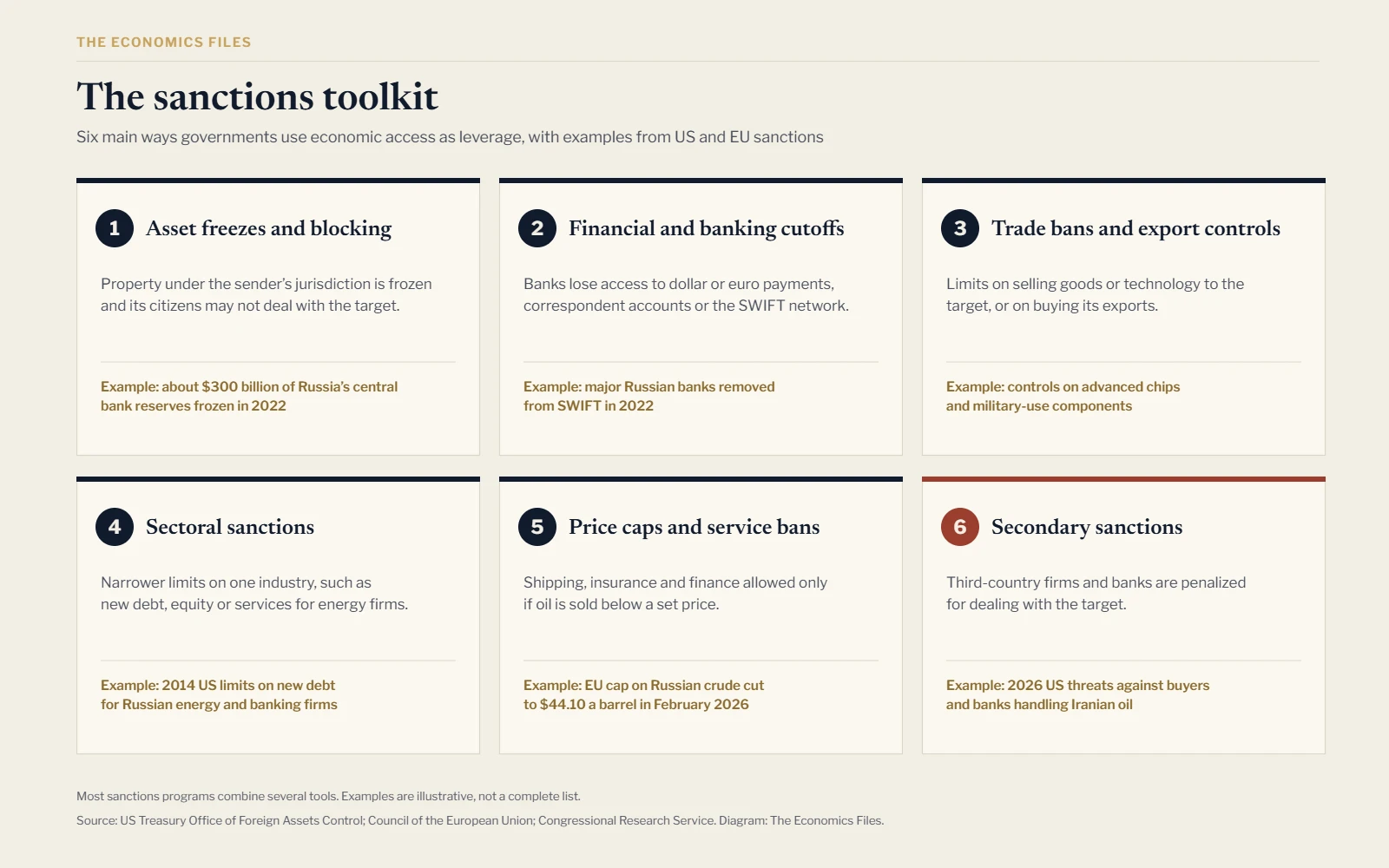
Financial sanctions are the most powerful tool in the modern kit. Most international trade, from oil to semiconductors, is priced and paid for in US dollars. Those payments usually pass through correspondent accounts at US banks. When the United States blocks a target, any bank that processes its dollar payments risks penalties, and the target finds it very hard to buy or sell abroad.
Freezing assets works the same way. In February 2022, the Group of Seven barred transactions with Russia’s central bank, immobilizing about $300 billion of its reserves held in Western jurisdictions, out of roughly $630 billion in total. Major Russian banks were also removed from SWIFT, the Belgium-based messaging network that banks use to send payment instructions across borders. Our explainer on what a central bank does explains why reserves matter so much in a crisis: they are what a country uses to defend its currency and pay for imports.
OFAC and the SDN List
In the United States, the Treasury’s Office of Foreign Assets Control (OFAC) administers most sanctions. Its main tool is the Specially Designated Nationals and Blocked Persons List, usually called the SDN List. When a person, company or vessel is added, any of its property under US jurisdiction is frozen and Americans are generally barred from dealing with it. Companies owned 50% or more by blocked persons are treated as blocked too, even if they are not named.
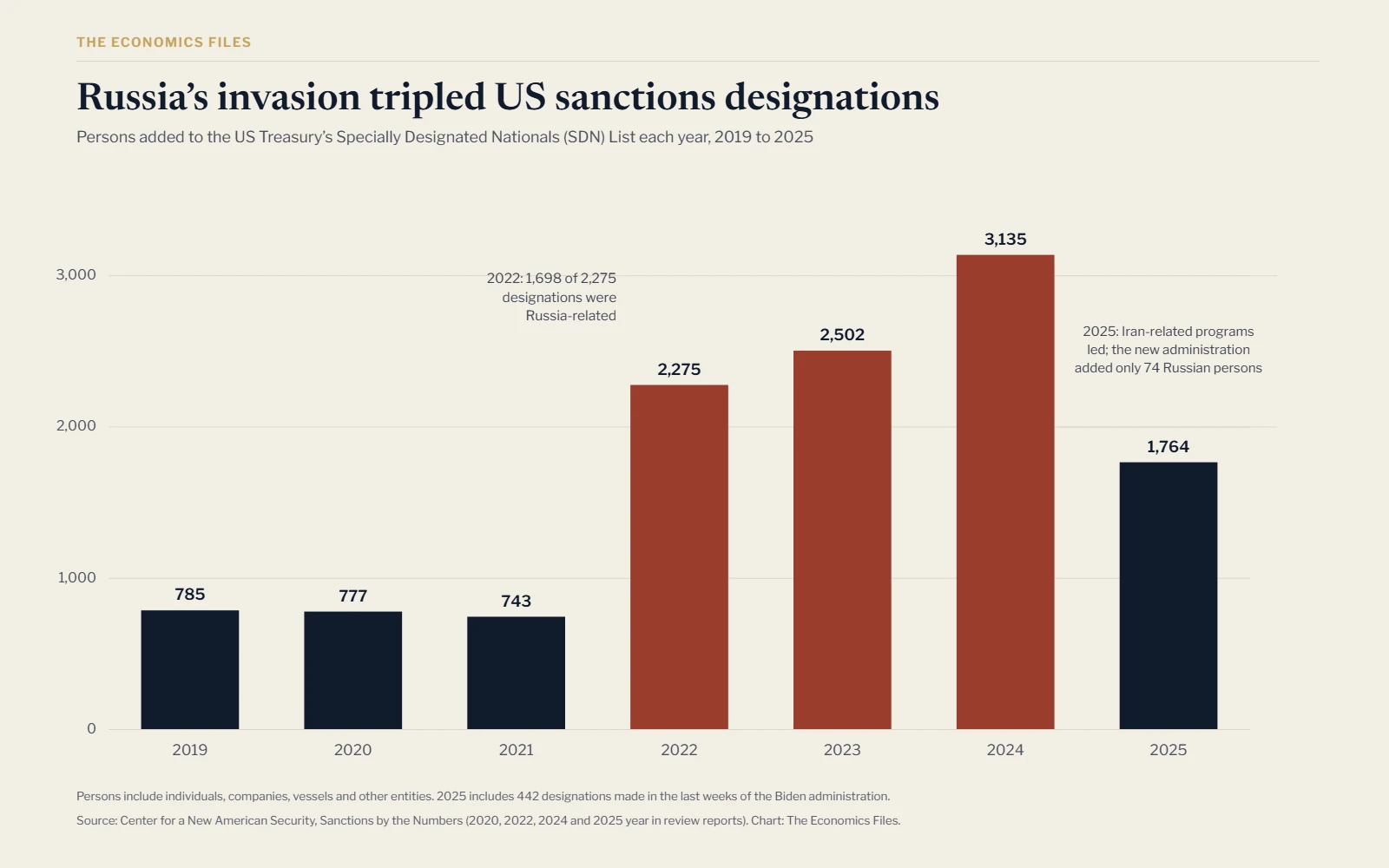
The list has grown fast. According to the Center for a New American Security, the United States added 743 persons to the SDN List in 2021. After Russia’s invasion of Ukraine, that jumped to 2,275 in 2022, with 1,698 of them Russia-related, then to 2,502 in 2023 and 3,135 in 2024. In 2025 the total fell to 1,764, and the focus shifted: Iran-related programs led the year’s designations, while only 74 Russian persons were added after the new administration took office.
Treasury also enforces the rules. Companies that break sanctions face civil penalties, and individuals can face criminal charges. Banks, shipping firms and insurers spend heavily on compliance screening for that reason.
Secondary Sanctions: Reaching Beyond US Borders
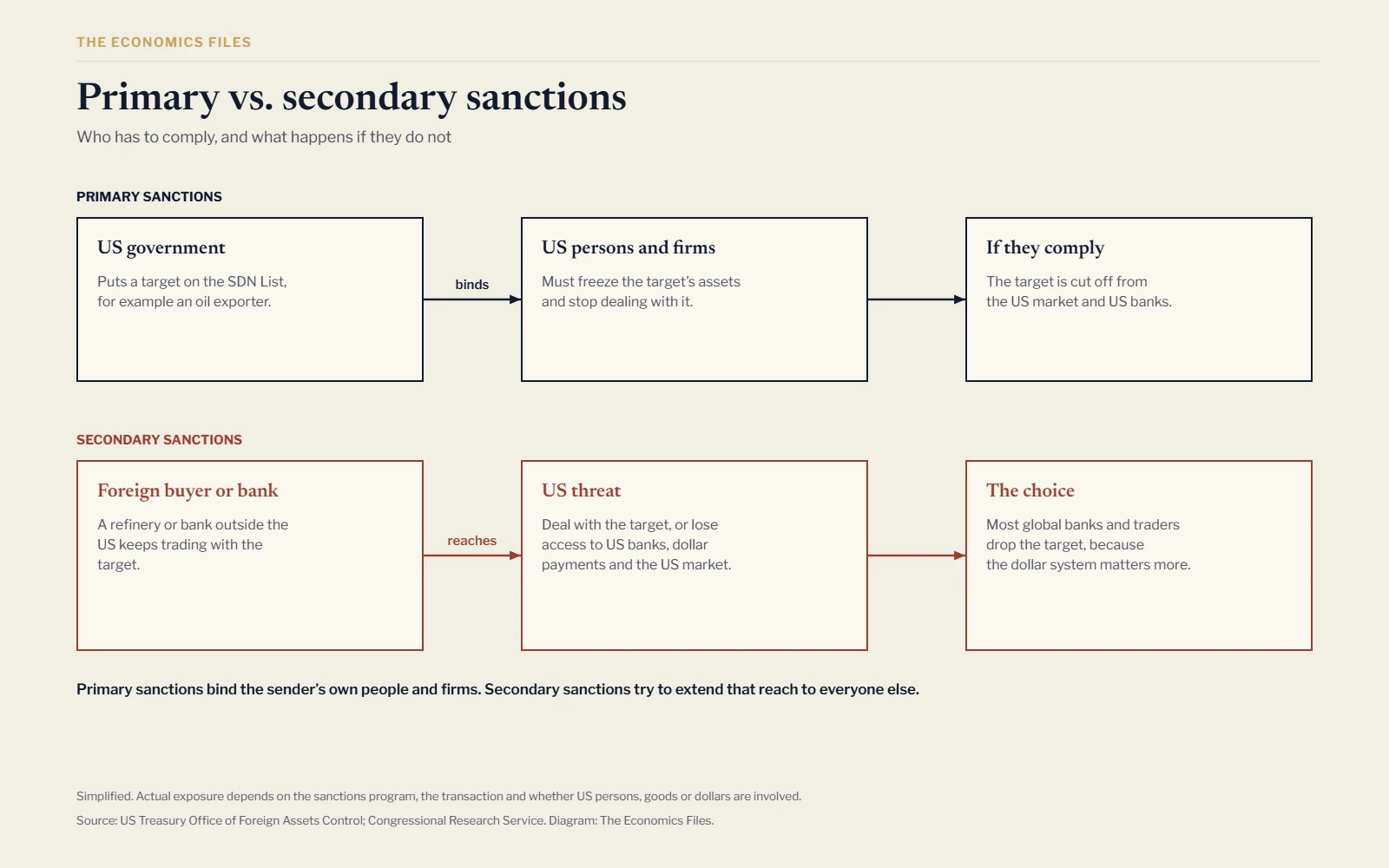
Primary sanctions bind a country’s own citizens and companies. Secondary sanctions go further. They threaten foreign banks and firms with losing access to the US financial system if they keep dealing with a sanctioned target. Faced with a choice between a sanctioned customer and the world’s largest economy and currency, most global banks walk away.
This is the lever the United States is pulling against both Russia and Iran. When Washington blocked Russia’s two largest oil producers, Rosneft and Lukoil, the measures took effect on November 21, 2025. Because the two companies handle roughly half of Russia’s oil exports, the sanctions threatened buyers in India and China with penalties of their own. Against Iran, Treasury sanctioned the Chinese refinery Hengli Petrochemical in 2026 as one of Iran’s largest customers, and in August it threatened penalties on any country still trading with Tehran. Before the war, China bought roughly 80% to 90% of Iran’s oil exports.
The power of this tool comes with friction. Allies sometimes object to the United States punishing their companies, and rivals have an incentive to build payment systems that avoid the dollar.
Price Caps and Shadow Fleets: The Russia Oil Experiment
The Russian oil price cap is a newer design. Rather than ban Russian oil outright and risk a global price spike, the G7 and the EU agreed in late 2022 to let Western firms ship, insure and finance Russian crude only if it was sold below $60 a barrel. The goal was to keep Russian oil flowing while cutting Moscow’s revenue.
The EU later tightened the cap. Its 18th sanctions package lowered it to $47.60 and introduced an automatic mechanism that sets the cap 15% below the average market price of Russian Urals crude. Under that rule, the cap fell to $44.10 a barrel from February 1, 2026.
Russia responded by building a “shadow fleet” of older tankers owned through opaque companies and insured outside the West, so its oil could move without Western services. By October 2025, the EU had sanctioned 557 such vessels. The contest between new restrictions and new evasion routes is typical of sanctions on large economies.
Do Sanctions Work?
The economic effects are often large. The political effects are harder to achieve. Research using the Global Sanctions Data Base finds that the success rate of sanctions rose until the mid-1990s and has fallen since. Classic studies put the share of cases that achieved at least part of their goals at around one-third.
Sanctions tend to work best when the goal is limited, the target depends heavily on the countries imposing them, and many countries join in. Pressure on South Africa in the 1980s and the multilateral sanctions that brought Iran into the 2015 nuclear deal are often cited as examples where sanctions helped. They work worst against large, determined governments with alternative partners. Russia’s economy proved more resilient than many expected after 2022, as it redirected oil sales to China and India and found ways around restrictions. Iran has lived under layers of sanctions for decades without changing course on its core policies.
The costs of sanctions
- Civilian harm. Broad sanctions can hurt ordinary people through shortages of food, medicine and jobs, even with humanitarian exemptions, because banks often refuse legitimate transactions to avoid risk.
- Costs at home. Sanctioning major energy exporters can push up global fuel prices. The 2026 war with Iran, and the pressure on its oil exports, has pushed energy prices higher.
- Evasion and new networks. Targets turn to third-country traders, front companies, shadow fleets and cryptocurrency.
- Erosion of the dollar’s reach. Heavy use of financial penalties gives other countries a reason to settle trade in other currencies over time.
Sanctions and the Wider Economy
Sanctions are part of a broader shift toward using economic ties as weapons, alongside tariffs, export controls on technology and restrictions on investment. History shows how powerful economic pressure can be. The 1973 Arab oil embargo added fuel to the Great Inflation in the United States. Today, sanctions on Russia and Iran, two of the world’s largest energy exporters, affect oil prices, shipping routes and inflation far beyond their borders.
For investors and businesses, the practical lesson is that sanctions risk is now a normal part of operating internationally. For readers following the news, the key questions to ask about any new sanctions are simple: who is targeted, which countries are joining, whether foreign firms face penalties for ignoring them, and how easily the target can find other buyers and suppliers.
Frequently Asked Questions
What are economic sanctions?
Economic sanctions are restrictions on trade, investment or financial dealings that one or more governments impose on a country, organization or individual to pressure it to change its behavior or to limit its resources. They can include asset freezes, trade bans, export controls and limits on access to banks and payment systems.
Who decides US sanctions?
The president can impose sanctions under emergency powers, mainly the International Emergency Economic Powers Act, and Congress can pass sanctions laws. The Treasury Department’s sanctions office administers most programs and maintains the SDN List, while the State and Commerce Departments handle other parts, such as visa bans and export controls.
What does it mean to be on the SDN List?
A person or company on the SDN List has its property under US jurisdiction frozen, and US citizens and companies are generally prohibited from doing business with it. Companies owned 50% or more by listed persons are also blocked.
What is the difference between primary and secondary sanctions?
Primary sanctions restrict what a country’s own citizens and companies can do. Secondary measures threaten foreign companies and banks with penalties, such as losing access to the US financial system, if they deal with a sanctioned target.
Do sanctions actually work?
Sometimes. They reliably impose economic costs, but they achieve their political aims in only a minority of cases. They are most effective when goals are limited, many countries participate and the target has few alternatives.
Sources and Method
- US Department of the Treasury, Office of Foreign Assets Control, sanctions programs and SDN List, and press release on Iranian military oil sales.
- Center for a New American Security, Sanctions by the Numbers: 2025, 2024, 2022 and 2020 year in review reports.
- Congressional Research Service, “Russia’s War on Ukraine: Financial and Trade Sanctions” and “Russia’s Invasion of Ukraine: New Financial and Trade Sanctions”.
- Gabriel Felbermayr and coauthors, “The Global Sanctions Data Base”, European Economic Review, 2020, and Release 4 (1950–2023), 2025.
- Gary Clyde Hufbauer, Jeffrey J. Schott, Kimberly Ann Elliott and Barbara Oegg, Economic Sanctions Reconsidered, 3rd edition, Peterson Institute for International Economics, 2007.
- Mayer Brown, “Russia/Ukraine Sanctions Update, January 2026”, on the EU price cap.
- Stockholm School of Economics, “New sanctions rattle Russia’s oil sector”; Bloomberg via World Oil, August 24, 2026; Reuters via Al-Monitor, August 24, 2026.
Method: SDN designation counts are persons (individuals, entities and vessels) added to the list in each calendar year as compiled by the Center for a New American Security; 2025 combines 1,322 designations by the Trump administration and 442 by the Biden administration in January. Russian central bank reserve figures are from the Congressional Research Service. Price cap levels are those set by the EU. Events are current as of November 22, 2026; sanctions change often, and this article will be updated as major programs change. Diagrams are by The Economics Files.