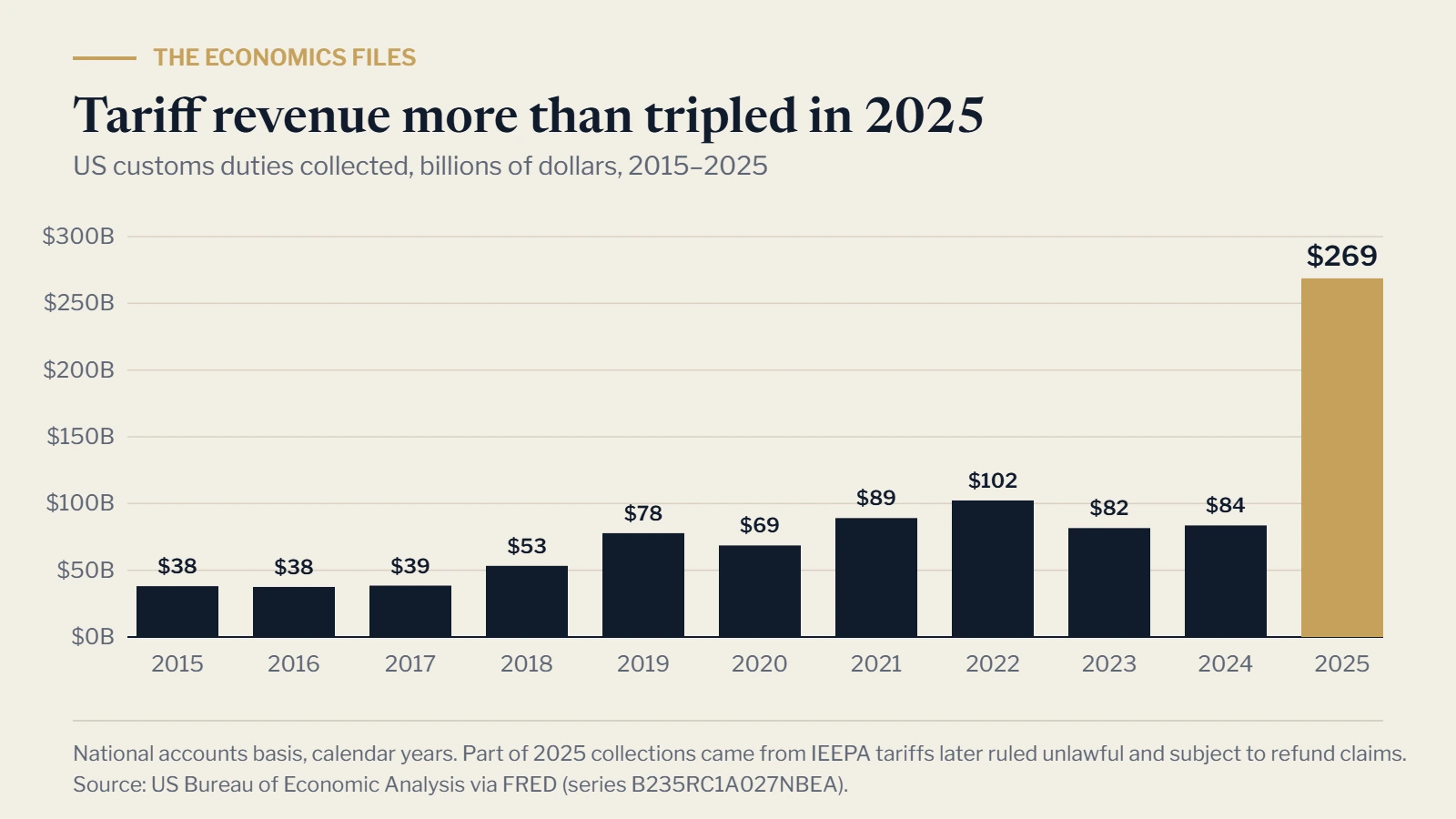
The United States collected $268.7 billion in customs duties in 2025, more than three times the $83.6 billion it collected in 2024, according to Bureau of Economic Analysis data. Measured against the value of goods imported, that works out to an average tariff of about 8%, the highest since 1946 by our calculation.
Then the legal ground shifted. On February 20, 2026, the Supreme Court ruled 6–3 that the emergency law behind most of those duties does not give the president power to impose tariffs. Within months, new tariffs under different laws had taken their place. So how do tariffs work, who really pays them, and what is in force now? This guide answers all three with the evidence.
Short answer
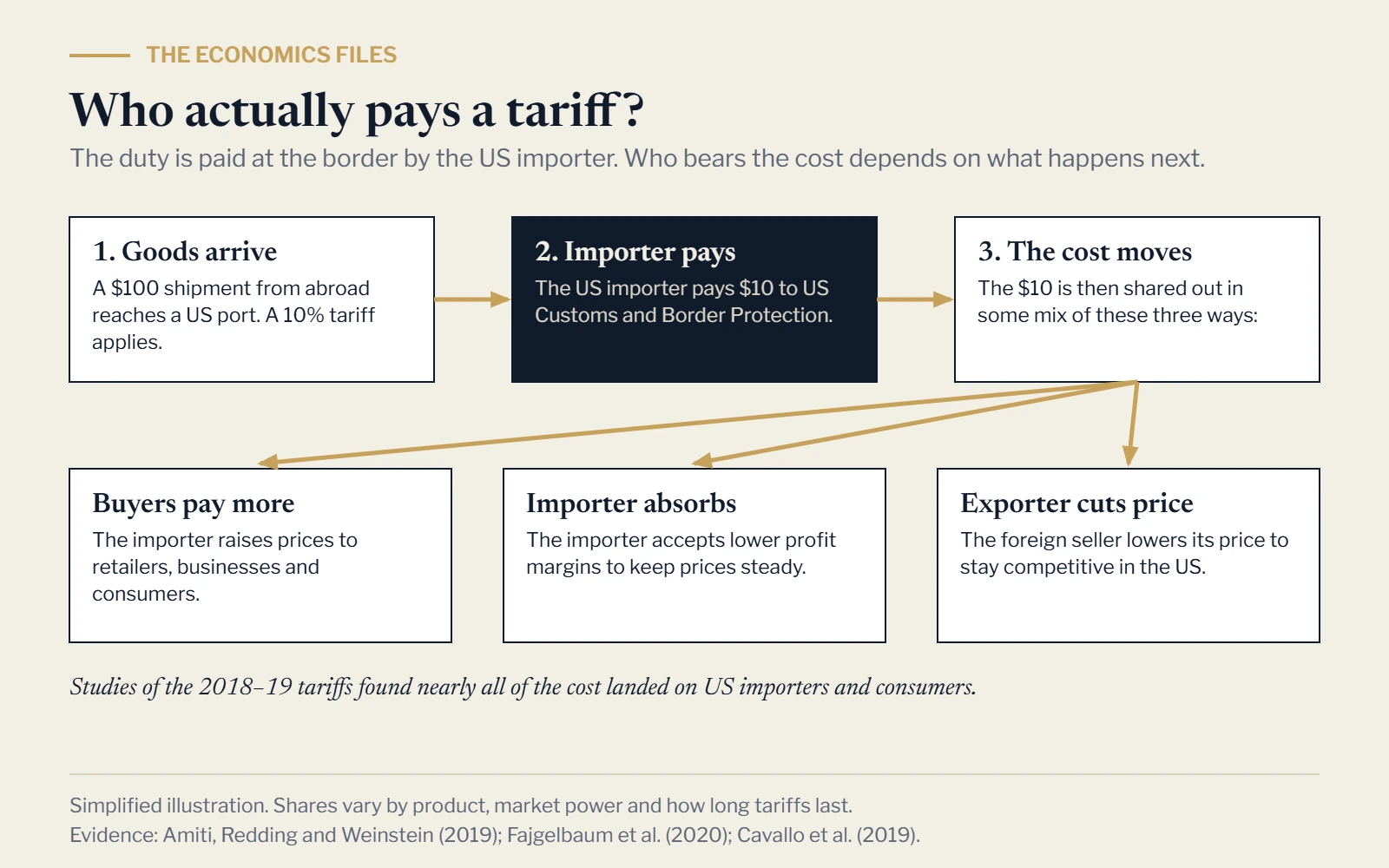
A tariff is a tax on imported goods. The US importer pays it to US Customs and Border Protection when the goods arrive, not the foreign country. The importer then passes some or all of the cost to customers, absorbs it, or pushes the foreign seller to cut prices. Studies of the 2018–19 US tariffs found nearly all of the cost fell on US importers and consumers.
What Is a Tariff?
A tariff, also called a duty, is a tax charged on goods when they cross a border. Most US tariffs are ad valorem, meaning a percentage of the import’s value: a 10% tariff on a $100 shipment is $10. Some are specific duties, a fixed amount per unit, such as cents per kilogram.
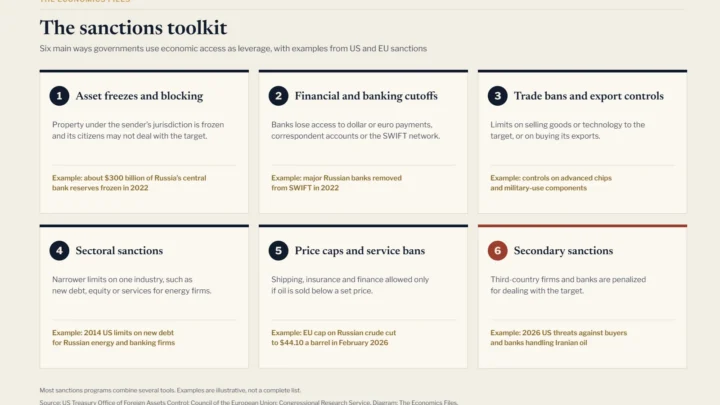
Governments use tariffs for several reasons: to raise revenue, to protect domestic industries from foreign competition, to retaliate against another country’s trade practices, or as leverage in negotiations, a role they share with sanctions. For most of the 20th century, raising revenue mattered less and less in the US, as income taxes became the main source of federal money. Tariffs have now become a meaningful revenue source again.
How Tariffs Work at the Border
The process is mechanical. When a shipment arrives, the company bringing it in, known as the importer of record, declares what the goods are using the Harmonized Tariff Schedule, states their value and country of origin, and pays any duty owed to US Customs and Border Protection (CBP). Only then are the goods released.
Notice who writes the check: a US business. The foreign exporter does not send money to the US Treasury. That is the real question behind “how do tariffs work?”: what happens to the cost after the duty is paid.
Who Pays Tariffs? What the Evidence Shows
In principle, the cost can land in three places. The importer can raise prices for its customers, accept a thinner profit margin, or press the foreign supplier to cut its price. Economists call the split the tariff’s incidence, and the 2018–2019 US tariffs gave researchers an unusually clean chance to measure it.
The answer to who pays tariffs was strikingly consistent. Mary Amiti of the New York Fed, Stephen Redding of Princeton and David Weinstein of Columbia found complete pass-through of the tariffs into domestic prices of imported goods, meaning foreign exporters did not cut their prices to absorb the duty. A separate team led by Pablo Fajgelbaum, using a different method, reached the same conclusion, as the NBER summary notes. Researchers at the Boston Fed, using Bureau of Labor Statistics import price data, also found the burden fell largely on the United States.
That does not mean every dollar showed up in store prices. Some importers and retailers absorbed part of the cost in their margins, especially at first. Effects also differed by industry; when the same economists added 2019 data, they found significant differences in behavior across sectors.
A Case Study: Washing Machines
The 2018 tariffs on imported washing machines show the full chain. Foreign manufacturers responded by opening US plants, which added roughly 1,800 jobs. But washer prices rose about 12%, and dryer prices rose too, even though dryers were not tariffed, because the two are usually bought together. According to the American Economic Association’s summary of the study by Aaron Flaaen, Ali Hortaçsu and Felix Tintelnot, the median washer rose about $86 and the median dryer about $92. The authors put the annual cost to consumers at $1.5 billion, about $820,000 per new job.
The Effective Tariff Rate: Measuring the Burden
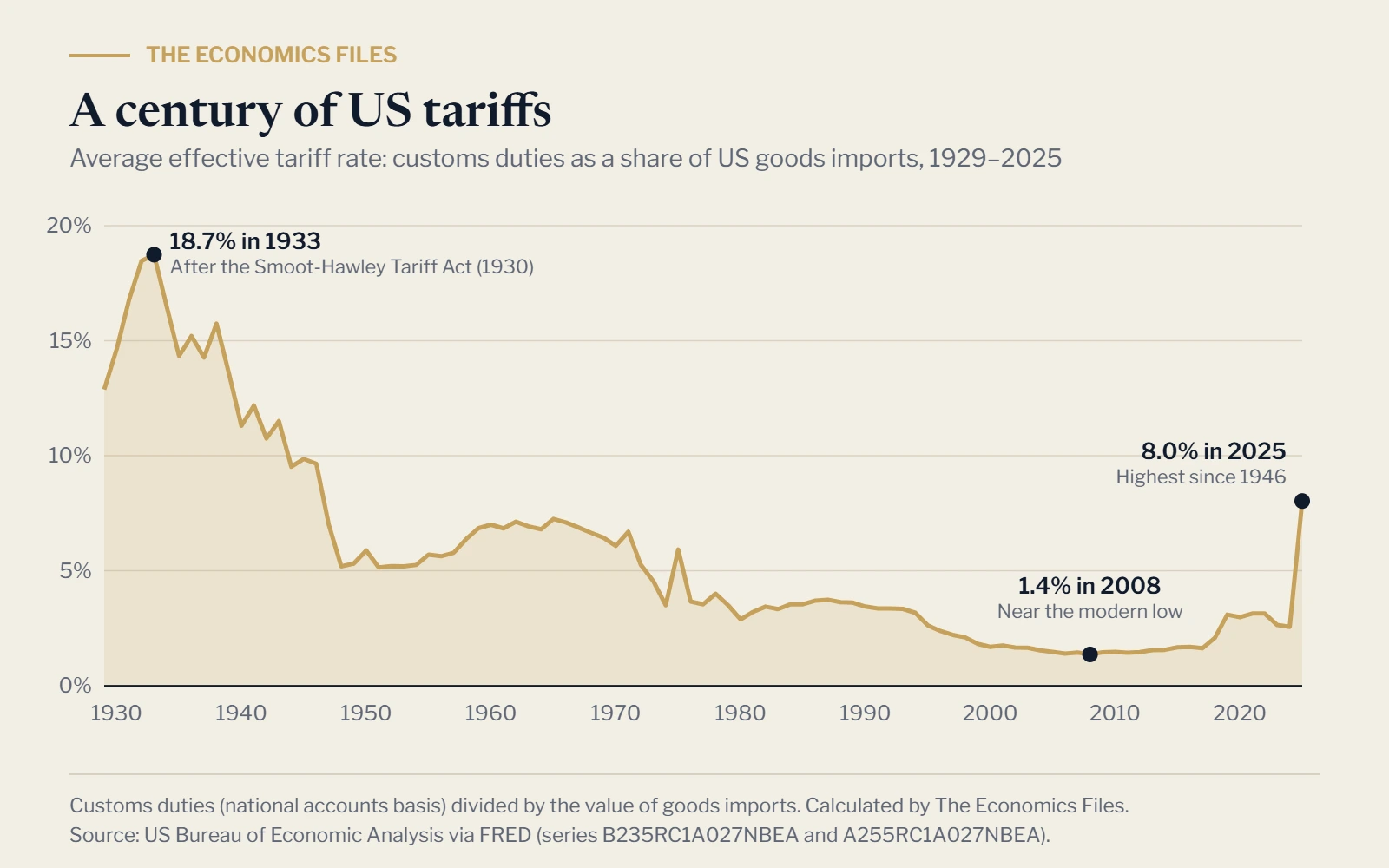
Headline tariff announcements can mislead, because rates vary by product and country and many goods are exempt. A better gauge is the effective tariff rate: total customs duties collected divided by the value of goods imported. It shows the average tariff actually paid across all imports.
From Smoot-Hawley to the Modern Low
By this measure, US tariffs peaked at about 18.7% in 1933, after the Smoot-Hawley Tariff Act of 1930 raised duties on thousands of goods. They fell steadily after World War II as countries negotiated reductions, and hovered around 1.4% to 1.7% from the mid-2000s through 2017. The 2018–2019 tariffs lifted the rate to about 3%. In 2025 it reached about 8%.
Estimates for 2026 depend on which rate is measured. The Tax Foundation estimates an applied rate of 11.8% but a collected rate of 7.2% for 2026, because importers shift toward lower-tariff suppliers and products. The Penn Wharton Budget Model reported a collected rate of 7.1% as of August 2026.
US Tariffs in 2026: What Changed
To understand US tariffs in 2026, start with the law behind the 2025 increases. Most of them rested on the International Emergency Economic Powers Act (IEEPA), a 1977 law that lets the president regulate trade during a declared national emergency. In Learning Resources, Inc. v. Trump, decided February 20, 2026, the Supreme Court held that IEEPA does not authorize tariffs. The ruling struck down both the “fentanyl” tariffs on Canada, Mexico and China and the worldwide “reciprocal” tariffs, while leaving tariffs under other laws intact.
The administration moved quickly to other statutes. A 10% global tariff under Section 122 of the Trade Act of 1974 took effect on February 24, 2026. That law caps such tariffs at 150 days without congressional approval, and it expired on July 24, 2026. The same day, new Section 301 tariffs of 10% or 12.5% took effect on imports from 60 economies, following investigations into whether those trading partners enforced bans on goods made with forced labor.
| Legal authority | What it allows | Status in late 2026 |
|---|---|---|
| IEEPA (1977) | Emergency economic powers | Ruled not to cover tariffs, Feb. 20, 2026; refunds being worked out in court |
| Section 122, Trade Act of 1974 | Temporary tariffs of up to 15% for up to 150 days | Used for a 10% global tariff, Feb. 24 to July 24, 2026; expired |
| Section 232, Trade Expansion Act of 1962 | Tariffs on imports judged a threat to national security | In force on products such as steel, aluminum, autos and heavy trucks |
| Section 301, Trade Act of 1974 | Tariffs in response to unfair foreign trade practices | In force, including 10% to 12.5% tariffs on 60 economies since July 24, 2026 |
What Happens to IEEPA Tariff Refunds?
Importers paid an estimated $170 billion or more under the invalidated tariffs. The Supreme Court did not decide how refunds would work; it sent that question back to the lower courts, ultimately the US Court of International Trade. Refunds go to the importers of record who paid the duties. Consumers who paid higher prices as a result have no direct claim.
The Case For and Against Tariffs
Economists have long been skeptical of broad tariffs, but the debate is real, and each side makes arguments worth understanding.
What Supporters Argue
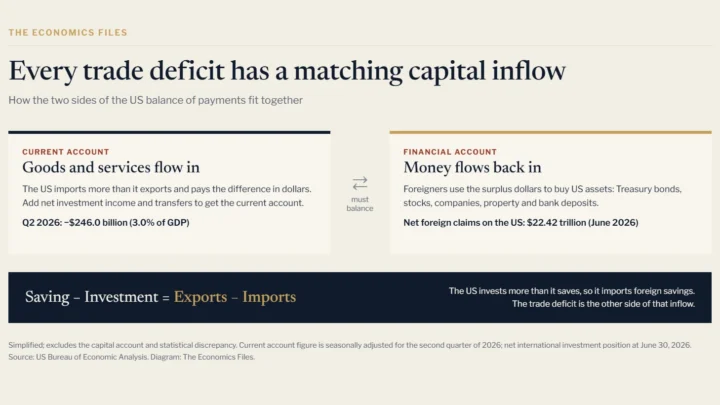
Supporters such as Oren Cass of the think tank American Compass and former US Trade Representative Robert Lighthizer argue that markets do not price in the value of a strong industrial base. In their view, tariffs can lower the trade deficit, strengthen manufacturing and protect national security, especially in strategic sectors where dependence on China creates risk. They also point to tariffs as leverage that can win concessions in trade negotiations, and as a source of federal revenue that does not fall on income. Whether tariffs can shrink the overall deficit is the subject of our explainer on what a trade deficit is and whether it matters.
What Critics Argue
Critics point to the cost evidence above: higher prices for consumers and for manufacturers that rely on imported parts, and very high costs per job protected. They note that other countries often retaliate, hurting US exporters, and that protected industries face less pressure to improve. The Tax Foundation, for example, disputes American Compass’s reading of the economic data since 2025. Some analysts who favor a stronger manufacturing base argue that tariffs alone will not deliver it if they raise the cost of manufacturing inputs.
Both sides agree on one point: tariffs involve a trade-off. The disagreement is over whether the strategic and industrial benefits are worth the economic cost.
Key Takeaways
- A tariff is a tax on imports, paid by the US importer to Customs and Border Protection.
- Research on the 2018–2019 tariffs found nearly all of the cost fell on US importers and consumers, not foreign exporters.
- The US average effective tariff rose to about 8% in 2025, the highest since 1946, and customs revenue reached $268.7 billion.
- The Supreme Court struck down the IEEPA tariffs in February 2026; Section 122 and then Section 301 tariffs replaced much of them.
- Supporters see tariffs as a tool for industry and security; critics stress the cost to consumers and exporters.
Frequently Asked Questions
Do foreign countries pay US tariffs?
No, not directly. The US importer pays the tariff to US Customs and Border Protection. A foreign exporter bears part of the cost only if it cuts its prices, and studies of the 2018–2019 tariffs found that this happened very little.
Are tariffs a tax?
Yes. A tariff is a tax on imported goods. In its February 2026 ruling, the Supreme Court stressed that the Constitution gives Congress the power to lay and collect taxes and duties, which is why it read emergency powers narrowly.
Do tariffs cause inflation?
Tariffs raise the price level of the goods they cover, which shows up as a one-time jump in measured inflation (see what causes inflation for how cost shocks work). Economists on both sides of the tariff debate agree a tariff by itself does not cause prices to keep rising year after year unless it feeds into wages and expectations.
Will consumers get refunds for the IEEPA tariffs?
Refunds go to the importers of record who paid the duties, through a process the courts are still working out. Consumers who paid higher prices have no direct claim, though some companies may choose to pass savings on.
What is the difference between Section 232 and Section 301 tariffs?
Section 232 tariffs are imposed on imports judged a threat to national security, such as steel and aluminum. Section 301 tariffs respond to foreign trade practices the US finds unfair, such as the forced-labor findings behind the tariffs on 60 economies from July 2026.
Sources and Method
- Supreme Court ruling: EY Global Tax Alert, February 20, 2026; DLA Piper analysis; Council on Foreign Relations; SCOTUSblog.
- Section 301 replacement tariffs: RV Industry Association summary of the USTR action, July 2026.
- Effective tariff rates: Penn Wharton Budget Model, October 14, 2026; Tax Foundation tariff tracker.
- Incidence research: Amiti, Redding and Weinstein, “The Impact of the 2018 Tariffs on Prices and Welfare,” Journal of Economic Perspectives, 2019, and 2020 update; Cavallo, Gopinath, Neiman and Tang, Boston Fed Working Paper 19-12.
- Washing machines: Flaaen, Hortaçsu and Tintelnot, American Economic Review, 2020, as summarized by the AEA and University of Chicago.
- Debate: American Compass; Tax Foundation response.
- Data: BEA customs duties (B235RC1A027NBEA) and goods imports (A255RC1A027NBEA) via FRED.
Method: the historical effective rate is customs duties on a national-accounts basis divided by the value of goods imports, calculated by The Economics Files from BEA data. It can differ slightly from rates built on Treasury collections or Census import data. Tariff policy changes often; figures here reflect sources available in November 2026.