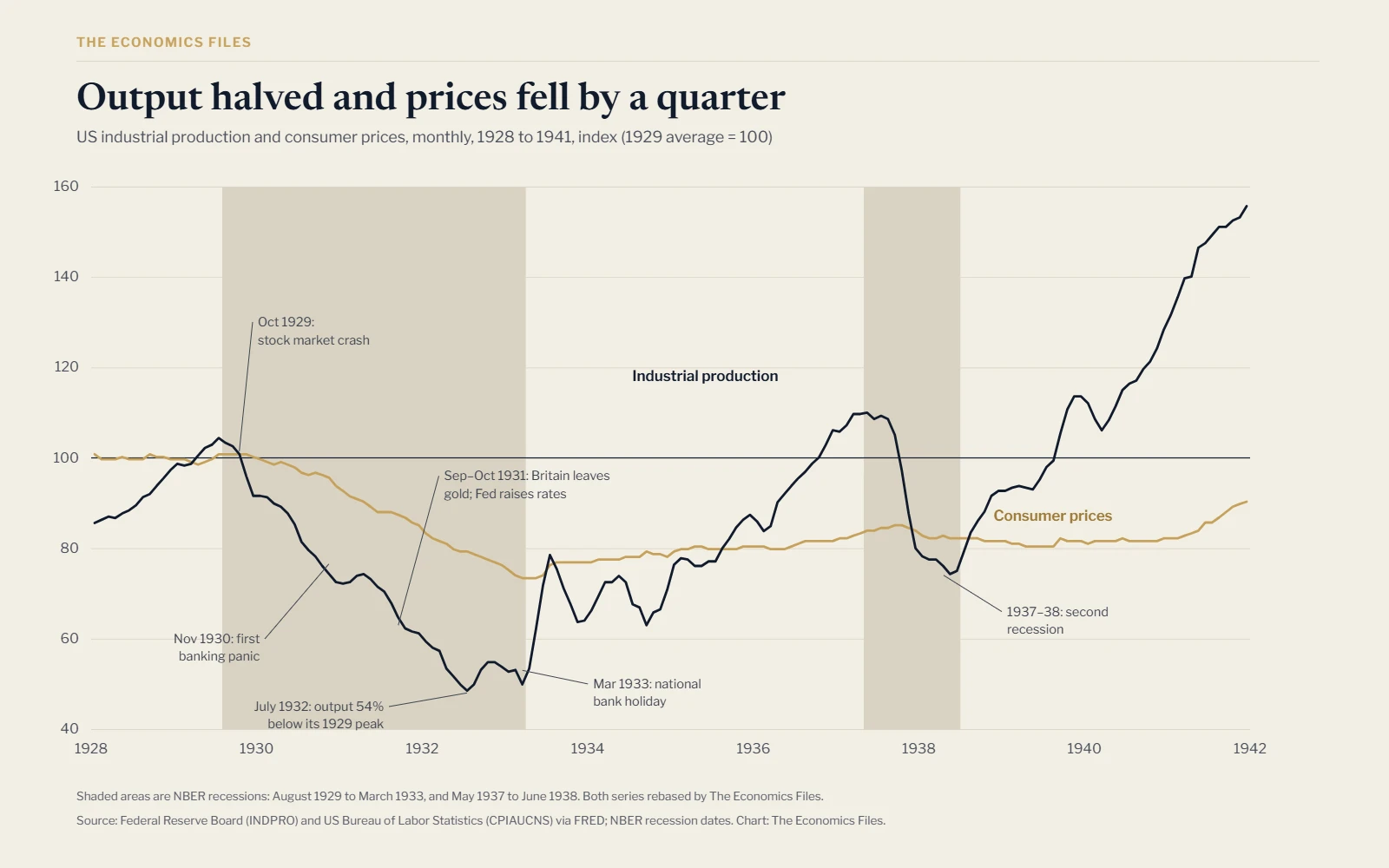
Between the summer of 1929 and the summer of 1932, American industrial production fell by more than half. By 1933, one worker in four was unemployed, consumer prices had dropped by about a quarter and thousands of banks had closed their doors. The Great Depression was the worst economic collapse in modern US history, and economists have spent almost a century working out why it happened and why it lasted so long.
Short answer: The Great Depression began as an ordinary recession in August 1929, made worse by the stock market crash that October. It became a depression because of waves of bank failures from 1930 to 1933, which shrank the money supply by nearly 30% and set off a deflation that crushed borrowers and businesses. The Federal Reserve failed to stop the collapse, and the gold standard spread it around the world. High tariffs added damage. Recovery began only when the United States left the gold standard and stabilized its banks in 1933.
What Caused the Great Depression?
There is no single answer to what caused the Great Depression, but there is now broad agreement among economic historians on the main forces. The economy was already slowing in 1929 after the Federal Reserve raised interest rates to curb stock speculation. The October crash wiped out wealth and confidence. Then, starting in late 1930, a series of banking panics destroyed a large part of the nation’s money and credit. Prices fell, the real burden of debts rose and spending collapsed. At each stage, policy choices made things worse.
The 1929 Crash: Trigger, Not Cause
The 1929 crash is the event most people associate with the Depression, but the downturn had already begun. The NBER dates the business cycle peak to August 1929, two months before the crash. In 1928 and 1929, the Fed had raised interest rates to cool speculation in stocks, which slowed the economy and, through the gold standard, pushed other countries toward recession too.
The Dow Jones Industrial Average peaked at 381.17 on September 3, 1929. Selling began in earnest on Thursday, October 24, and turned into panic on October 28 and 29, when the index lost about a quarter of its value in two days. By July 1932 it had fallen 89% from its peak and did not regain its 1929 high until 1954.
The crash hurt spending by destroying wealth and frightening consumers and businesses. Still, through most of 1930 the downturn looked like a severe but ordinary recession. According to the Fed’s own history, what turned it into the Great Depression was a series of banking crises that began in November 1930.
Bank Failures of the 1930s and the Collapse of Money
In 1930, most American banks were small, local and unprotected. Fewer than half belonged to the Federal Reserve System, and there was no federal deposit insurance. When depositors feared a bank might fail, they rushed to withdraw cash, and the run itself could bring the bank down. Fear spread from one town to the next.
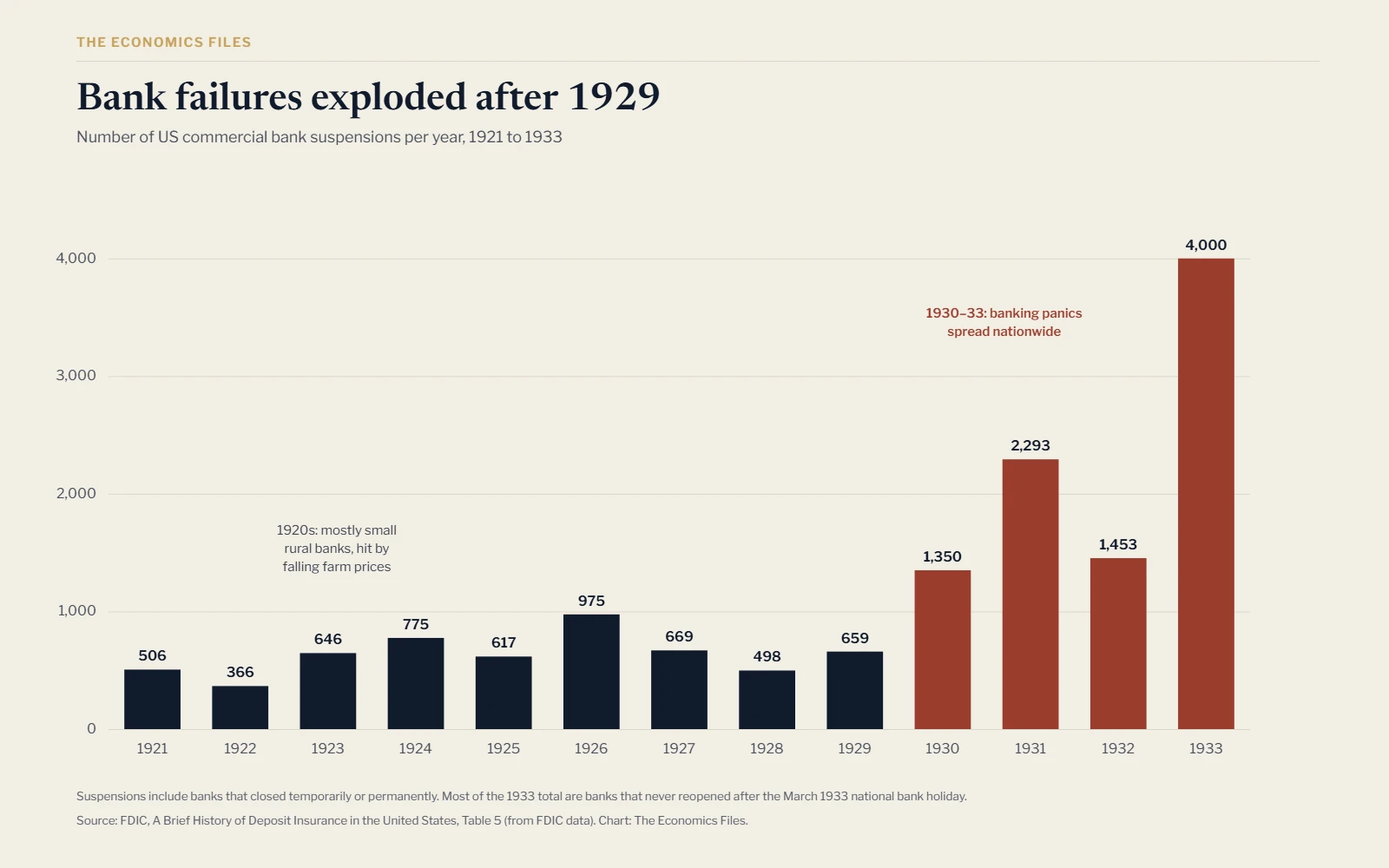
The first wave of panics hit in November 1930. More followed in 1931, with a nationwide crisis in the fall, and a final panic in early 1933. In all, 1,350 commercial banks suspended operations in 1930, 2,293 in 1931 and 1,453 in 1932. In 1933, about 4,000 more never reopened after the national bank holiday. Between 1930 and 1933, more than 9,000 banks failed, roughly 30% of all banks that existed at the end of 1929.
Why bank failures shrank the economy
The bank failures of the 1930s did damage in three ways. First, they destroyed money. Bank deposits are money, so when banks failed and frightened households pulled out cash, the money supply shrank. From the fall of 1930 to the winter of 1933, it fell by nearly 30%, and average prices fell by about the same amount. Our explainer on how banks create money shows why the process also works in reverse.
Second, falling prices made debts harder to repay. The economist Irving Fisher called this debt deflation: as prices and incomes fell, the real value of mortgages, farm loans and business debts rose, pushing more borrowers into default and more banks into failure. Third, as Ben Bernanke argued in a 1983 paper, bank failures cut off credit to the farmers and small businesses that relied on local banks, because the knowledge those banks held about their borrowers was lost when they closed.
The Fed’s failure
The Federal Reserve was created in 1913 to prevent banking panics. In the early 1930s it failed to act as a lender of last resort to struggling banks and did little to stop the fall in the money supply. In 1963, Milton Friedman and Anna Schwartz made the case in A Monetary History of the United States that this inaction turned a recession into a catastrophe. Their view is now widely accepted, including by the Fed itself. In 2002, Bernanke, then a Fed governor, told Friedman at his 90th birthday celebration: “You’re right, we did it. We’re very sorry.” Our guide to what a central bank does explains the lender of last resort role the Fed failed to play.
The Gold Standard Spread the Damage
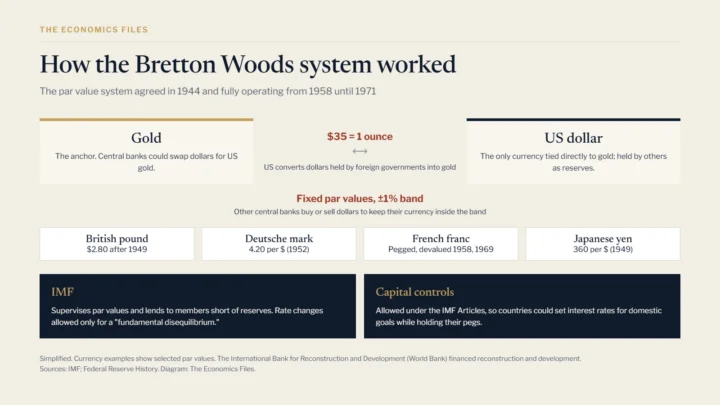
Under the gold standard, countries pledged to exchange their currencies for gold at a fixed price. That tied their interest rates and money supplies together. When the Fed tightened, gold flowed toward the United States and other countries had to tighten as well to protect their reserves. The system turned a US downturn into a global one.
The gold standard also forced damaging choices. When Britain abandoned gold in September 1931, investors feared the United States would follow and began converting dollars into gold. To defend the dollar, the Fed raised its discount rate sharply in October 1931, in the middle of a banking crisis. Bank failures and deflation accelerated. Economists Barry Eichengreen and Jeffrey Sachs later showed that countries that left gold earlier recovered sooner, a pattern that has held up in later research.
The turning point in 1933
Franklin Roosevelt took office on March 4, 1933, as the banking system collapsed. He declared a national bank holiday on March 6, and Congress passed the Emergency Banking Act on March 9. Banks reopened only after inspection. The government restricted gold exports and private gold holdings in 1933, and the Gold Reserve Act of January 1934 raised the official price of gold from $20.67 to $35 an ounce, devaluing the dollar. Deposit insurance arrived with the Banking Act of 1933.
The effect was immediate. Industrial production rose by nearly half between March and July 1933, and prices began to rise. Money and credit started growing again as gold flowed into the country.
Did Smoot-Hawley Cause the Depression?
President Herbert Hoover signed the Smoot-Hawley Tariff Act on June 17, 1930, raising tariffs on thousands of imported goods despite a public appeal from more than a thousand economists to veto it. Other countries retaliated with tariffs of their own, and world trade shrank sharply in the years that followed.
Most economists see the tariff as a serious mistake that deepened the global slump and soured international relations, but not as the main cause of the Depression. US imports and exports were a small share of the economy, and much of the fall in trade reflected collapsing incomes and prices. Our explainer on how tariffs work covers why retaliation tends to hurt exporters on both sides.
Why the Depression Lasted So Long
Real GDP fell by about 26% from 1929 to 1933 and did not regain its 1929 level until 1936. Even then, unemployment was still close to 17%. The recovery was strong in percentage terms, but it started from an extremely low base.
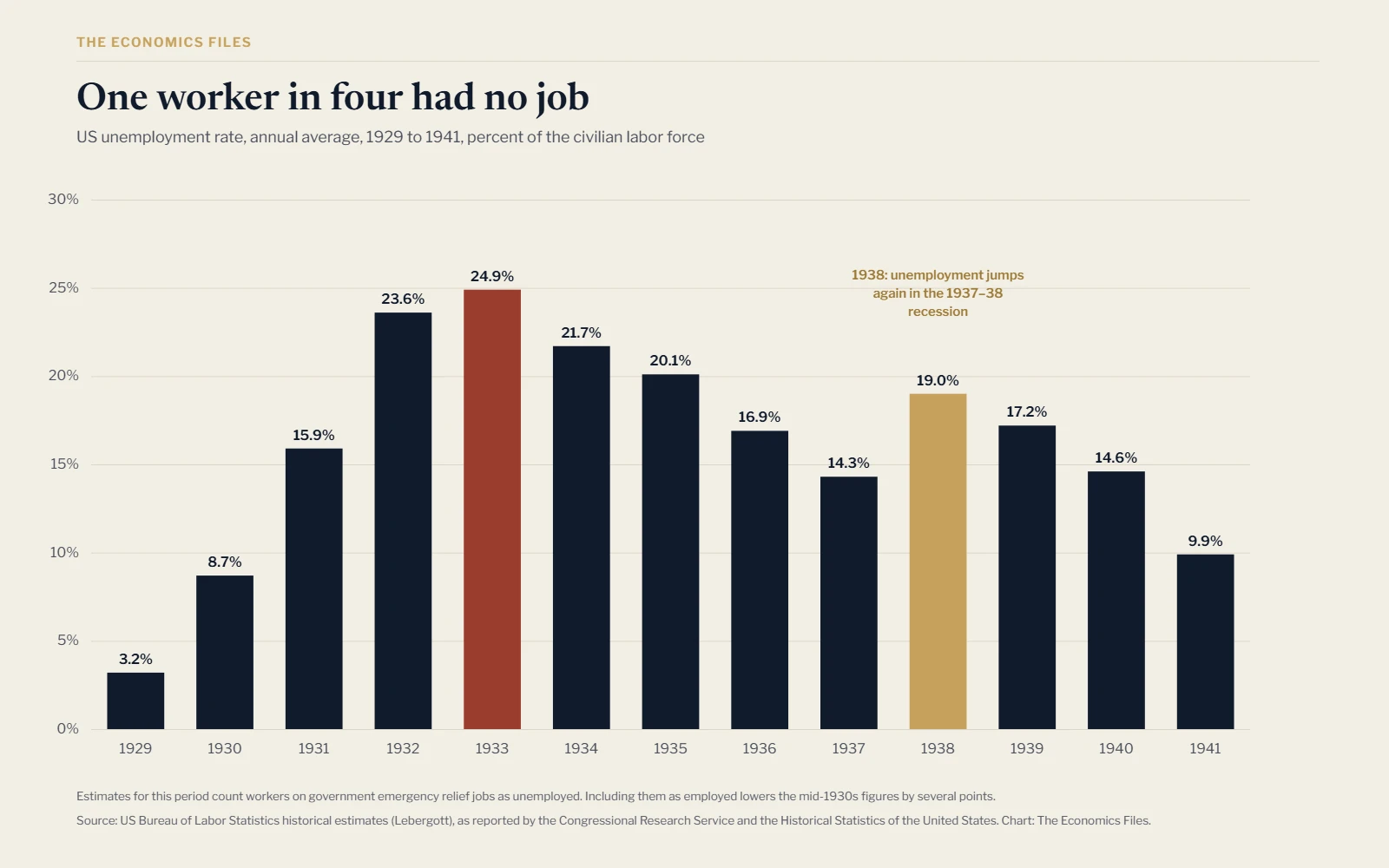
Then policy tightened too soon. In 1936 and 1937, the Fed doubled banks’ reserve requirements, the Treasury held back incoming gold from the money supply and federal budget deficits were cut. The economy fell into a second recession from May 1937 to June 1938. Industrial production dropped by about a third, and unemployment rose from 14.3% in 1937 to 19.0% in 1938. Full employment returned only with the massive spending of World War II.
The Debates That Remain
Agreement on the big picture leaves room for argument about the details. Peter Temin argued in 1976 that a fall in spending, not money, started the slump, with the monetary collapse following rather than leading. Keynesian economists stress the collapse in investment and the absence of large-scale government spending to replace it until the war.
Others focus on policies that may have slowed the recovery. The Revenue Act of 1932 raised the top income tax rate from 25% to 63% in the depths of the downturn. Harold Cole and Lee Ohanian argued in 2004 that New Deal policies, especially the National Industrial Recovery Act of 1933, held wages and prices above market levels and delayed the return to full employment. Their critics answer that the recovery from 1933 to 1937 was one of the fastest on record. These debates are about how much each factor mattered, not about whether the banking collapse and the monetary contraction were central.
What the Great Depression Changed
Working out what caused the Great Depression reshaped economic policy. Four changes stand out:
- Deposit insurance. The FDIC, created in 1933, ended most bank runs by guaranteeing ordinary deposits.
- A central bank that acts. In 2008 and 2020, the Fed lent heavily and expanded the money supply, determined not to repeat the 1930s. Bernanke, who studied the Depression, chaired the Fed in 2008.
- Fear of deflation. Central banks now target low positive inflation, partly to keep a safe distance from falling prices. Our article on what causes inflation explains that target.
- No more gold standard. The link between currencies and gold was weakened in the 1930s and ended in 1971, giving central banks the freedom to respond to crises.
The deepest lesson is that a financial shock becomes a depression when the banking system and the money supply are allowed to collapse. That explains why governments now move so quickly to stop bank failures, and why the recessions of recent decades, painful as they were, never came close to the 1930s.
Frequently Asked Questions
Did the stock market crash cause the Great Depression?
Not on its own. The economy was already in recession when stocks crashed in October 1929, and the crash made it worse. The banking panics that began in November 1930, and the collapse in money and prices that followed, are what turned the downturn into a depression.
How long did the Great Depression last?
The sharpest phase ran from August 1929 to March 1933, 43 months by the NBER’s dates. Recovery followed, interrupted by a second recession in 1937 and 1938. Most historians date the end of the Depression to 1941, when wartime production brought back full employment.
How many banks failed during the Great Depression?
More than 9,000 banks failed between 1930 and 1933, about 30% of the banks operating at the end of 1929. Around 4,000 of them closed for good after the national bank holiday of March 1933.
What ended the Great Depression?
Leaving the gold standard and stabilizing the banks in 1933 started the recovery, as money, credit and prices began to grow again. Full employment came back only with the enormous government spending of World War II.
Could a Great Depression happen again?
Deposit insurance, a central bank willing to act as lender of last resort and freedom from the gold standard make a repeat much less likely. The 2008 financial crisis showed both the risk and the defenses: it was severe, but aggressive policy kept it from turning into a depression.
Sources and Method
- Gary Richardson, “The Great Depression”, Federal Reserve History.
- Federal Reserve History, “Banking Panics of 1930–31”.
- Federal Deposit Insurance Corporation, A Brief History of Deposit Insurance in the United States, chapter 3 and Table 5; and FDIC history, 1930–1939.
- Milton Friedman and Anna J. Schwartz, A Monetary History of the United States, 1867–1960, Princeton University Press, 1963.
- Ben S. Bernanke, “Nonmonetary Effects of the Financial Crisis in the Propagation of the Great Depression,” American Economic Review, 1983; and remarks at the conference to honor Milton Friedman, November 8, 2002.
- Barry Eichengreen and Jeffrey Sachs, “Exchange Rates and Economic Recovery in the 1930s,” Journal of Economic History, 1985.
- Irving Fisher, “The Debt-Deflation Theory of Great Depressions,” Econometrica, 1933.
- Peter Temin, Did Monetary Forces Cause the Great Depression?, 1976; Harold L. Cole and Lee E. Ohanian, “New Deal Policies and the Persistence of the Great Depression,” Journal of Political Economy, 2004.
- Congressional Research Service, “The Labor Market During the Great Depression and the Current Recession”, 2009; US Bureau of Labor Statistics historical unemployment estimates.
- National Bureau of Economic Research, “US Business Cycle Expansions and Contractions”.
- Data via FRED: INDPRO, CPIAUCNS and GDPCA.
Method: industrial production and consumer prices are monthly series rebased so that their 1929 averages equal 100. The 54% fall in output runs from the July 1929 peak to the July 1932 low of the industrial production index. Real GDP changes use BEA annual chained-dollar estimates. Unemployment rates for 1929 to 1941 are historical estimates based on Stanley Lebergott’s work and count workers on emergency relief programs as unemployed. Bank suspension counts are from FDIC data. Stock market figures are closing values of the Dow Jones Industrial Average. Charts are by The Economics Files.