On the evening of August 15, 1971, President Richard Nixon went on national television and announced that the United States would no longer exchange dollars for gold with foreign governments. In one Sunday-night speech, he ended the arrangement that had organized the world’s money for a quarter of a century. Within two years, the major currencies were floating against each other, and they still are.
That arrangement was the Bretton Woods system. Agreed in July 1944 at a resort hotel in New Hampshire, it fixed the value of other currencies to the US dollar and fixed the dollar to gold at $35 an ounce. It created the International Monetary Fund and what became the World Bank. And it built the dollar’s central role in global finance, which outlasted the system itself.
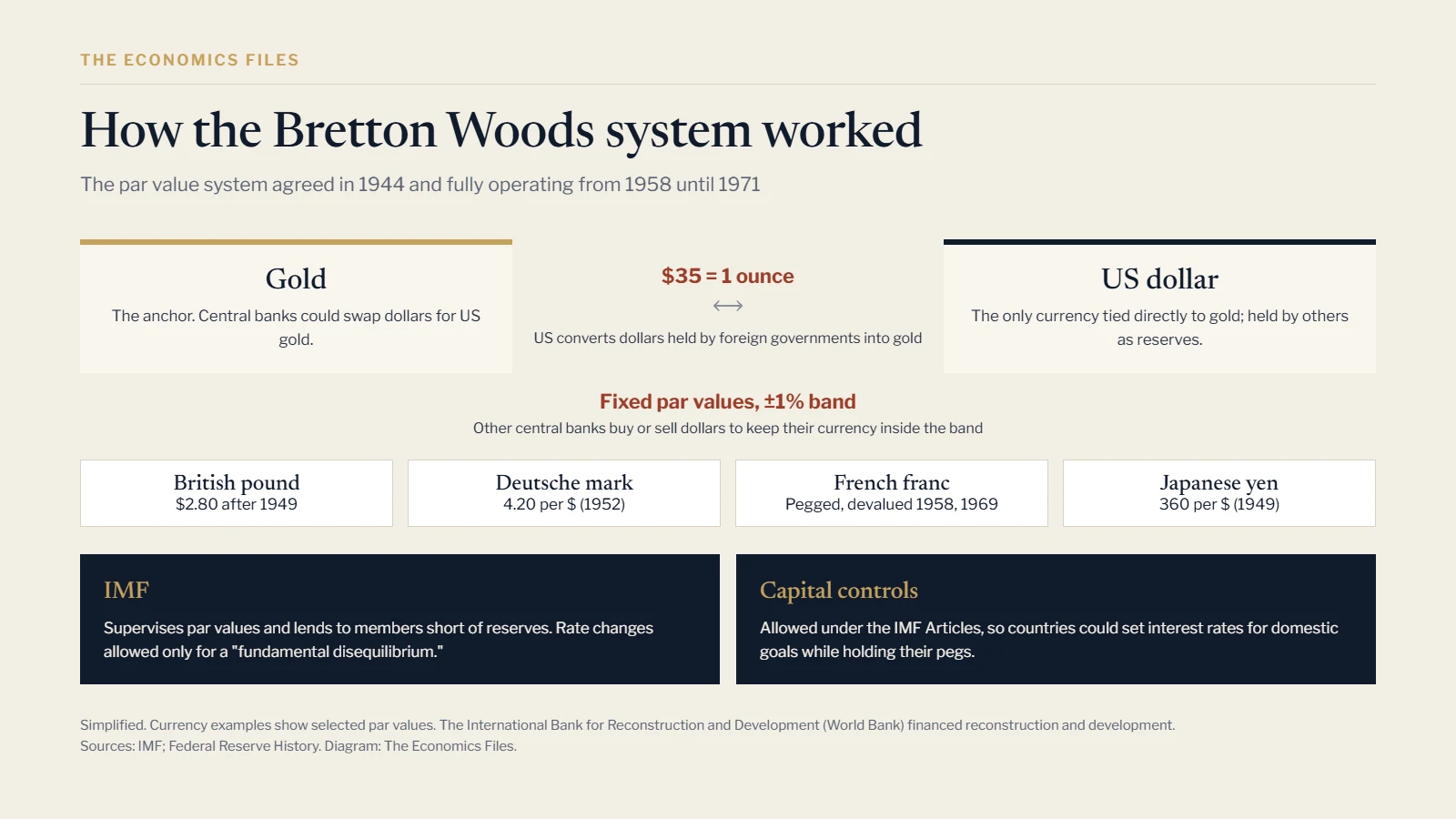
In short, the Bretton Woods system was a set of rules for exchange rates and international payments, in force from 1945 to 1971 and fully working from 1958. Countries kept their currencies within 1% of an agreed value against the dollar, the United States promised to convert dollars held by foreign governments into gold, and the IMF lent to countries that ran short of reserves. It ended because the United States did not have enough gold to back all the dollars held abroad.
Why the System Was Created
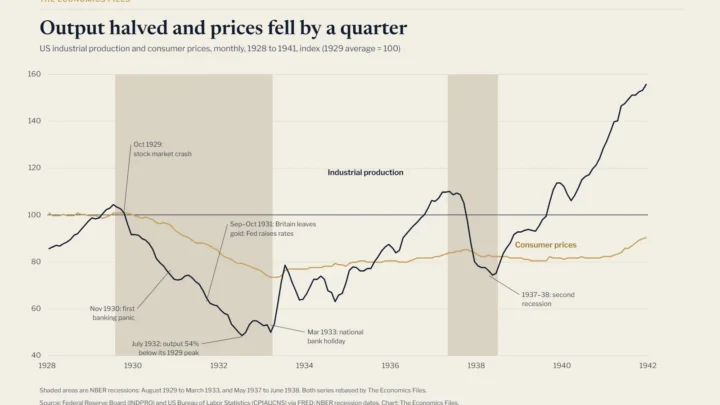
The men who met at Bretton Woods had lived through the 1930s. The interwar gold standard had transmitted the Depression from country to country, as we explain in our article on what caused the Great Depression. When it broke down, governments devalued against each other to win export markets, raised tariffs and restricted payments. World trade shrank, and the economic conflict fed the political tensions that led to war.
The goal in 1944 was a system that kept exchange rates stable enough for trade to recover, but flexible enough that no country would be forced into deflation and mass unemployment to defend its currency. The United Nations Monetary and Financial Conference brought 730 delegates from 44 nations to the Mount Washington Hotel from July 1 to 22, 1944, according to the Federal Reserve’s history of the event.
Two plans competed. John Maynard Keynes, representing Britain, proposed an International Clearing Union that would issue its own currency, the bancor, and put pressure on both deficit and surplus countries to adjust. Harry Dexter White of the US Treasury proposed a smaller stabilization fund built from members’ gold and currencies. The United States was the world’s largest creditor and held most of its monetary gold, and the final agreement looked much more like White’s plan.
Fixed Exchange Rates: How the System Worked
Each member declared a par value for its currency in terms of gold or the US dollar. Central banks then had to keep market exchange rates within 1% of that par by buying or selling their currency, usually against dollars. A British pound was worth $4.03 at the start and $2.80 after a 1949 devaluation; the rate could move only inside a narrow band around that figure.
Defending a peg was hands-on work. If the pound slipped toward the bottom of its band because more people wanted to sell sterling than buy it, the Bank of England, Britain’s central bank, had to buy pounds with its dollar reserves. If reserves ran low, it could borrow from the IMF, raise interest rates to attract money, or ask the government to cut spending and imports. Those last two options were exactly the kind of painful adjustment the system was designed to soften, which is why the IMF’s lending role mattered so much.
The pegs were “fixed but adjustable.” A country could change its par value to correct what the IMF’s Articles called a “fundamental disequilibrium” in its balance of payments, with the Fund’s agreement. Britain devalued in 1949 and again in 1967, France devalued in 1958 and 1969, and West Germany revalued in 1961 and 1969. In practice, governments treated devaluation as a humiliation and delayed it as long as possible, which often invited speculative attacks.
The system also allowed something that later became rare: controls on movements of capital. Countries could limit how much money flowed in and out for investment and speculation, which gave central banks room to set interest rates for domestic purposes while holding their pegs. Economists later called this the “impossible trinity”: a country cannot have a fixed exchange rate, free capital movement and an independent monetary policy all at once. Bretton Woods gave up the second to keep the other two.
The IMF Founding and the World Bank
The conference created two institutions. The International Monetary Fund formally came into existence in December 1945, when its first 29 members signed the Articles of Agreement, and began operations on March 1, 1947. France was the first country to borrow from it later that year.
The IMF’s job was to supervise the par values and lend to members facing temporary balance-of-payments problems, so they could defend their pegs without slashing imports or forcing a recession. Each member paid in a quota, partly in gold and partly in its own currency, which determined both what it could borrow and its voting power. The International Bank for Reconstruction and Development, now part of the World Bank Group, was to finance rebuilding in Europe and, later, development in poorer countries.
Who joined and who stayed out
The Soviet Union sent a delegation to Bretton Woods and signed the final act, but never ratified the Articles, and the Eastern bloc stayed outside the system during the Cold War. Many developing countries joined but had little say, because voting power followed quotas and quotas followed economic size. The United States held the largest quota and enough votes to block major decisions, an arrangement that still shapes debates about IMF governance.
The system was slow to start. Europe was short of dollars after the war, and most currencies could not be freely exchanged for trade. The Marshall Plan, not the IMF, supplied most of Europe’s early dollars. The Bretton Woods system became fully operational only in December 1958, when the main Western European currencies became convertible for current-account transactions.
The Dollar-Gold Link and Its Weak Point
The keystone was the US promise to convert dollars held by foreign central banks into gold at $35 an ounce. That made the dollar “as good as gold” and let other countries hold dollars as reserves, which paid interest, instead of gold, which did not.
At first the promise was easy to keep. After the war, the United States held about three-quarters of the world’s official gold reserves. Its monetary gold stock peaked at $24.6 billion in September 1949.
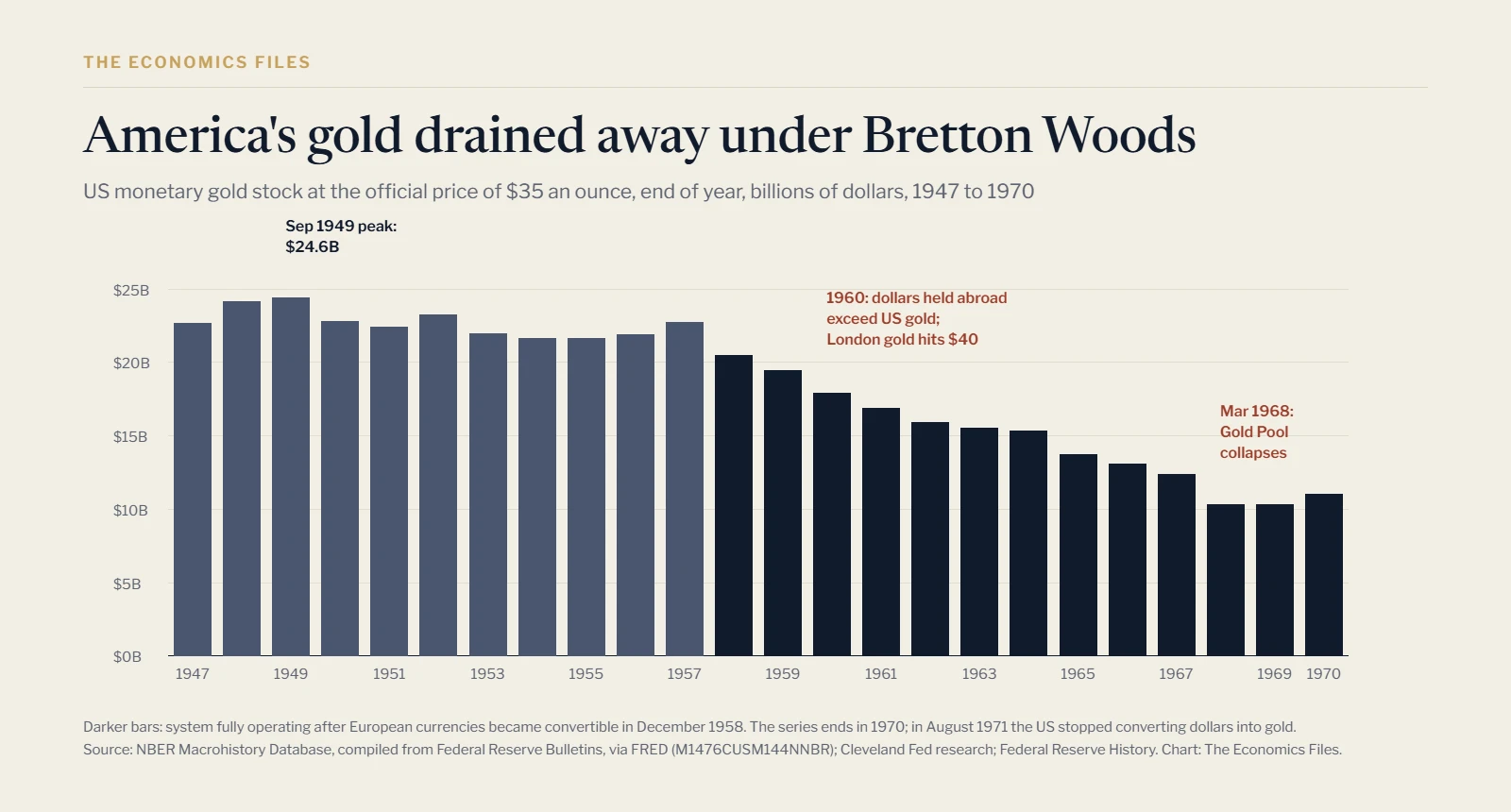
The flaw was built in. As world trade grew, other countries needed more reserves, and the main source of new reserves was dollars that the United States paid out through deficits in its balance of payments: military spending abroad, foreign aid, and American companies investing overseas. In 1959 and 1960, economist Robert Triffin warned Congress, and readers of his book Gold and the Dollar Crisis, that this could not last. If the United States stopped running deficits, the world would run short of reserves. If it kept running them, foreign dollar holdings would eventually exceed its gold, and the promise to convert would lose credibility.
That point arrived quickly. By 1960, total US dollar liabilities to foreigners exceeded the US gold stock, according to research by economists at the Cleveland Fed. In October 1960, the private gold price in London briefly hit $40 an ounce, a sign that markets doubted the official $35.
How Bretton Woods Ended
For a decade, governments patched the system. In 1961, eight central banks formed the London Gold Pool to sell gold and hold the market price at $35. The Federal Reserve set up currency swap lines with other central banks from 1962, so they could avoid converting unwanted dollars into gold. Washington taxed purchases of foreign securities and limited lending abroad.
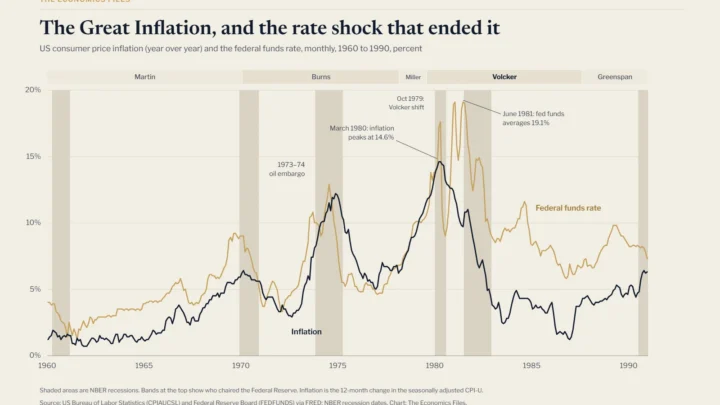
Pressure grew in the late 1960s as US inflation rose with spending on the Vietnam War and domestic programs, the start of the episode described in our article on the Great Inflation of the 1970s. After Britain devalued sterling in November 1967, a run on gold followed. The Gold Pool collapsed in March 1968 and was replaced by a two-tier market: central banks still traded gold among themselves at $35, while the private price was allowed to float.
In 1971 the United States recorded its first trade deficit of the twentieth century, and foreign central banks began asking for gold. On August 15, Nixon closed the “gold window.” He also imposed a 90-day freeze on wages and prices and a 10% surcharge on imports, a measure meant to push trading partners to raise the value of their currencies. It is a forerunner of debates over how tariffs work as a bargaining tool today.
Why Nixon closed the gold window
Washington had three bad options. It could raise the official gold price, a devaluation that needed other countries to agree and that would reward those who had hoarded gold. It could tighten money and cut spending to shrink the deficit, at the cost of a recession a year before the 1972 election. Or it could stop converting dollars and force a renegotiation. Nixon’s advisers, led by Treasury Secretary John Connally, chose the third. Connally’s attitude toward European complaints was later summed up in a line widely attributed to him: the dollar is “our currency, but your problem.”
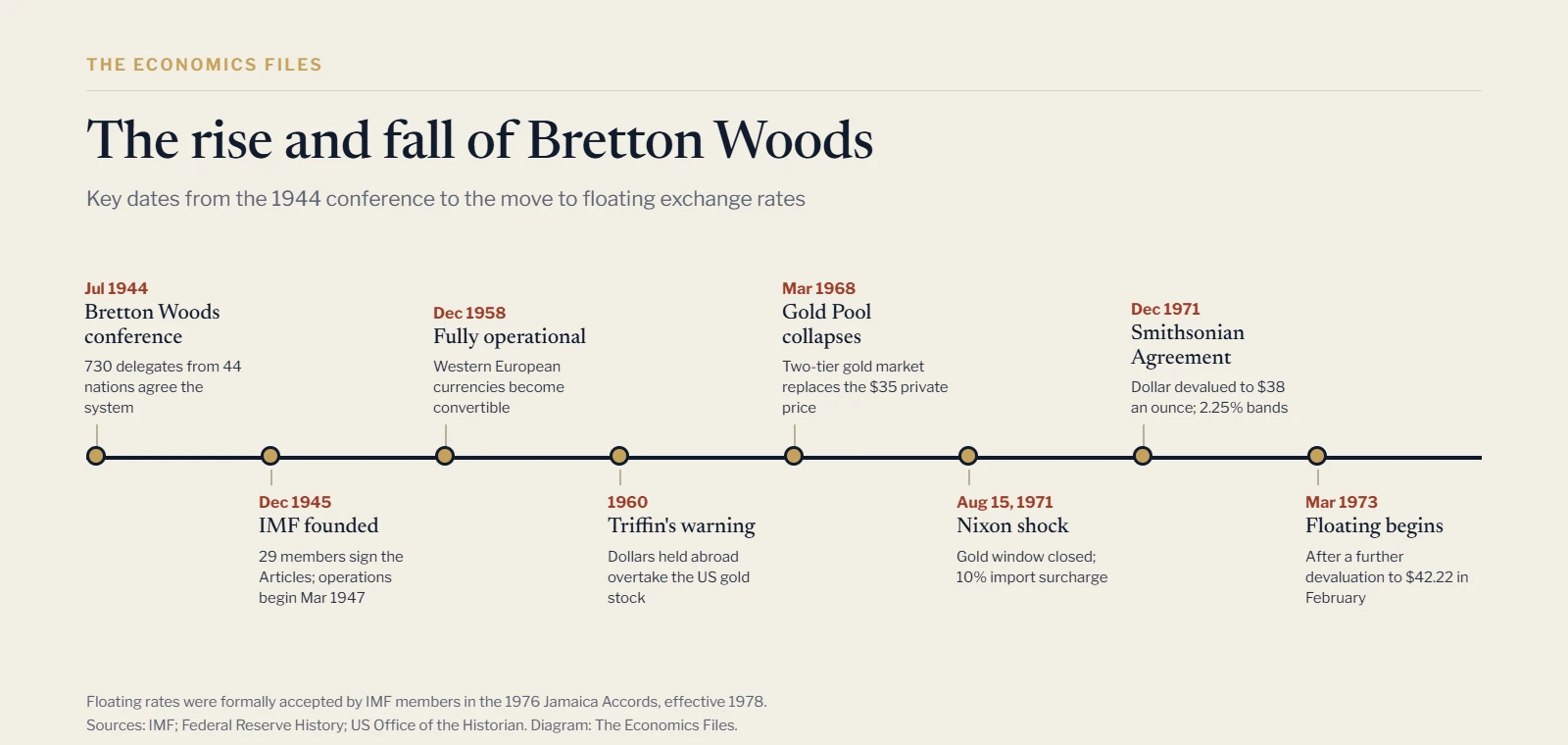
The aftermath took two years. Under the Smithsonian Agreement of December 1971, the Group of Ten devalued the dollar to $38 an ounce of gold and widened the allowed bands to 2.25%. It did not hold. In February 1973, the dollar was devalued again, to $42.22, and in March the major currencies began to float. The IMF’s members formally accepted floating rates in the Jamaica Accords of 1976, which took effect in 1978.
Did the Bretton Woods System Work?
By several measures, yes. The years from 1950 to 1973, often called the postwar golden age, brought unusually fast growth in Western Europe and Japan, and world trade expanded quickly. Many economic historians credit postwar recovery, technology catching up with the United States and trade liberalization more than the exchange-rate rules themselves, but the stability of those rules helped.
The critiques are just as strong. The system depended on one country’s discipline, and it asked the United States to supply reserves while keeping its currency as good as gold, which was impossible over time. Fixed rates also transmitted US inflation abroad in the late 1960s, as countries holding pegs had to absorb dollars. And the capital controls that made it work would be hard to reconcile with today’s global financial markets.
What Bretton Woods Left Behind
The system ended, but its institutions and its currency hierarchy did not. The IMF and the World Bank are still the core of international financial cooperation, now lending to countries in crisis rather than defending par values. The dollar remains the main reserve currency: it made up 56.7% of the world’s identified official foreign exchange reserves in the second quarter of 2026, according to the IMF, down from about 71% around 2000 but far ahead of the euro at 20.6%.
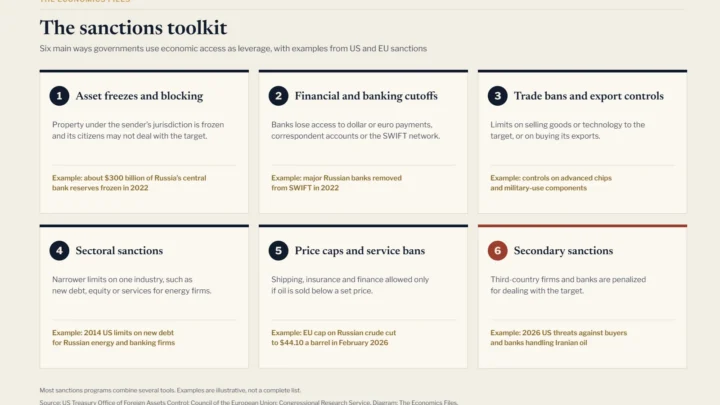
That continued dominance is the system’s most surprising legacy. The dollar became central because it was tied to gold. It stayed central after the link was cut because of the size and depth of US financial markets, the reach of its banks and the role of US policy, including the use of financial sanctions. When politicians today call for a “new Bretton Woods,” they usually mean a negotiated reset of exchange rates and global rules. History suggests such deals are hard to build and harder to keep.
Frequently Asked Questions
What was the Bretton Woods system in simple terms?
It was an international agreement, made in 1944, that fixed the value of other currencies to the US dollar and fixed the dollar to gold at $35 an ounce. Countries kept their exchange rates within 1% of an agreed value, and the IMF lent to countries that ran short of reserves.
Why did the Bretton Woods system collapse?
The United States did not have enough gold to back all the dollars held by foreign governments. As US deficits and inflation grew in the 1960s, other countries began converting dollars into gold. In August 1971, President Nixon stopped conversion, and by March 1973 the major currencies were floating.
Is the IMF still part of the Bretton Woods system?
The IMF and the World Bank were created at Bretton Woods and are often called the Bretton Woods institutions. They outlived the fixed exchange-rate system. Today the IMF monitors economies, lends to countries in crisis and publishes data such as the currency composition of global reserves.
What was the Nixon shock?
The Nixon shock refers to the measures President Richard Nixon announced on August 15, 1971: ending the conversion of dollars into gold for foreign governments, a 90-day freeze on wages and prices, and a 10% surcharge on imports. It marked the end of the Bretton Woods par value system.
Could the world return to a Bretton Woods-style system?
It would be difficult. Fixed rates under Bretton Woods relied on capital controls and on one country supplying reserves backed by gold. Today money moves freely across borders in huge volumes, and most large economies prefer flexible exchange rates and independent monetary policy.
Sources
- Federal Reserve History, “Creation of the Bretton Woods System”
- Federal Reserve History, “Nixon Ends Convertibility of US Dollars to Gold and Announces Wage/Price Controls”
- Federal Reserve History, “The Smithsonian Agreement”
- International Monetary Fund, “Cooperation and Reconstruction (1944–71)”
- US Department of State, Office of the Historian, “Nixon and the End of the Bretton Woods System, 1971–1973”
- NBER Macrohistory Database, Monetary Gold Stock for United States, via FRED
- Bordo, Humpage and Schwartz, “U.S. Intervention During the Bretton Woods Era: 1962–1973,” NBER Working Paper
- Michael Bordo, “The Operation and Demise of the Bretton Woods System; 1958 to 1971,” NBER Working Paper
- IMF Data Brief, Currency Composition of Official Foreign Exchange Reserves, September 30, 2026
Method: The US gold stock chart uses December values of the NBER Macrohistory series on the US monetary gold stock (FRED series M1476CUSM144NNBR), compiled from Federal Reserve Bulletins, in billions of dollars at the official $35 price; the series ends in 1970. Reserve-currency shares are from the IMF’s COFER data for the second quarter of 2026, released September 30, 2026. Data as of November 23, 2026.