Four years after ChatGPT’s release, the predictions about artificial intelligence and work range from mass unemployment to a productivity boom. The data now arriving tell a narrower and more specific story. In August 2026, Stanford researchers using payroll records for millions of American workers found no sign of economy-wide job losses from AI. They did find that young workers in the jobs most exposed to AI had fallen 19% behind their peers in less exposed occupations, and that the gap was still widening.
Short answer: So far, AI has not caused widespread job losses. Overall employment in AI-exposed occupations looks similar to employment elsewhere, and the US unemployment rate in October 2026 was 4.1%. The clearest early effect is on entry-level hiring: employers appear to be hiring fewer young workers into jobs where AI can do much of the work, such as some programming and customer service roles. Research also shows AI can raise the productivity of workers who use it, especially less experienced ones. How large the long-run effects will be is still uncertain.
How Will AI Affect Jobs?
How will AI affect jobs over the next decade? The most useful starting point is that technology changes tasks before it changes jobs. Most occupations are bundles of tasks. AI can take over some of them, help with others and leave many untouched. Whether a worker gains or loses depends on which of those effects dominates in their job.
Economists describe two broad channels. When AI substitutes for a worker’s tasks, employers need fewer people to do the same work. When AI complements a worker, it makes each person more productive, which can raise wages and, if demand grows, employment. Past technologies did both. Research by David Autor and coauthors estimates that about 60% of US employment in 2018 was in job types that did not exist in 1940, showing how new work tends to appear as old work is automated.
Lessons from earlier technologies
History offers useful, if imperfect, guides. When automated teller machines spread across the United States in the 1980s and 1990s, many expected bank teller jobs to vanish. Instead, as economist James Bessen has shown, ATMs made it cheaper to run a branch, banks opened more branches and teller employment held up for decades, while the job shifted toward sales and customer service. Spreadsheet software cut demand for bookkeeping clerks but helped create far more jobs for accountants and financial analysts.
The lesson is not that technology never destroys jobs. It often does, and the workers displaced are not always the ones who get the new jobs. The lesson is that the net effect depends on how much cheaper the work becomes, how much extra demand that creates and how quickly workers can move into new roles.
What AI Exposure Measures, and What It Doesn’t
Researchers estimate AI exposure by matching what each occupation involves with what AI systems can do. The resulting numbers are large. An International Monetary Fund study in January 2024 found that almost 40% of global employment is in occupations highly exposed to AI, rising to about 60% in advanced economies and falling to 26% in low-income countries. A 2023 study by researchers at OpenAI and the University of Pennsylvania estimated that around 80% of US workers could see at least 10% of their tasks affected by large language models, and about 19% could see at least half affected.
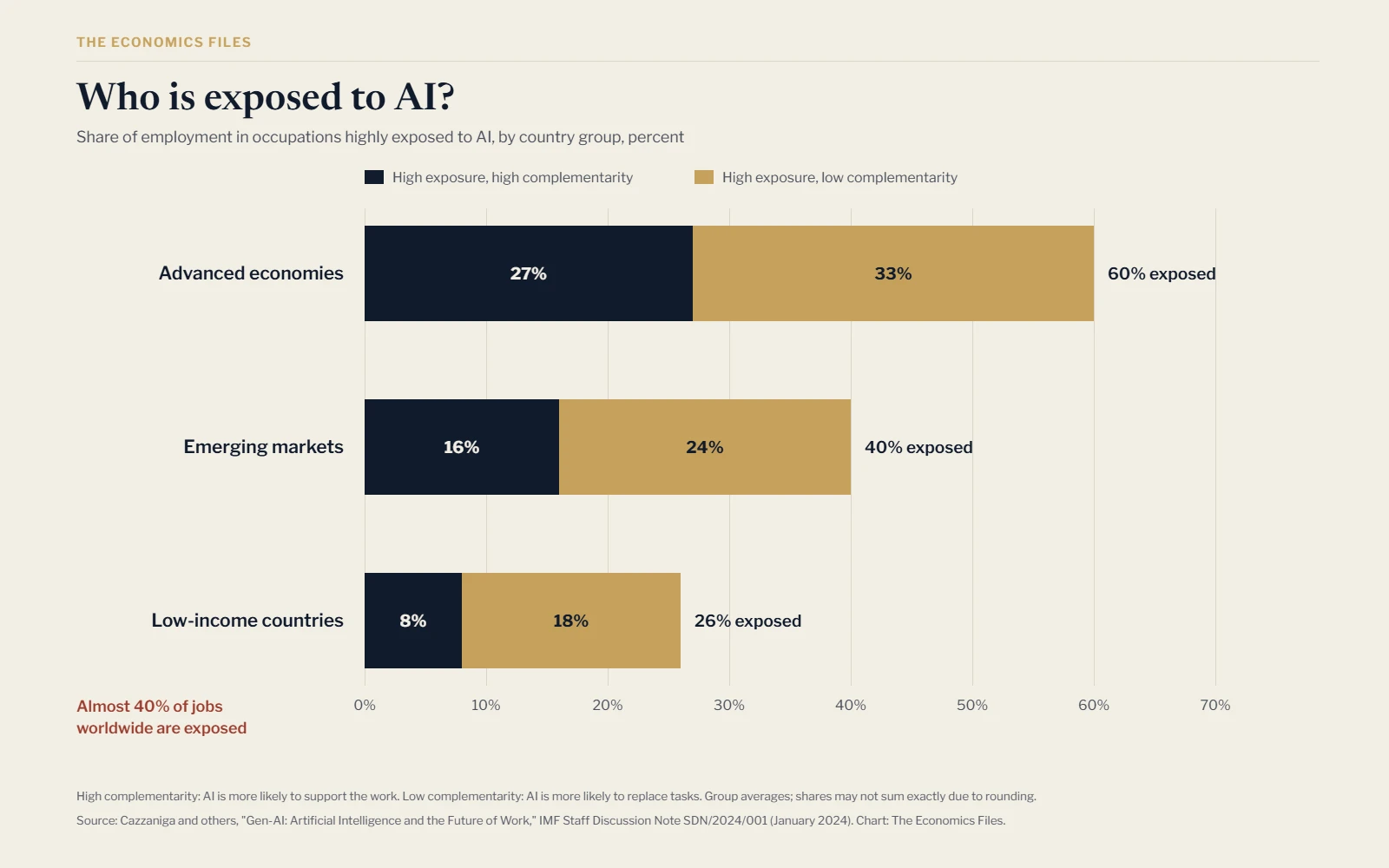
Exposure is not the same as job loss. The IMF split exposed jobs into two groups: those where AI is likely to support the work, such as many professional roles that require judgment and responsibility, and those where AI is more likely to replace tasks. In advanced economies the two groups are roughly equal in size. Exposure measures also capture what AI could do, not whether companies adopt it, how quickly or at what cost.
One pattern stands out. Unlike past waves of automation, which mainly affected factory and routine clerical work, generative AI is most exposed to educated, white-collar occupations that work with text, code and data.
AI and Employment: What the Data Show So Far
The evidence on AI and employment is still early, but three findings are now well documented.
1. No economy-wide displacement yet
Across the whole labor market, there is little sign of AI-driven job loss. The Budget Lab at Yale, which tracks the mix of occupations in the US workforce, found that the mix has been changing slightly faster than in the past, but that the shift began before generative AI arrived and is not large. Its April 2026 update found no clear link between measures of AI use and changes in employment or unemployment. Stanford’s payroll analysis also found no widespread displacement.
2. Entry-level workers are feeling it first
The exception is young workers. Using ADP payroll data through June 2026, Erik Brynjolfsson, Bharat Chandar and Ruyu Chen found that employment of workers aged 22 to 25 in the most AI-exposed occupations fell by about 11% after late 2022, while employment of the same age group in the least exposed occupations rose by about 10%. Relative to trend, the gap has reached 19%, up from 15% a year earlier. For young software developers, headcount fell about 20% from late 2022. Experienced workers in the same occupations showed no decline.
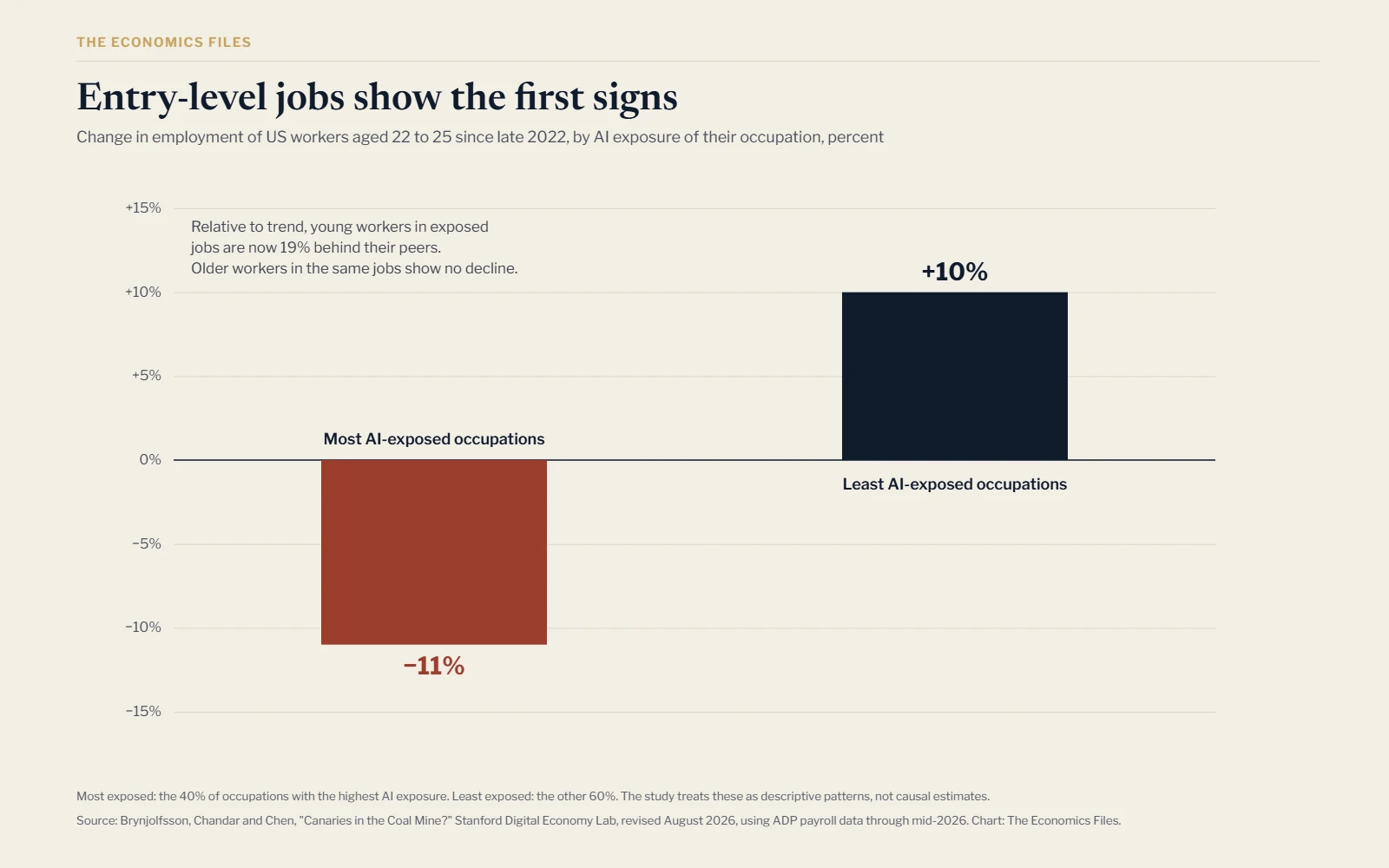
The adjustment is happening through hiring rather than layoffs. Employers are bringing in fewer young people rather than firing existing staff. A March 2026 analysis by economists at the Federal Reserve Bank of Dallas found the same pattern: lower employment among young workers in exposed occupations was driven mainly by fewer people moving from outside the workforce into those jobs, with only a slight effect on the overall unemployment rate.
3. The effects depend on how AI is used
Stanford’s research found declines concentrated in occupations where AI usage mainly substitutes for human tasks. Where AI mainly complements workers, employment was flat or rising, especially for experienced staff. The authors also found that jobs built on codified knowledge, the kind found in textbooks and documentation, were more affected than jobs that depend on tacit knowledge gained through experience.
The caveats
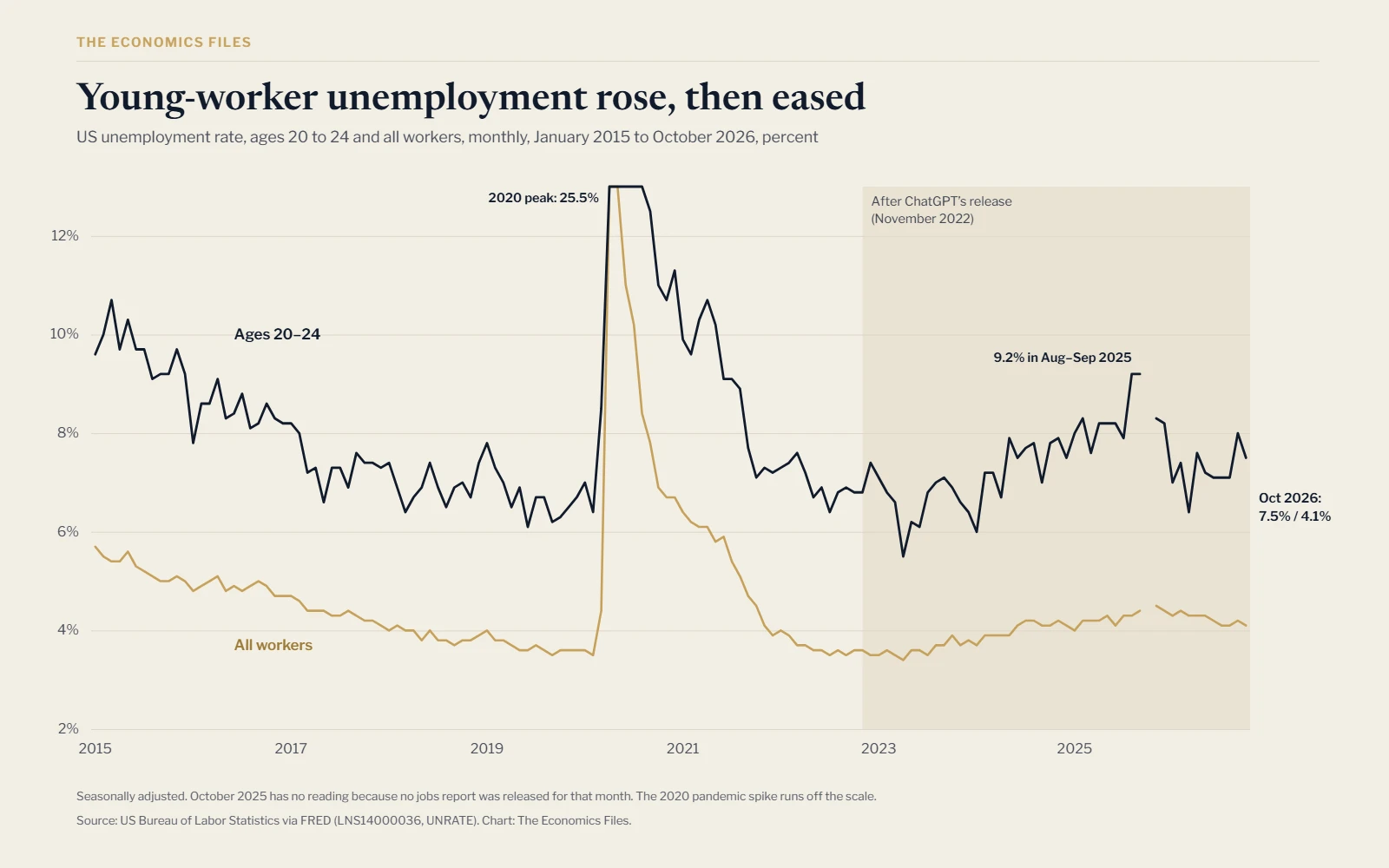
These findings are descriptive, not proof that AI caused the changes. The Stanford authors note that the patterns weaken when they control for education and that some trends began before generative AI. The early 2026 labor market has been described as low-hire, low-fire, and higher interest rates have weighed on hiring across the economy. Unemployment among Americans aged 20 to 24 rose from around 6.5% in 2023 to 9.2% in August and September 2025, then eased to 7.5% by October 2026. Separating AI from the business cycle is hard, and it may become clearer only when the next recession tests whether companies replace laid-off workers with AI.
AI as a Productivity Tool
The other side of the evidence is productivity. In one of the most cited studies, Brynjolfsson, Danielle Li and Lindsey Raymond followed 5,179 customer support agents as a company introduced an AI assistant. Productivity, measured as issues resolved per hour, rose 14% on average and 34% for novice and lower-skilled workers, with little gain for the most experienced. Agents with two months of experience using the tool performed as well as agents with six months of experience without it. Other experiments have found similar gains in writing and coding tasks.
That creates a tension. AI helps beginners catch up quickly, which could make junior workers more valuable. It can also let a smaller team do the same work, which could reduce how many junior workers are hired. The early employment data suggest the second effect is currently stronger in the most exposed jobs.
Automation Risk: Which Jobs Are Most and Least Exposed?
Automation risk from generative AI is highest in jobs centered on tasks that are digital, codified and easy to check. It is lowest in jobs that require physical presence, manual skill or trust built in person.
- More exposed: software development, customer service, translation, writing and editing, administrative support, data entry, bookkeeping and parts of finance and law.
- Mixed: teaching, management, healthcare diagnosis, marketing and research, where AI can take over parts of the work but responsibility and judgment remain human.
- Less exposed: construction, skilled trades, nursing and personal care, hospitality, transport and maintenance, where much of the work is physical and in person.
Within the same occupation, experience matters. Senior workers often supply the judgment, relationships and context that AI lacks, while junior roles have traditionally included the routine tasks AI now handles well. That is why the early effects show up by age more than by occupation alone.
The Bigger Picture: Growth, Wages and Inequality
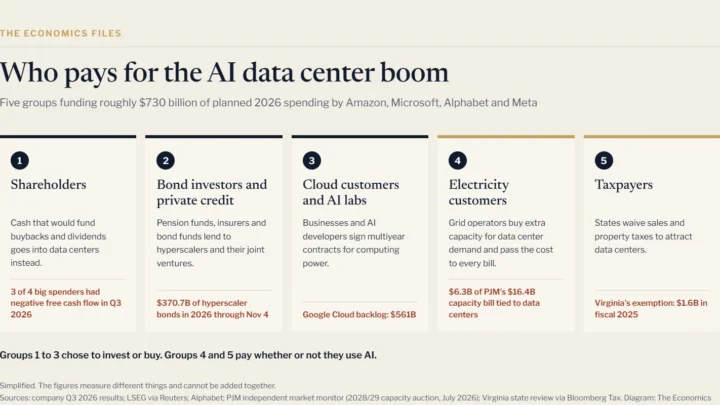
Estimates of AI’s economic impact vary widely. Goldman Sachs economists estimated in 2023 that generative AI could expose the equivalent of 300 million full-time jobs worldwide to automation and raise global GDP by 7% over a decade. MIT economist Daron Acemoglu reached a far more modest conclusion in 2024, estimating a total productivity gain of around 0.7% over ten years, because only a fraction of tasks are both exposed and cheap enough to automate. Which estimate proves closer will also decide whether the roughly $730 billion Big Tech plans to spend on data centers in 2026 pays off, a question we examine in who pays for the AI data center boom.
The distribution of gains is another concern. The IMF has warned that in most scenarios AI is likely to worsen overall inequality, because workers who can use AI to complement their skills may see income gains while others lose ground. Central banks are paying attention too: in November 2026, Federal Reserve Chair Kevin Warsh said the Fed was studying AI’s possible economic ramifications. Our explainer on what a central bank does covers why the Fed watches productivity and employment so closely.
What This Means for Workers and Policymakers
Anyone asking how will AI affect jobs in their own field should look less at headline exposure numbers and more at which of their daily tasks AI can do reliably today. For workers, the evidence points to a few practical conclusions. Jobs are changing faster than they are disappearing, so learning to use AI tools well is becoming part of many white-collar roles. Experience, judgment and the ability to work with people remain valuable. The entry-level squeeze is the most immediate risk, which makes internships, apprenticeships and other ways of gaining experience more important.
For policymakers, the challenge is to watch for displacement while it is still small. Better data on AI use by employers, support for training and job transitions, and unemployment insurance that works for people changing careers are the policy responses most often proposed. Because the effects are still emerging, regular monitoring matters more than confident forecasts.
Frequently Asked Questions
Will AI take my job?
For most workers, AI is more likely to change parts of the job than eliminate it in the near term. The risk is higher in roles made up mostly of digital, routine tasks that AI can perform and check, and lower in roles requiring physical work, in-person interaction or complex judgment.
Which jobs are most at risk from AI?
Research points to software development, customer service, translation, writing, administrative support and data-heavy clerical work, especially at the entry level. Within those occupations, younger workers have seen the clearest declines in employment so far.
Is AI causing unemployment right now?
There is no evidence of widespread AI-driven unemployment. The US unemployment rate was 4.1% in October 2026. Studies do find that hiring of young workers in AI-exposed occupations has slowed, which shows up mainly as fewer people getting jobs rather than more people losing them.
Which jobs are safest from AI?
Jobs that depend on physical presence, manual skill and human relationships are the least exposed: skilled trades, construction, nursing and personal care, hospitality and maintenance work. Senior roles that rely on judgment and accountability also tend to be more protected.
Will AI create new jobs?
Very likely, though they are hard to predict in advance. Most of today’s job titles did not exist a century ago, and new roles in building, managing, checking and applying AI are already appearing. Whether new jobs arrive fast enough to offset the losses is the central open question.
Sources and Method
- Erik Brynjolfsson, Bharat Chandar and Ruyu Chen, “Canaries in the Coal Mine? Six Facts about the Recent Employment Effects of Artificial Intelligence”, Stanford Digital Economy Lab, revised August 12, 2026; and summary of the August 2026 update.
- Mauro Cazzaniga and others, “Gen-AI: Artificial Intelligence and the Future of Work”, IMF Staff Discussion Note SDN/2024/001, January 2024; and Kristalina Georgieva, “AI Will Transform the Global Economy”, IMF Blog.
- The Budget Lab at Yale, “Tracking the Impact of AI on the Labor Market”, April 2026 update, and “AI Is Probably Not (Yet) the Reason for Labor Market Weakening”.
- Tyler Atkinson and Shane Yamco, “Young Workers’ Employment Drops in Occupations with High AI Exposure”, Federal Reserve Bank of Dallas, March 2026.
- Erik Brynjolfsson, Danielle Li and Lindsey R. Raymond, “Generative AI at Work”, Quarterly Journal of Economics, 2025 (NBER Working Paper 31161).
- Tyna Eloundou, Sam Manning, Pamela Mishkin and Daniel Rock, “GPTs are GPTs: Labor Market Impact Potential of LLMs,” Science, 2024 (working paper 2023).
- David Autor, Caroline Chin, Anna Salomons and Bryan Seegmiller, “New Frontiers: The Origins and Content of New Work, 1940–2018,” Quarterly Journal of Economics, 2024.
- Daron Acemoglu, “The Simple Macroeconomics of AI,” Economic Policy, 2024; Goldman Sachs, “The Potentially Large Effects of Artificial Intelligence on Economic Growth,” March 2023; James Bessen, Learning by Doing, Yale University Press, 2015.
- US Bureau of Labor Statistics via FRED: LNS14000036 and UNRATE.
Method: the IMF exposure shares are group averages of the share of employment in high-exposure occupations. Stanford’s employment changes compare workers aged 22 to 25 in the two most AI-exposed quintiles of occupations with those in the other three, using ADP payroll data through mid-2026; the 19% figure is the gap relative to the trend of less exposed peers. Unemployment rates are seasonally adjusted monthly BLS figures; October 2025 has no reading because no jobs report was released for that month. Charts are by The Economics Files.