In 2025, a group of investors agreed to take Electronic Arts private in a $56.6 billion deal, the largest buyout in history. Private equity firms now own tens of thousands of companies, from software makers and hospitals to restaurant chains and veterinary clinics. Yet the industry is also under strain: by early 2026 it was sitting on about 32,000 companies it had not yet sold, worth an estimated $3.8 trillion, while its investors waited for cash to come back.
Short answer: Private equity firms raise money from institutions such as pension funds, borrow heavily to buy companies, try to increase their profits, and sell them a few years later at a higher price. The firms earn money in two ways: an annual management fee, typically 1.5% to 2% of the money they manage, and a share of the profits, usually about 20%, known as the carry. Their investors earn whatever is left. Borrowed money magnifies the gains when deals go well and the losses when they do not.
How Does Private Equity Make Money?
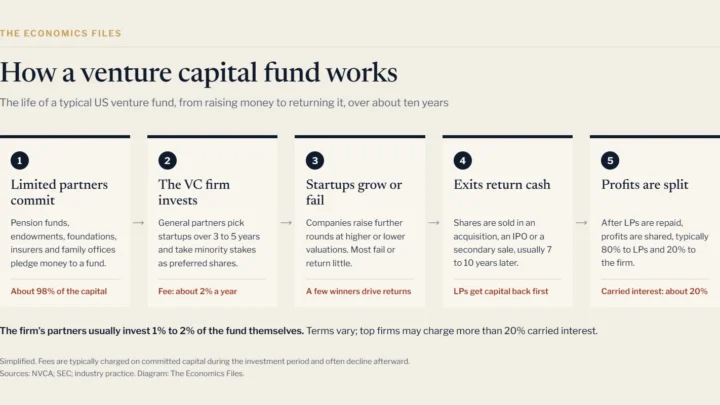
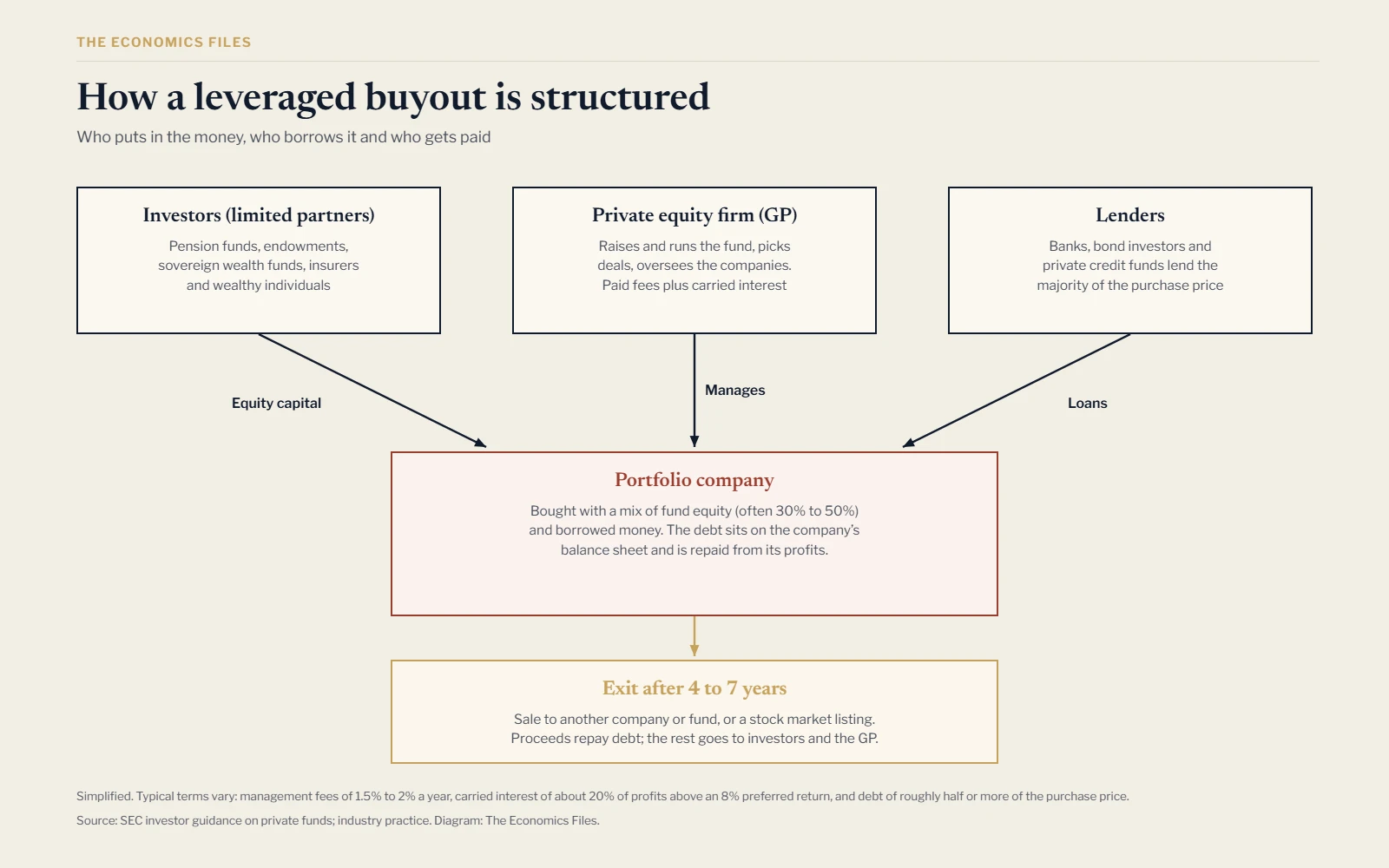
How does private equity make money in practice? A private equity firm, called the general partner or GP, raises a fund from outside investors, called limited partners or LPs. These are mostly pension funds, university endowments, sovereign wealth funds, insurance companies and wealthy families. They commit money for about ten years and cannot easily withdraw it.
The GP uses that money, plus a large amount of debt, to buy companies outright. It then works to make each company more valuable, usually over four to seven years, and sells it to another company, another fund or public shareholders. The profit is split between the investors and the GP, after the GP has collected its fees.
The Leveraged Buyout: How Debt Multiplies Returns
The core deal is the leveraged buyout. The fund puts in part of the purchase price as equity and borrows the rest. Crucially, the debt is placed on the balance sheet of the company being bought, so the company’s own profits pay the interest and principal.
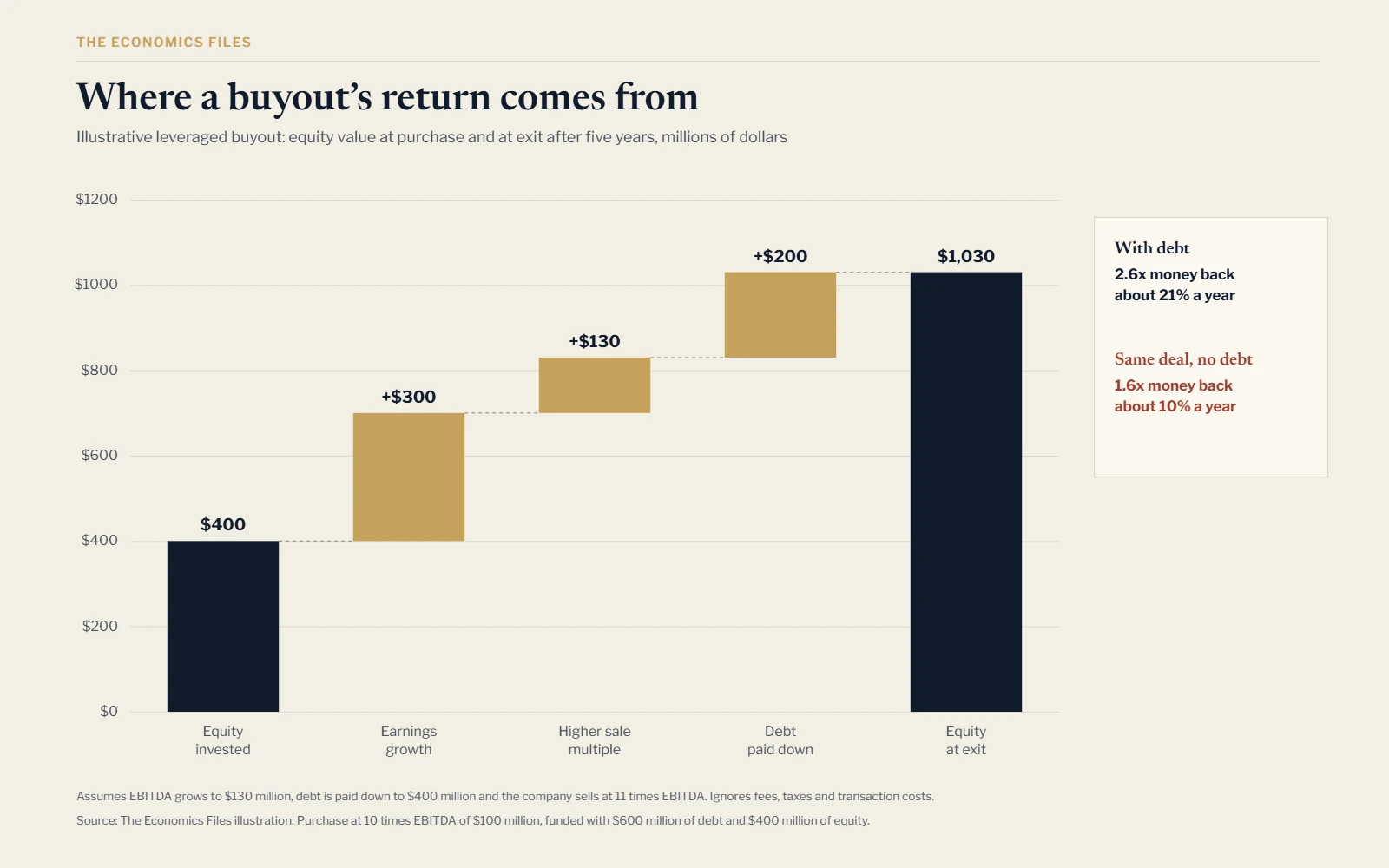
Consider an illustrative deal. A fund buys a company earning $100 million a year before interest, taxes, depreciation and amortization (EBITDA) for 10 times that figure, or $1 billion. It pays with $400 million of equity and $600 million of debt. Over five years, earnings grow to $130 million, cash flow pays the debt down to $400 million, and the company sells for 11 times earnings, or $1.43 billion. After repaying the debt, the fund’s equity is worth $1.03 billion, 2.6 times what it put in, a return of about 21% a year. The same deal with no debt would have returned about 1.6 times, or roughly 10% a year.
The three sources of return
Every buyout gain comes from some mix of three things:
- Growing earnings: raising sales, cutting costs, buying smaller rivals or improving management.
- Selling at a higher multiple: persuading the next buyer to pay more per dollar of earnings, often because the business is bigger, faster-growing or better run, or because markets have risen.
- Paying down debt: using the company’s cash flow to reduce borrowing, so more of the sale price belongs to the owners.
During the era of near-zero interest rates after 2008, cheap debt and rising valuations did much of the work. Bain & Company’s 2026 industry report says those tailwinds are mostly gone, so firms now need faster earnings growth to deliver the same returns.
PE Fees: How the Firms Get Paid
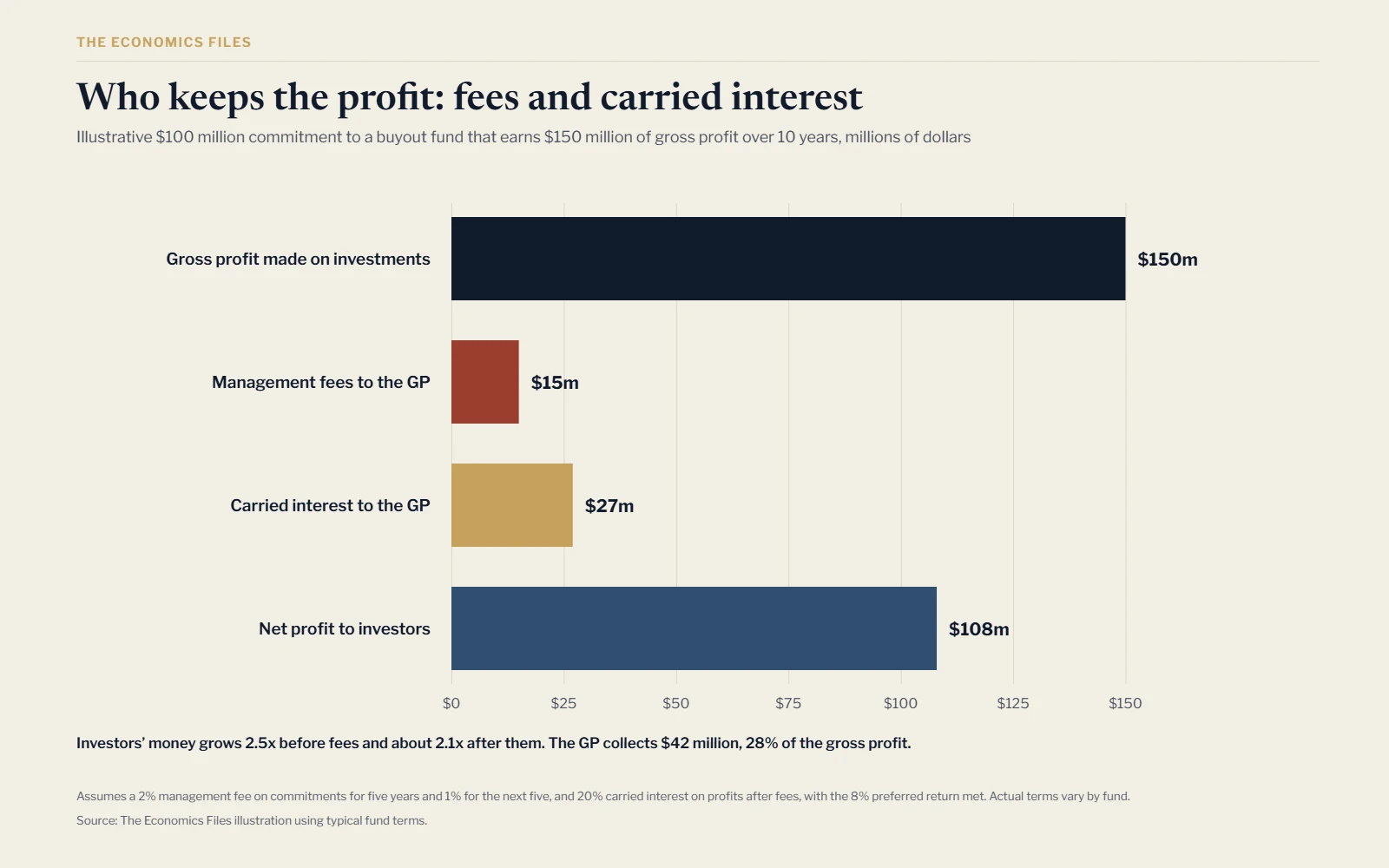
PE fees come in two layers. The first is the management fee, charged every year on the money investors commit or the money invested. The traditional rate is 2%, though large funds often charge less, and it usually steps down after the investment period. These fees pay for staff, offices and deal costs, and they arrive whether or not the fund does well.
Firms also charge portfolio companies for services such as monitoring and arranging transactions, though many funds now credit some or all of these against the management fee. Regulators, including the Securities and Exchange Commission, have pushed for clearer disclosure of these charges.
Carried Interest: The Profit Share
The second layer, and the one that makes private equity partners wealthy, is carried interest. After investors get their money back plus a preferred return, usually 8% a year, the GP typically takes 20% of the remaining profits. If a fund doubles its investors’ money, the GP’s share can be worth many times its management fees.
The tax treatment is controversial. In the United States, the GP’s share is generally taxed as a long-term capital gain, at a top federal rate of 20% plus a 3.8% investment income tax, rather than as ordinary income at up to 37%, provided the investments are held for more than three years. Supporters say the profit share is a return on entrepreneurial risk. Critics say it is payment for managing other people’s money and should be taxed like wages. Proposals to change the rule have been debated for nearly two decades without being enacted.
Does Private Equity Beat the Stock Market?
The industry’s pitch to investors is that it earns higher returns than public stocks, in exchange for locking money up for years. Studies of funds raised before the mid-2000s generally found that buyout funds did outperform public markets on average, after fees. The more recent record is weaker.
State Street’s Private Capital Index, which covers more than 4,200 funds, shows buyout funds underperforming the S&P 500 across every reported horizon through the first quarter of 2026. State Street notes that the comparison is demanding, because recent stock market gains were concentrated in a handful of giant technology companies, and it attributes much of the shortfall to cyclical pressures such as higher interest rates and difficult exits. Returns also vary widely between firms, so picking the right manager matters more than in public markets.
The cash problem
Investors also care about when they get their money back. Bain reports that distributions to investors as a share of fund value have stayed below 15% for four years in a row, an industry record. With average holding periods near seven years, firms are increasingly using continuation funds, which sell a company from one of their funds to another, to return cash. Such deals still account for less than 10% of exit value.
What Private Equity Does to Companies and Workers
The evidence on what happens to the companies themselves is mixed and depends on the type of deal. A study of about 9,800 US buyouts by Steven Davis, Josh Lerner and coauthors found that employment fell 13% over two years at public companies taken private, relative to similar firms, but rose 13% at privately held firms bought by private equity. Labor productivity rose about 8% on average.
In some sectors the findings are more troubling. A widely cited study of US nursing homes by Atul Gupta, Sabrina Howell and coauthors found that private equity ownership was associated with higher short-term mortality among Medicare patients, alongside lower staffing. Critics also point to heavily indebted companies that failed after buyouts. Supporters answer that private equity revives neglected businesses and that most failures reflect bad luck or bad management rather than the model itself.
Why interest rates matter so much
Because buyouts depend on debt, the industry is highly sensitive to interest rates. When rates rose sharply in 2022 and 2023, borrowing costs for leveraged companies jumped and the value of existing deals came under pressure. Our explainers on what a central bank does and on why bond prices fall when rates rise explain the mechanics. Higher rates also pushed more lending toward private credit funds, which now finance a large share of buyouts in place of bank loans.
From Barbarians to Mainstream: A Short History
Buyouts took off in the United States in the 1980s, when firms such as Kohlberg Kravis Roberts used junk bonds to buy large public companies. The era peaked with KKR’s takeover of RJR Nabisco in 1989 for about $25 billion, a deal so aggressive it inspired the book Barbarians at the Gate. Several of the 1980s deals later collapsed under their debts, and the industry rebranded itself from “LBO firms” to “private equity.”
Over the following decades, the industry grew into a mainstream part of finance. Today the largest firms, including Blackstone, KKR, Apollo and Carlyle, are themselves listed on stock exchanges and run businesses that stretch from buyouts to real estate, infrastructure and lending. That shift also changes the answer to how does private equity make money: for the biggest firms, steady fees on ever-larger pools of capital have become as important as the profit share on individual deals.
Private Equity and Ordinary Investors
Private equity has long been limited to institutions and wealthy individuals. That is changing. In August 2025, President Donald Trump signed an executive order directing regulators to make it easier for 401(k) retirement plans to include private equity and other alternative assets, and large firms have launched funds aimed at individual investors. Supporters say this gives savers access to a broader set of companies, since many businesses now stay private longer. Critics warn that higher fees, limited liquidity and hard-to-verify valuations make these products riskier for ordinary savers than they look.
Frequently Asked Questions
What is private equity in simple terms?
Private equity is money invested in companies that are not traded on a stock exchange. Buyout firms raise funds from institutional investors, borrow additional money, buy companies, try to improve them and sell them several years later.
What is “2 and 20” in private equity?
It is shorthand for the traditional fee structure: a 2% annual management fee and a 20% share of profits for the firm. Many funds now charge lower management fees, and the profit share usually applies only after investors receive a preferred return of about 8% a year.
How do private equity firms make money if a deal fails?
They still collect management fees, which do not depend on performance. They lose the chance to earn their profit share on that deal and may lose their own investment in the fund, which is usually 1% to 5% of its size. Investors bear most of the loss.
Is private equity good or bad for companies?
It depends on the deal. Research finds productivity gains on average and job growth at many privately held targets, but job cuts at public companies taken private and worse outcomes in some sectors such as nursing homes. Heavy debt raises the risk of failure when conditions turn.
Why is private equity so focused on debt?
Debt lets a fund buy a large company with a smaller amount of its own money, which magnifies returns on that equity. Interest payments are also usually tax-deductible. The trade-off is higher risk: if earnings fall, the company may struggle to meet its debt payments.
Sources and Method
- Bain & Company, “Private Equity Outlook 2026: Gaining Traction”, Global Private Equity Report 2026.
- State Street, “Private markets beyond the underperformance paradox”, August 2026.
- Steven J. Davis, John Haltiwanger, Kyle Handley, Ben Lipsius, Josh Lerner and Javier Miranda, “The Economic Effects of Private Equity Buyouts”, NBER Working Paper 26371.
- Atul Gupta, Sabrina T. Howell, Constantine Yannelis and Abhinav Gupta, “Does Private Equity Investment in Healthcare Benefit Patients? Evidence from Nursing Homes” (later published in the Review of Financial Studies, 2024).
- Steven N. Kaplan and Antoinette Schoar, “Private Equity Performance: Returns, Persistence, and Capital Flows,” Journal of Finance, 2005; Robert Harris, Tim Jenkinson and Steven Kaplan, “Private Equity Performance: What Do We Know?” Journal of Finance, 2014.
- US Securities and Exchange Commission, investor guidance on private funds.
- The White House, executive order “Democratizing Access to Alternative Assets for 401(k) Investors,” August 7, 2025.
Method: the buyout and fee examples are illustrations built by The Economics Files from typical industry terms, not data on any real fund or company. The buyout example ignores fees, taxes and transaction costs; returns are calculated as a multiple of equity invested and as a compound annual rate over five years. The fee example assumes a $100 million commitment, $150 million of gross profit over ten years, a 2% management fee on commitments for five years and 1% for the following five, and 20% carried interest after fees with the preferred return met. Industry figures are from the sources listed. Diagrams and charts are by The Economics Files.