On November 18, 2026, Anthropic sold 980 million new shares at $83 each and raised $81.3 billion, the largest initial public offering on record. The next day, its first trade on Nasdaq printed at $111.50, a little before noon in New York. By the 4 p.m. close the stock had slipped to $97.17, still 17% above the offer price.
Anthropic received money at only one point in that sequence: the $83 sale. Every trade after it was between investors, and none of the rise to $97.17 went to the company. That split between issuing shares and trading them is the best place to start.
So how does the stock market work? In short, companies sell ownership stakes to raise money, and investors then buy and sell those stakes among themselves. Brokers send orders to exchanges and other trading venues, where buyers and sellers are matched at the best available price. Prices move whenever traders change what they are willing to pay or accept. A clearinghouse guarantees each trade, and the shares and cash change hands one business day later. The Securities and Exchange Commission (SEC) and FINRA supervise every step.
What Are Shares, and Why Do Companies Sell Them?
Shares are units of ownership in a corporation. If a company has 100 million shares outstanding and you own 1,000, you hold 0.001% of the business: a claim on that slice of its future profits and, for most share classes, a vote on directors at the annual meeting. Some companies issue several classes of stock so that founders keep voting control while selling most of the economic value.
Companies sell equity because it never has to be repaid. A bank loan or bond carries fixed interest and a maturity date; shareholders get paid only if the company succeeds, through dividends or a higher share price. The price of that flexibility is dilution. Existing owners give up part of the company and part of its future profits.
The primary market: the one time the company gets paid
The first sale of shares to the public is an initial public offering. The company hires investment banks as underwriters, files a registration statement with the SEC that discloses its finances and risks, and markets the shares to large investors. The banks collect orders, set a final price and allocate the shares. Anthropic marketed its stock at $70 to $78 a share, then priced it at $83 because orders far exceeded the shares on offer. Companies can return to this primary market later through follow-on offerings, and private companies can raise equity without listing at all, from venture capital funds or private equity firms.
The secondary market: investors trading with investors
Almost everything people call “the stock market” is the secondary market. In 2025, an average of 17.6 billion US shares worth about $1.1 trillion changed hands every trading day, according to Cboe Global Markets. The companies behind those shares received none of it.
The secondary market still matters to them. Investors pay more for new shares when they know they can sell them later, so a liquid market lowers the cost of raising capital. The share price also works as a public, continuously updated estimate of what the business is worth, and companies use their own shares to pay employees and buy other firms.
What Is a Stock Exchange?
A stock exchange is a regulated marketplace where buy and sell orders meet under published rules. The US has 17 exchanges registered for stock trading, but most belong to three groups: Intercontinental Exchange (owner of the New York Stock Exchange), Nasdaq and Cboe. The NYSE traces its history to the 1792 Buttonwood Agreement among 24 brokers in lower Manhattan. Today nearly all trading on every exchange is electronic, although the NYSE still keeps a trading floor.
Listing versus trading
Exchanges do two separate jobs. The first is listing: a company that meets an exchange’s standards for size, finances, governance and disclosure pays fees and becomes “listed” there. Anthropic listed on Nasdaq. The second is trading, and here the listing matters less than most people assume. Under federal rules, a stock listed on one exchange can trade on all of them, so Anthropic shares also change hands on NYSE Arca, Cboe’s exchanges and the rest.
Trading hours and auctions
The regular session runs from 9:30 a.m. to 4:00 p.m. Eastern time, Monday to Friday. Many venues also run pre-market and after-hours sessions from 4 a.m. to 8 p.m. The listing exchange opens and closes each regular session with an auction that gathers orders and sets a single price. The closing auction has become one of the busiest moments of the day, because index funds trade there to match the closing prices their benchmarks use. It accounted for about 8% of all US share volume in August 2026, according to Rosenblatt Securities.
Those hours are about to stretch. On December 6, 2026, Nasdaq plans to open a night session from 9 p.m. to 4 a.m., which, combined with its existing sessions, would allow trading 23 hours a day, five days a week. The start depends on the consolidated market-data feeds being ready to run overnight.
How a Stock Price Is Set
A stock has no official price set by anyone. It has a record of the last trade and a list of standing offers to buy and sell, called the order book. The highest price any buyer is currently offering is the bid. The lowest price any seller will accept is the ask, or offer. The gap between them is the spread.
Here is a simplified order book for a hypothetical stock:
| Bids (buyers) | Shares | Asks (sellers) | Shares |
|---|---|---|---|
| $100.02 (best bid) | 500 | $100.03 (best ask) | 300 |
| $100.01 | 1,200 | $100.04 | 800 |
| $100.00 | 2,000 | $100.05 | 1,500 |
If you send a market order to buy 300 shares, you accept the best price available and pay $100.03. If you place a limit order to buy at $100.01, your order joins the queue of bids and waits until a seller agrees to that price. Market orders favor speed; limit orders protect the price but may never fill.
The best bid and best ask across all exchanges combined form the national best bid and offer, or NBBO. SEC rules generally bar venues from executing trades at prices worse than the protected quotes displayed elsewhere, which is why a share of the same company costs essentially the same everywhere at a given moment.
Prices change when traders change their minds. An earnings report, a merger, a shift in expected interest rates or simply a large seller can lead buyers to lower their bids or sellers to cut their asks. Interest rates matter in a specific way: a stock is valued on profits that arrive years from now, and higher rates make those future dollars worth less today. That is the same arithmetic behind why bond prices fall when rates rise, and it is why stock traders watch how the Fed sets interest rates so closely.
What Market Makers Do
Someone has to be willing to buy when you want to sell. Market makers are firms that post both a bid and an ask in a stock throughout the day, profiting from the spread and carrying the risk that prices move against the inventory they hold. They come in three main forms:
- Designated market makers at the NYSE, each responsible for specific stocks, who run the opening and closing auctions and must help keep trading orderly.
- Electronic market makers registered on exchanges, which quote thousands of stocks at once using automated systems.
- Wholesalers, a handful of large trading firms that buy order flow from retail brokers and fill those orders from their own books instead of sending them to an exchange.
Wholesalers are the reason most zero-commission trading exists. They pay brokers for the right to handle customer orders, a practice called payment for order flow, and usually fill those orders at or slightly better than the NBBO. They can afford to, because small retail orders are less likely than institutional orders to come from traders with better information. Critics argue the payments give brokers a reason to route orders for their own benefit. Defenders point to the price improvement customers receive. Brokers are bound by a duty of best execution, enforced by FINRA, and must publish quarterly reports on where they send orders and what they are paid.
Retail investors now matter far more to this business than they used to. They accounted for about 21% of US equity volume in 2025, up from roughly 10% historically, according to Bloomberg Intelligence figures cited by SIFMA.
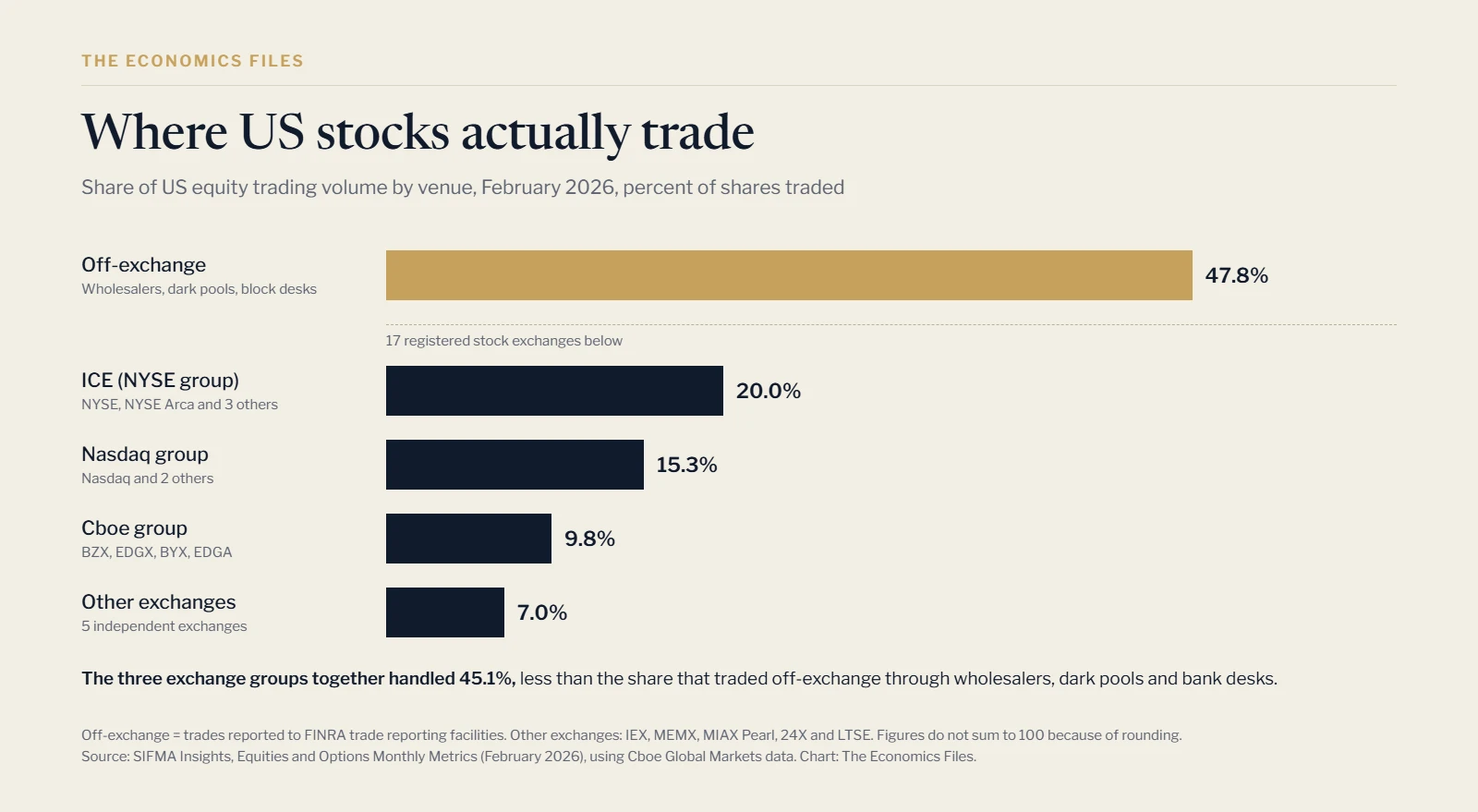
The result is that the exchanges no longer handle most trading. Off-exchange venues executed 50.6% of US share volume in 2025, the first year above half, according to Cboe. About four-fifths of that volume went through broker-dealers trading as principal, chiefly the wholesalers. The rest traded on alternative trading systems, the private matching platforms often called dark pools because they do not display quotes before a trade.
What Happens After You Click “Buy”
Most people who ask how does the stock market work picture the trade itself, which takes a fraction of a second. Making that trade final takes the rest of the system.
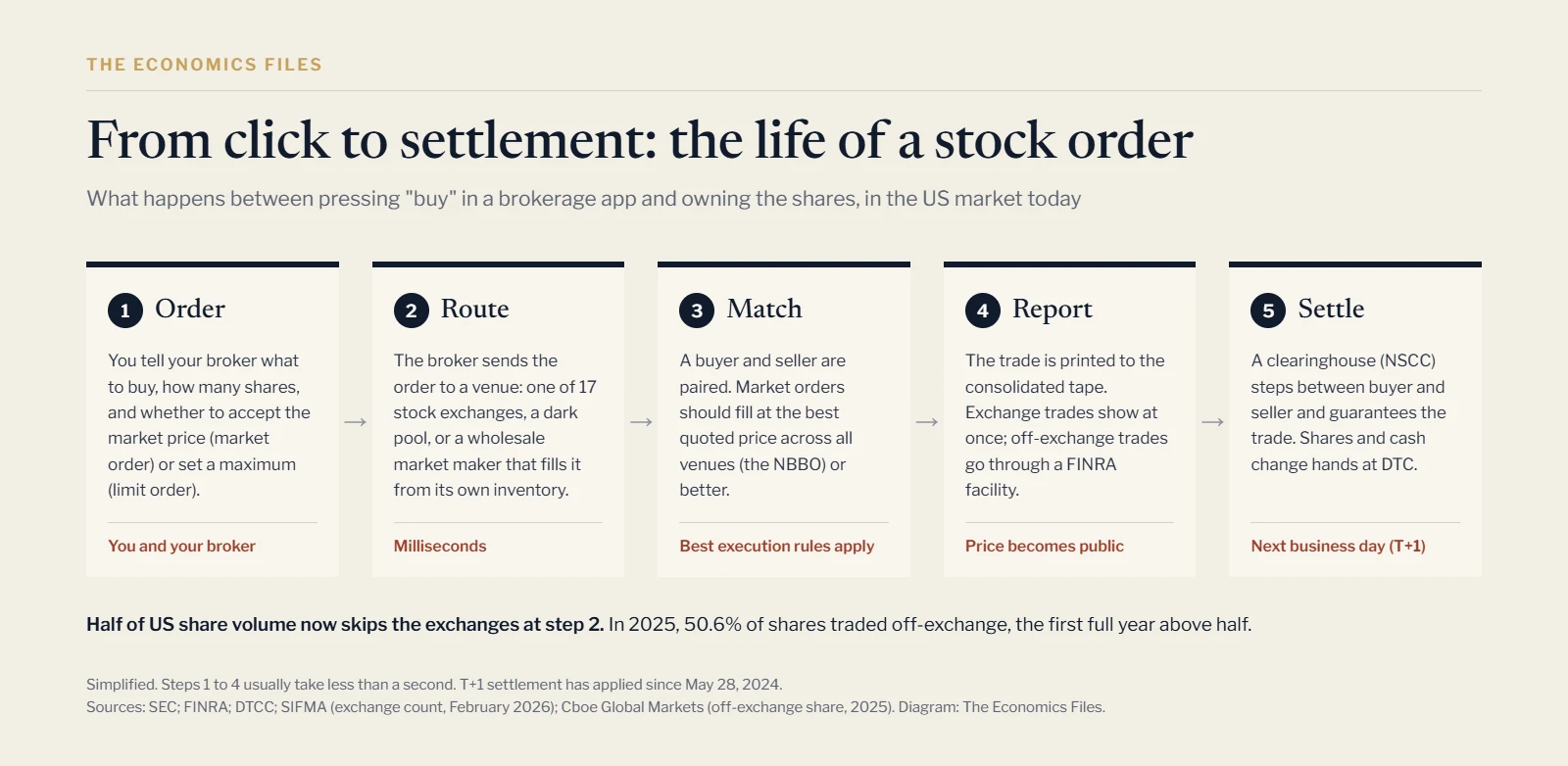
Once your order is matched, the venue reports the trade so the price appears on the consolidated tape that every quote screen draws from. The trade then goes to the National Securities Clearing Corporation, a subsidiary of the Depository Trust & Clearing Corporation (DTCC). NSCC becomes the buyer to every seller and the seller to every buyer, so if one firm fails, the other side still gets paid. It also nets each firm’s trades against each other, so millions of transactions shrink to far smaller payments.
Settlement, the actual swap of shares for cash, happens at the Depository Trust Company one business day after the trade. The US moved to this T+1 cycle on May 28, 2024, from two days. The SEC pushed for the change partly after the January 2021 meme-stock frenzy, when brokers faced sudden collateral demands while trades sat unsettled. A shorter gap means less money tied up as protection against failures.
Who Regulates the Stock Market?
Federal oversight began with the Securities Exchange Act of 1934, which created the SEC after the crash of 1929 and the collapse that followed, covered in our article on what caused the Great Depression. The SEC writes the market’s rules, approves exchange rule changes and requires public companies to disclose their finances every quarter. FINRA, a self-regulatory organization overseen by the SEC, licenses and polices broker-dealers. The exchanges supervise trading on their own venues.
The rules also include automatic brakes. If the S&P 500 falls 7% or 13% from the previous close before 3:25 p.m., trading in all US stocks halts for 15 minutes. A 20% drop closes the market for the rest of the day. Individual stocks have their own price bands, and a stock that moves outside its band and does not return within 15 seconds pauses for five minutes.
Who Owns the Stock Market?
The US stock market was worth $68.9 trillion at the end of 2025, or 43.7% of all listed equity in the world, according to SIFMA. That is 4.4 times the size of China’s, the next largest.
Ownership is wide but shallow. In Gallup’s April 2026 survey, 58% of American adults said they owned stock, directly or through funds and retirement accounts, down from 62% a year earlier. Most of those holdings are small. Federal Reserve data show how concentrated the dollars are.
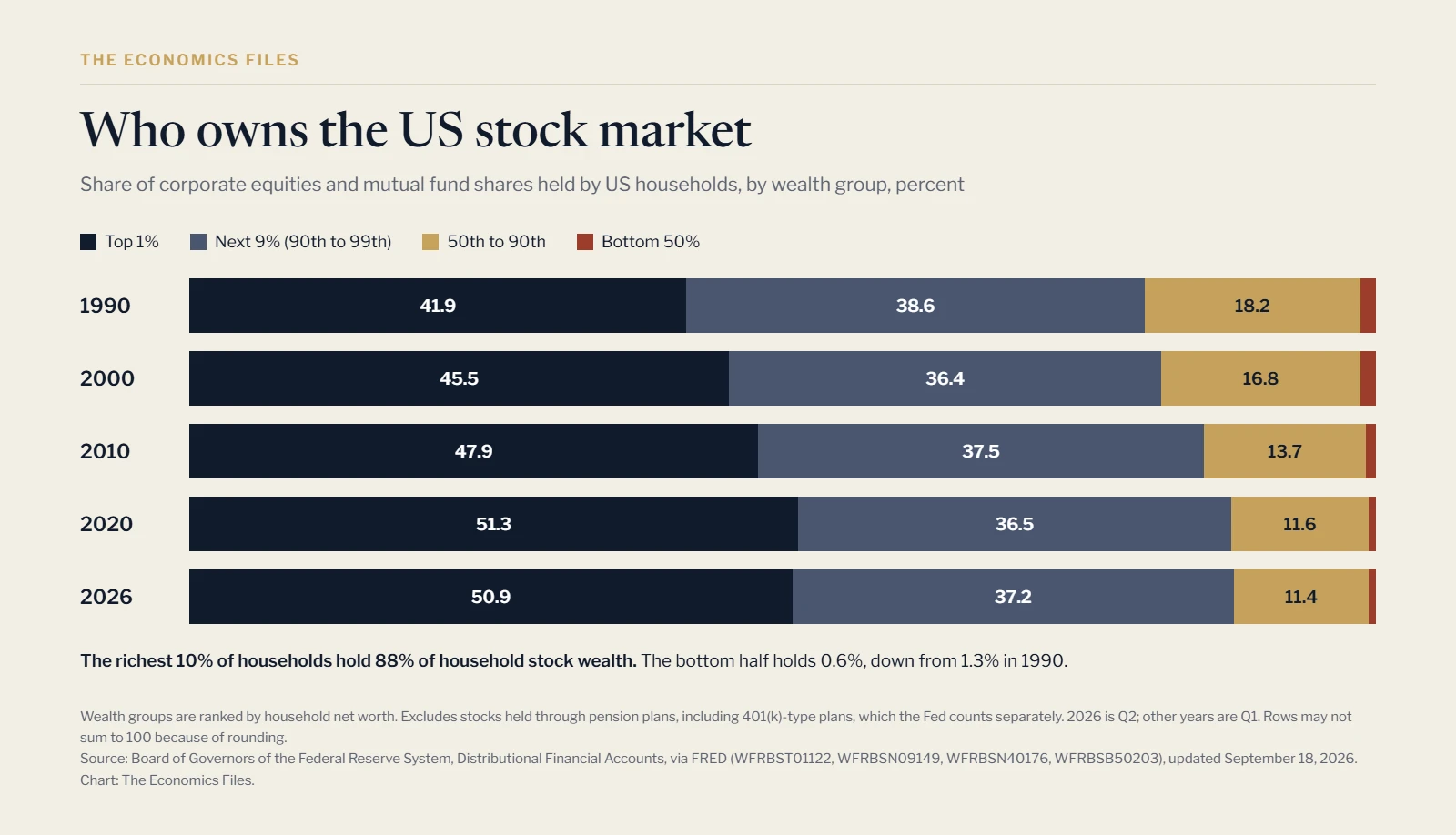
The top 1% of households by wealth held 50.9% of household stocks and mutual fund shares in the second quarter of 2026, up from 41.9% in 1990. The richest 10% held about 88%. This is why rising share prices widen measured wealth inequality, and why fortunes at the very top are mostly stakes in companies, as we explain in how billionaires build their wealth. It also means stock market swings affect consumer spending mainly through the budgets of wealthier households.
Two changes are worth tracking over the next year: whether Nasdaq’s overnight session draws real volume after December 6, and whether off-exchange trading keeps taking share from the exchanges. Both will shape where your next order goes and the price it gets, even though the basic job of matching buyers with sellers has not changed since 1792.
Frequently Asked Questions
Does a company get money when its stock price goes up?
Not directly. A company receives cash only when it sells new shares, as in an IPO or a later offering. When investors trade existing shares, the money moves between them. A higher share price still helps the company: it can raise more money if it sells new shares, pay employees in stock and use its shares to buy other businesses.
What is the difference between the NYSE and Nasdaq?
Both are stock exchanges that list companies and run trading. The New York Stock Exchange is owned by Intercontinental Exchange and keeps a trading floor with designated market makers who oversee each stock’s auctions. Nasdaq started in 1971 as an electronic quotation system, has no trading floor and is known for listing technology companies. A stock listed on either one can trade on any US exchange.
What time does the stock market open and close?
The regular US session runs from 9:30 a.m. to 4:00 p.m. Eastern time, Monday to Friday, except market holidays. Many venues also offer extended-hours trading from 4 a.m. to 8 p.m. Nasdaq plans to add a session from 9 p.m. to 4 a.m. starting December 6, 2026, allowing trading 23 hours a day, five days a week.
What happens if the stock market falls sharply in one day?
Market-wide circuit breakers apply. If the S&P 500 drops 7% or 13% from the prior close before 3:25 p.m. Eastern, trading in all US stocks stops for 15 minutes. If it falls 20%, trading ends for the day. Individual stocks also pause for five minutes when they move outside set price bands.
Who decides the price of a stock?
No one sets it. The price is the level at which the latest buyer and seller agreed to trade. Buyers post bids, sellers post asks, and a trade happens when one side accepts the other’s price. When news changes what investors will pay or accept, the quotes move and so does the price.
Sources
- Cboe Global Markets, “2025 U.S. Equities Year in Review”
- SIFMA Insights, Equities and Options Monthly Metrics, February 2026
- SIFMA, “10 Key Findings from SIFMA’s 2026 Capital Markets Fact Book,” August 19, 2026
- Federal Reserve Board, Distributional Financial Accounts, share of corporate equities and mutual fund shares by wealth group, via FRED
- Gallup, “What Percentage of Americans Own Stock?”
- Nasdaq, 23/5 Trading Information Hub
- SEC Office of Investor Education and Advocacy, “New T+1 Settlement Cycle: What Investors Need to Know”
- SEC, “Trade Execution: What Every Investor Should Know”
- FINRA, Regulatory Notice 21-23, “Best Execution and Payment for Order Flow”
- Investor.gov, “Stock Market Circuit Breakers”
- Rosenblatt Securities, “US Securities Volumes: August 2026”
- Fox Business, “Anthropic begins trading on Nasdaq in record-breaking IPO,” November 19, 2026
- Associated Press via ITV News, “Anthropic begins trading in the biggest IPO on record,” November 19, 2026
Method: IPO details for Anthropic are from the company’s pricing announcement as reported by Fox Business and the Associated Press on November 19, 2026. Venue shares are for February 2026 (SIFMA, from Cboe data) and full-year 2025 (Cboe), measured in shares traded; shares of dollar value differ. Ownership shares are from the Federal Reserve’s Distributional Financial Accounts for Q2 2026, released September 18, 2026, and exclude stocks held through pension plans. The order book table is illustrative. Data as of November 23, 2026.