In March 2026, Forbes counted a record 3,428 billionaires worth a combined $20.1 trillion, about $4 trillion more than a year earlier. At the top, Elon Musk’s fortune reached an estimated $839 billion, the largest Forbes has ever recorded. Twenty people were worth at least $100 billion. Almost none of that wealth came from salaries. It came from owning things, mostly shares in companies, whose value rose.
Short answer: Billionaires make most of their money by owning large stakes in valuable companies, not by earning high pay. When a company’s value rises, so does the owner’s stake, often by billions of dollars in a single year. Most built that stake by founding or growing a business; a growing number inherited it. Because gains on shares are taxed only when they are sold, many billionaires can hold their stock, borrow against it to fund spending and pass it on to heirs, paying relatively little income tax along the way.
How Do Billionaires Make Money?
How do billionaires make money if not from pay? The answer is simple arithmetic. A person who owns 13% of a company worth $1 trillion holds a $130 billion stake. If the company’s value rises by a fifth, that stake grows by $26 billion, with no salary involved. Billionaire wealth, as measured by Forbes and others, is mostly the market value of what people own, minus their debts.
That is why billionaire rankings move with the stock market. The 2026 Forbes list rose sharply because of booming artificial intelligence investment and strong markets, which lifted the value of technology companies and their founders’ stakes. Musk’s estimated wealth roughly doubled in a year, driven by the values placed on Tesla, SpaceX and his other companies. Our article on how AI is affecting jobs looks at the other side of the same technology boom.
Equity Ownership: Why Stakes Beat Salaries
Equity ownership is the engine of large fortunes for two reasons. First, the value of a successful company can grow far faster than any salary, because investors pay for expected future profits, not just today’s. Second, gains compound: a stake that doubles and doubles again grows enormously without the owner adding anything.
Ownership of stocks is highly concentrated. According to the Federal Reserve’s Distributional Financial Accounts, the richest 1% of US households held 50.9% of all corporate equities and mutual fund shares in the second quarter of 2026. The same group held 32.5% of all household wealth, the highest share since the Fed’s series began in 1989, while the bottom half of households held 2.3%.
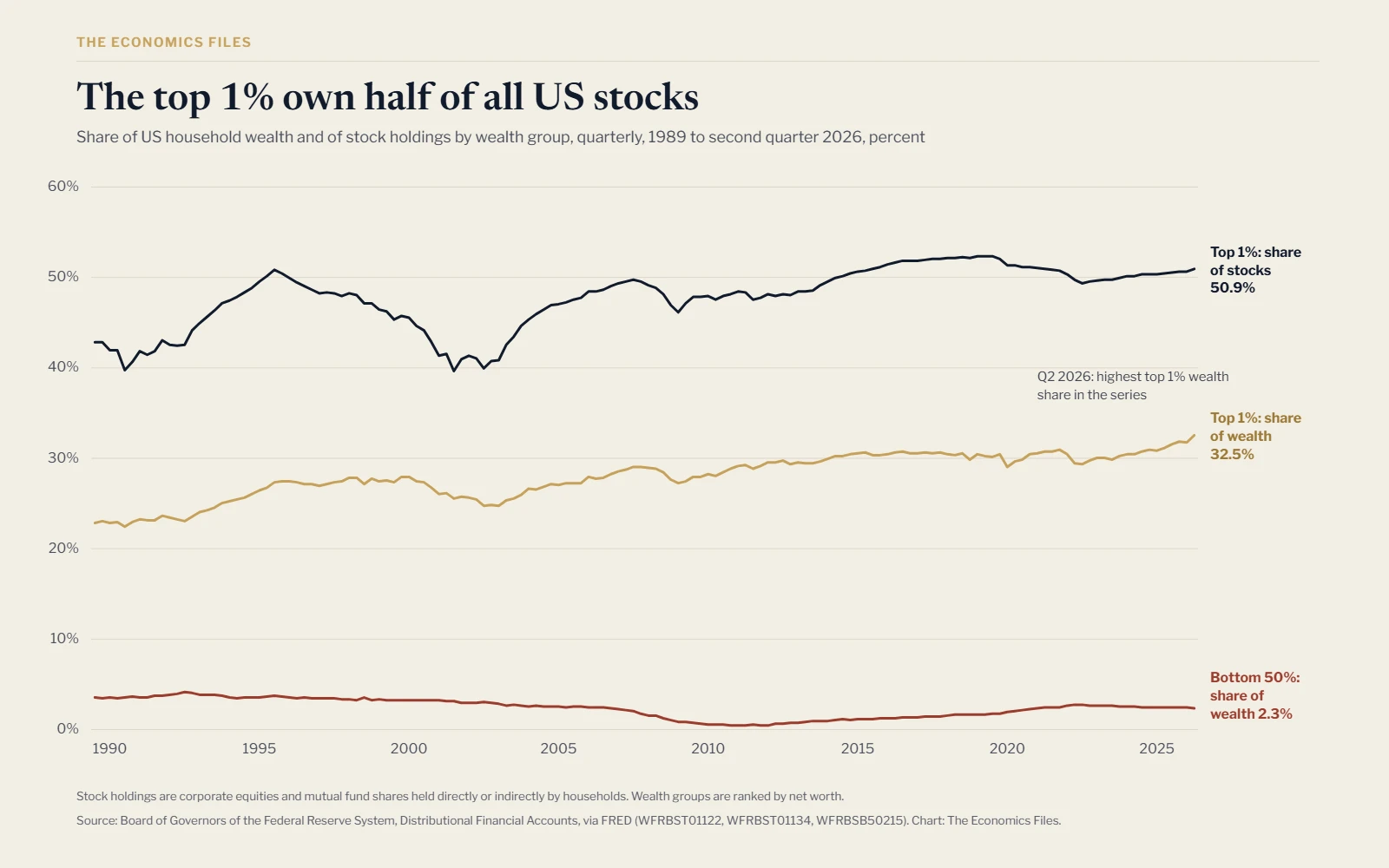
That concentration explains why strong markets tend to widen wealth inequality. Most middle-class wealth is in homes and retirement accounts, while the very top holds mainly company shares and private businesses. When share prices climb faster than house prices, the top pulls ahead.
Founder Wealth: Building and Keeping a Stake
Most of the world’s largest fortunes are founder wealth. Jeff Bezos, Mark Zuckerberg, Larry Page and Sergey Brin all became billionaires by starting companies and keeping large stakes as those companies grew. The typical path runs through several stages:
- Starting the company with most or all of the ownership.
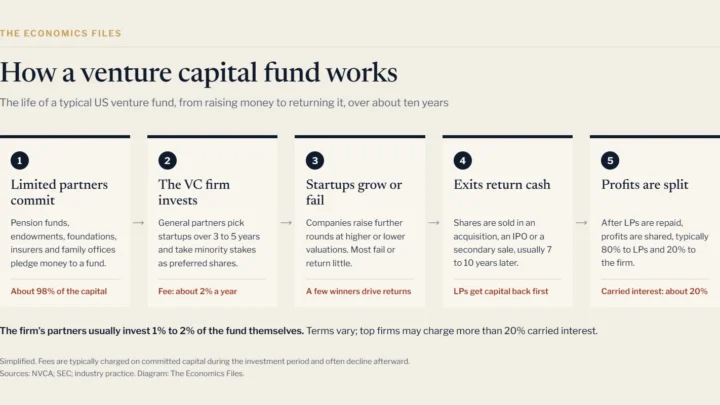
- Raising outside money from venture capital investors, who buy shares and dilute the founders’ stake, sometimes in exchange for the cash needed to grow.
- Going public or selling, which puts a market price on the company and turns paper value into tradable shares.
- Keeping control, often through special share classes that give founders extra voting power even after their economic stake shrinks.
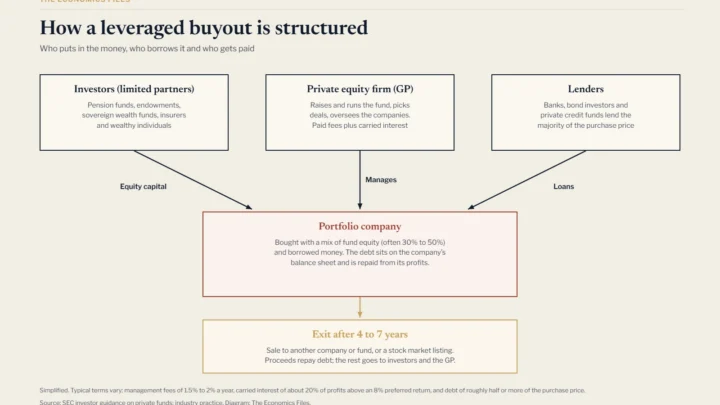
The UBS Billionaire Ambitions Report found that 196 people became self-made billionaires in the year to April 2025, holding $386.5 billion between them, the second-highest number since the report began, behind only 2021. Wealth from finance also grew strongly. Founders of investment firms, hedge funds and buyout firms make up a large group of billionaires, earning fortunes from fees and profit shares on other people’s money as well as their own stakes. Our explainer on how private equity makes money shows how that model works. Newer fortunes have also come from cryptocurrency and from companies building artificial intelligence.
Why valuations matter as much as profits
A founder’s fortune depends not only on how much profit the company makes but on how much investors are willing to pay for each dollar of it. Take a company earning $10 billion a year. If investors value it at 30 times earnings, it is worth $300 billion. If enthusiasm for its industry lifts that multiple to 40 times, it is worth $400 billion, and a founder owning a fifth of it becomes $20 billion richer even though profits have not changed. That is why fortunes built on fast-growing technology companies can swell during booms and shrink quickly when sentiment turns.
Inheritance: The Other Route
Not every billionaire built a fortune. UBS found that 91 people became billionaires through inheritance in the same year, receiving a combined $297.8 billion, more than a third above the previous year. About 860 multigenerational billionaires now oversee roughly $4.7 trillion, and UBS expects the number of heirs to keep rising as older billionaires pass wealth to their children over the next two decades. Inheritance was the most common route for women joining the billionaire ranks: 27 of the 43 women who became billionaires that year inherited their wealth.
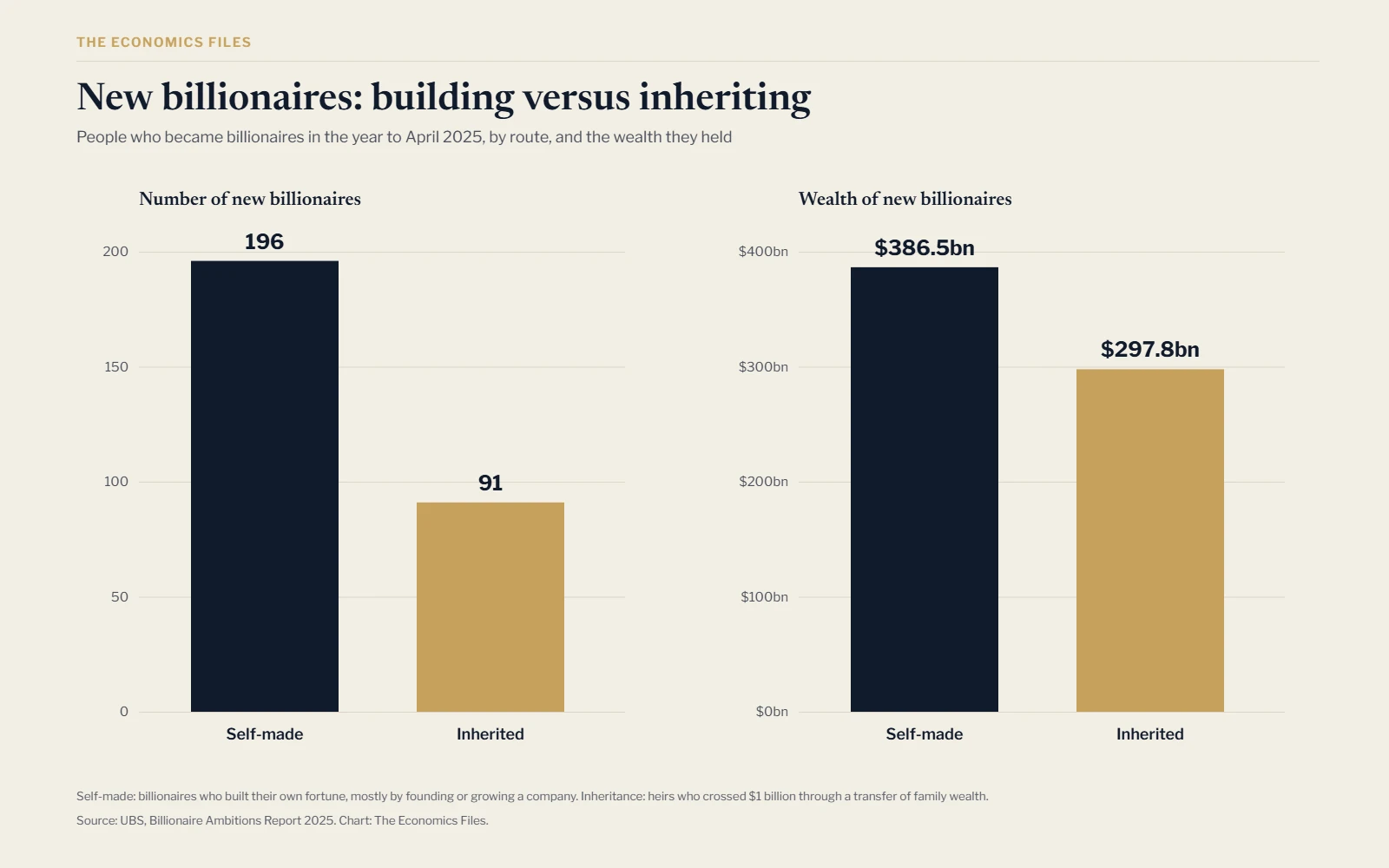
How much of today’s billionaire wealth is “self-made” depends on definitions. Many founders had family money, education or connections that helped them start. Many heirs actively run the businesses they inherited. Rankings usually classify people by how the fortune began rather than by everything that helped it grow.
Unrealized Gains: Why Billionaires Can Pay Little Income Tax
In the United States, an increase in the value of an asset is not taxed until the asset is sold. Until then it is an unrealized gain. A founder whose shares rise by $10 billion owes no income tax on that increase as long as she keeps the shares. Salaries, by contrast, are taxed every year.
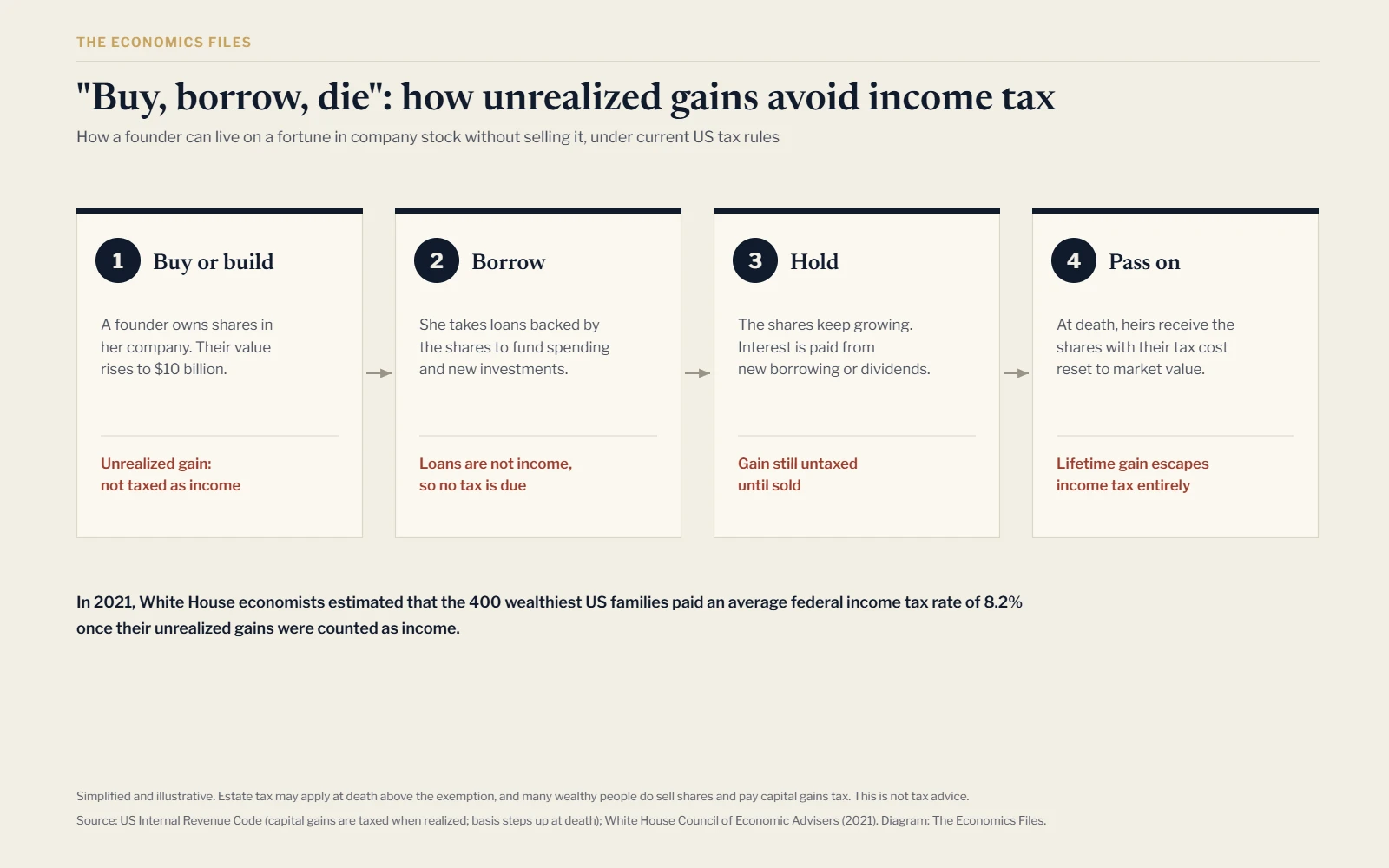
Many wealthy people build on this rule in a strategy often called “buy, borrow, die.” They hold appreciating shares, borrow against them to pay for spending or new investments, since loans are not taxable income, and keep the shares until death. At that point, heirs receive the assets with their tax cost “stepped up” to market value, so the gain built up over the owner’s lifetime is never subject to income tax. Estate tax may apply above a high exemption, but careful planning can reduce it.
The effect on tax rates is large. In 2021, economists at the White House Council of Economic Advisers estimated that the 400 wealthiest American families paid an average federal individual income tax rate of 8.2% from 2010 to 2018 once gains on assets they had not sold were counted as income. A ProPublica investigation the same year, based on leaked tax records, found that the 25 richest Americans paid a “true tax rate” of 3.4% on their wealth growth over five years.
The policy debate
Proposals to change this include taxing gains on unsold assets for the very wealthy, ending the step-up in basis at death or introducing an annual wealth tax. Supporters argue that the current system lets the richest households pay lower effective rates than many workers. Opponents argue that valuing private companies every year would be difficult and costly, that founders could be forced to sell shares to pay tax on gains they might later lose, and that such taxes could discourage investment or push wealthy people and companies abroad. None of these proposals has become US law, and the debate remains politically divided.
Why Billionaire Fortunes Swing So Much
Because their wealth is mostly shares, billionaires’ fortunes rise and fall with markets. Musk’s estimated wealth rose by about $497 billion in the year to March 2026. In bear markets, the reverse happens: technology founders lost hundreds of billions of dollars of paper wealth in 2022 as rising interest rates pushed down tech stock valuations. Our explainer on why bond prices fall when rates rise shows the same logic that hits growth stocks when rates climb.
That volatility also means billionaire wealth is less liquid than it looks. Selling a large stake can push the share price down, and founders often face limits on when they can sell. Headline net worth figures are best read as an estimate of what a fortune would be worth at today’s market prices, not as cash in the bank.
Where the World’s Billionaires Live
The United States has by far the most billionaires. Forbes counted a record 989 American billionaires in its 2026 list, about 29% of the global total, spread across sectors from technology and finance to retail and media. The full list covered people from 80 countries and territories. Anyone asking how do billionaires make money in different places will find the answer varies: in the United States technology and finance dominate, while in many other countries family-owned industrial groups, commodities, property and consumer brands play a larger role, and inherited wealth is more common. UBS found that most new billionaires in Western Europe inherited their fortunes, while the Americas led in new self-made wealth.
What Billionaire Wealth Means for the Economy
Views on the rise of billionaires divide along familiar lines. Supporters argue that large fortunes are mostly the reward for building companies that created products, jobs and value for shareholders and customers, and that most of the wealth stays invested in those businesses. Critics argue that extreme concentration gives a small number of people outsized influence over politics and the economy, that some fortunes reflect market power rather than innovation, and that low effective tax rates shift the burden onto other taxpayers.
The data settle some points but not the argument. Wealth at the top has grown faster than for most households, driven largely by rising stock values. Whether that reflects healthy reward for innovation or a system that needs reform is a question of values as much as economics.
Frequently Asked Questions
Do billionaires get a salary?
Some do, but it is usually a tiny share of their wealth. Several prominent founders have taken little or no salary at all. Their fortunes come from the value of the shares they own, and sometimes from dividends or occasional share sales.
How do billionaires pay for things if their wealth is in stock?
They sell shares from time to time, receive dividends or, increasingly, borrow against their holdings. Loans backed by shares let them raise cash without selling and without triggering capital gains tax.
Are most billionaires self-made?
Most new billionaires in recent years built their own fortunes, according to UBS. But inheritance is a large and growing route, and a significant share of the world’s billionaire wealth is now held by multigenerational families.
How many billionaires are there in the world?
Forbes counted 3,428 billionaires in March 2026, a record, with combined wealth of $20.1 trillion. The United States had more than any other country.
Why do billionaires get richer even in bad years for the economy?
Their wealth tracks asset prices more than the economy as a whole. Stock markets can rise when interest rates fall or when investors expect future profits to grow, even if wages and jobs are under pressure, and the richest households own most of those stocks.
Sources and Method
- Forbes, World’s Billionaires List 2026 (data as of March 1, 2026), as reported by Bernama/Anadolu, The Spokesman-Review and Statista.
- UBS, Billionaire Ambitions Report 2025; summaries by Funds Society and Fortune.
- Board of Governors of the Federal Reserve System, Distributional Financial Accounts, via FRED: WFRBST01122, WFRBST01134 and WFRBSB50215.
- Greg Leiserson and Danny Yagan, “What Is the Average Federal Individual Income Tax Rate on the Wealthiest Americans?” White House Council of Economic Advisers and Office of Management and Budget, September 2021.
- Jesse Eisinger, Jeff Ernsthausen and Paul Kiel, “The Secret IRS Files,” ProPublica, June 2021.
- US Internal Revenue Code: realization rule for capital gains and basis step-up at death (Section 1014).
Method: billionaire counts and fortunes are Forbes estimates based on stock prices and exchange rates on March 1, 2026; UBS figures cover the 12 months to early April 2025. Wealth shares are Federal Reserve estimates for US households ranked by net worth, second quarter of 2026. The valuation and stake examples are simple illustrations by The Economics Files. The “buy, borrow, die” diagram simplifies US tax rules and is not tax advice. Charts are by The Economics Files.