In March 2026, the 20 millionth bitcoin was mined, seventeen years after the network launched. Under rules written into its code in 2008, the final million will take about 114 more years to appear. No central bank sets that schedule and no company can change it on its own. That fixed design is what makes Bitcoin unusual as an economic system, and it is also the source of most arguments about whether it can work as money.
Short answer: Bitcoin is a digital currency that runs on a shared public ledger, the blockchain, maintained by thousands of computers around the world rather than by a bank. New transactions are grouped into blocks roughly every 10 minutes. Computers called miners compete to add each block by solving a costly computing puzzle, a system that makes the ledger expensive to tamper with, and the winner earns newly created bitcoins plus fees. The reward halves about every four years, which caps the total supply at 21 million coins. Its economics rest on that fixed supply, but its price is highly volatile.
How Does Bitcoin Work?
How does Bitcoin work without a bank in the middle? The system replaces a trusted institution with three things: cryptography, a public record and economic incentives.
Each user holds a private key, a long secret number that proves ownership of particular bitcoins. To pay someone, the owner signs a message with that key. Computers running Bitcoin’s software, called nodes, check that the signature is valid and that the coins have not already been spent. Every node keeps a full copy of the ledger, so anyone can verify the entire history of transactions back to the first block in January 2009.
The hard problem in digital money is preventing the same coin from being spent twice. Banks solve it by keeping the official record themselves. Bitcoin’s creator, who used the name Satoshi Nakamoto and has never been publicly identified, solved it in a 2008 paper by making it expensive to add records and easy to check them.
Proof of Work: Why the Ledger Is Hard to Cheat
Miners gather pending transactions into a candidate block and then search for a number that, combined with the block’s data and run through a cryptographic function, produces a result below a target. There is no shortcut. The only way to find a valid answer is to make trillions of guesses, which costs real electricity and specialized hardware. This is proof of work.
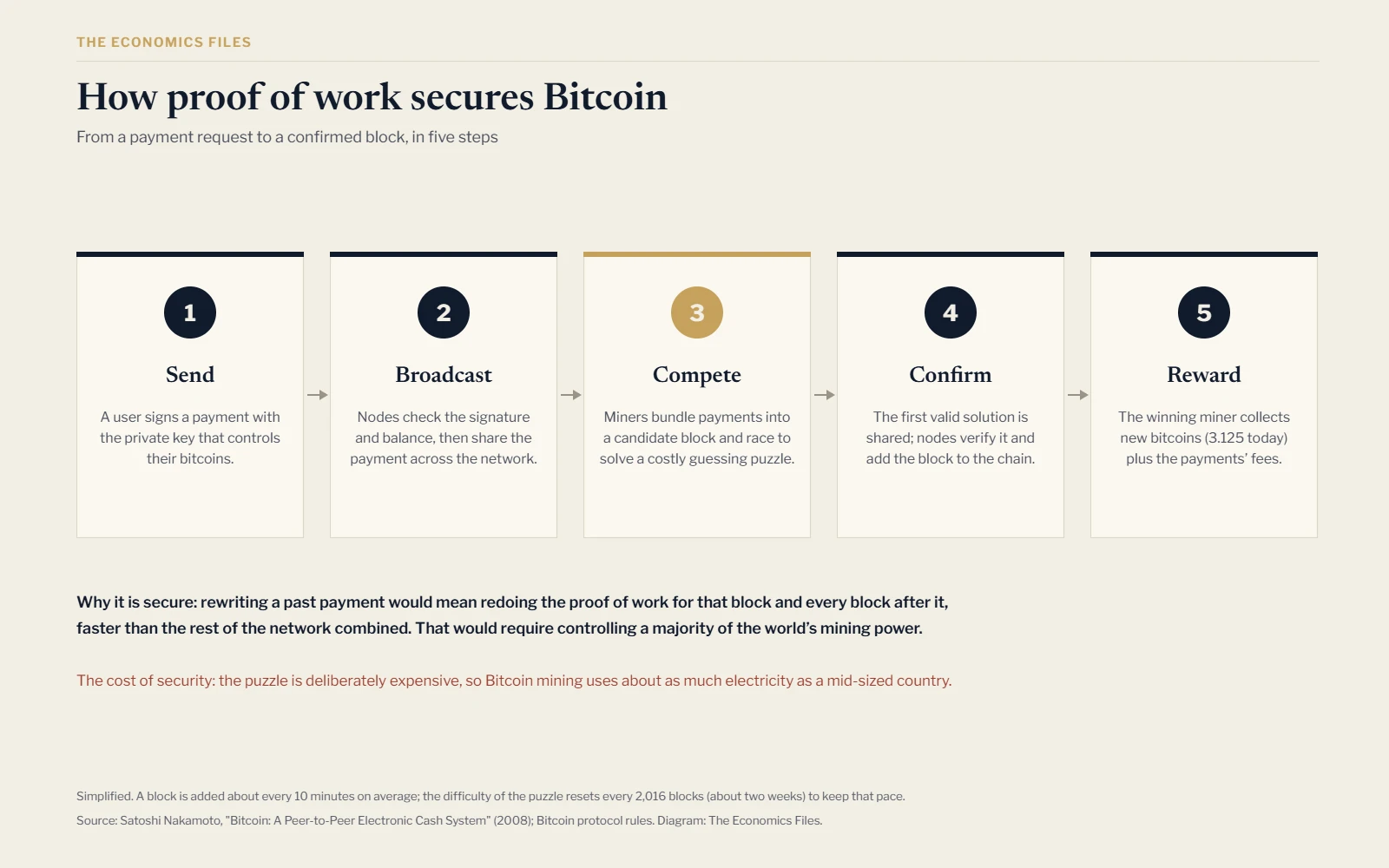
The first miner to find a valid answer broadcasts the block. Other nodes check it in a fraction of a second and add it to their copy of the chain. Every 2,016 blocks, about two weeks, the network adjusts the difficulty of the puzzle so that blocks keep arriving roughly every 10 minutes, however much computing power joins or leaves.
The security argument is economic. To reverse a payment, an attacker would need to redo the work for that block and every block after it, faster than all other miners combined. That would require controlling a majority of the world’s mining power, at enormous cost, to attack a system whose value depends on not being attacked.
The energy cost
The same design makes Bitcoin energy-intensive. The Cambridge Centre for Alternative Finance estimated annual electricity use at about 138 terawatt-hours in its 2025 industry report, roughly 0.5% of global electricity consumption. Preliminary figures it presented in 2026 put consumption at about 190 terawatt-hours by late 2025, with low-carbon sources making up about 59% of the reported mix. Critics see that as waste; supporters argue miners increasingly use surplus or stranded power. Either way, the energy is the cost of security in this design.
Bitcoin Supply: Fixed by Code
Bitcoin supply is set entirely by its issuance schedule. When the network launched, each new block created 50 bitcoins. Every 210,000 blocks, the reward is cut in half. Add up the series and the total approaches 21 million coins, a limit reached in practice around 2140.
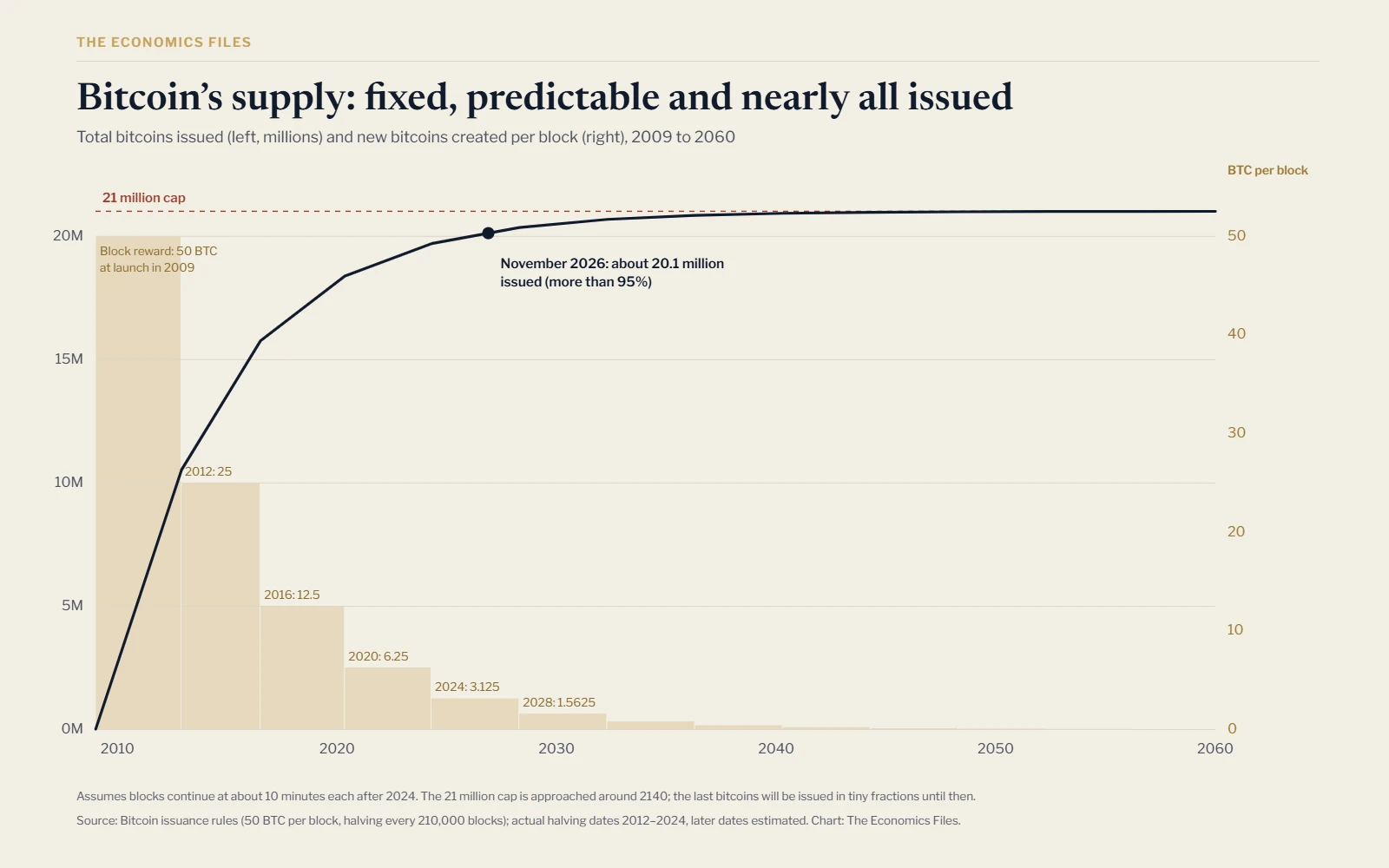
Because the reward shrinks so quickly, most coins were issued early. By November 2026, about 20.1 million bitcoins existed, more than 95% of the cap. The real supply in use is smaller than the official figure: estimates of coins lost through forgotten keys or discarded wallets range from about 2 million to 4 million.
This is the opposite of how modern money works. Most money today is created by commercial banks when they lend, and central banks adjust the supply to keep inflation low and stable. Our explainer on how banks create money shows that process, and our guide to what a central bank does explains why a flexible supply exists. Bitcoin removes that flexibility on purpose.
The Bitcoin Halving and Why It Matters
Each Bitcoin halving cuts the reward miners receive for every block. The fourth took place in April 2024, lowering the reward from 6.25 to 3.125 bitcoins. The next is expected around April 2028, at block 1,050,000, when it will fall to 1.5625.
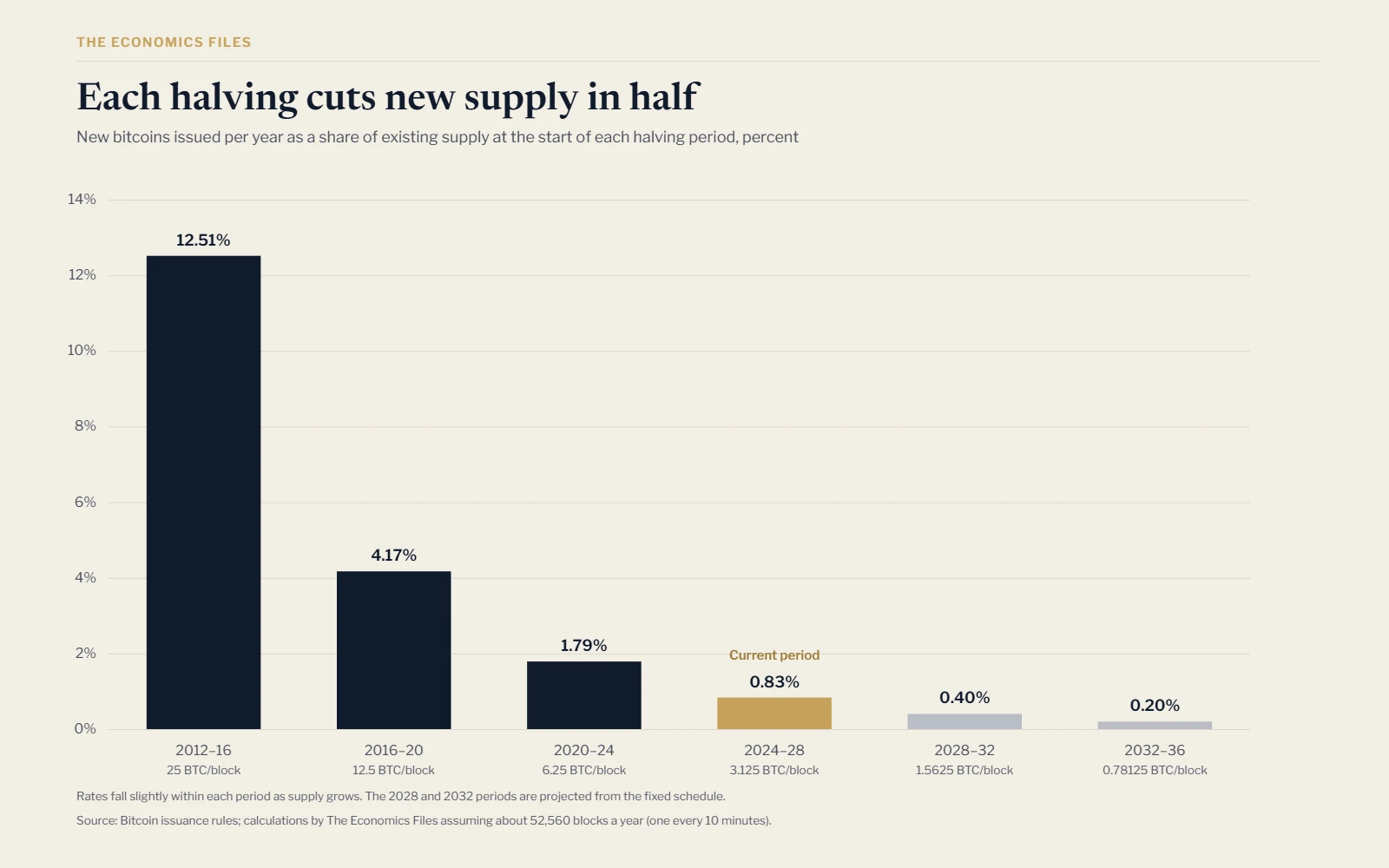
Halvings matter in two ways. First, they reduce how fast new coins enter the market. In the current period, new issuance adds a little over 0.8% a year to the existing supply. After 2028 it will be around 0.4%. Supporters argue this growing scarcity supports Bitcoin’s value over time, though prices have often moved for many other reasons, and past patterns around halvings are no guarantee of future ones.
Second, halvings cut miners’ revenue unless the price of bitcoin or transaction fees rise to compensate. Over the long run, as the new-coin reward approaches zero, miners will have to be paid almost entirely through fees. Whether fees will be high enough to fund the same level of security is one of the most debated questions about Bitcoin’s long-term economics.
Is Bitcoin Money?
Economists usually judge money by three functions: a medium of exchange, a unit of account and a store of value. Bitcoin scores unevenly.
- Medium of exchange: Bitcoin can move value across borders without a bank, but the main network handles only a handful of transactions per second and fees rise when it is busy. Faster layers built on top, such as the Lightning Network, aim to fix this, but everyday use remains limited.
- Unit of account: very few prices are set in bitcoin, largely because its value swings too much for businesses to plan around.
- Store of value: this is the role most supporters now emphasize, often calling Bitcoin “digital gold.” Its fixed supply makes that case, but its price volatility cuts against it.
The volatility is easy to see. Bitcoin was trading around $75,700 in early November 2026, about 40% below its record, and fell below $65,000 by mid-month as US spot bitcoin funds recorded more than $1 billion of outflows in a single week. Price moves of that size are rare for major currencies.
The gold standard comparison
A fixed supply has a historical precedent. Under the gold standard, money supply was tied to a metal that could not be created at will. That brought price stability over long periods, but it also stopped central banks from responding to crises, a rigidity that deepened the slump in the early 1930s. Our article on what caused the Great Depression explains how. Critics, including economists at the Bank for International Settlements, argue that a currency with a fixed supply cannot expand to meet demand in a crisis, and that this makes it unsuitable as a country’s main money.
Why People Use Bitcoin, and the Risks
Demand for Bitcoin comes from several groups with different motives. Some people use it to send money across borders without a bank. In countries with high inflation, capital controls or weak banks, some savers hold it as an alternative to a local currency they do not trust. Others value the fact that no government can freeze or reverse a payment on the network itself. Much of the trading, though, is speculation on the price.
Anyone asking how does Bitcoin work as an investment should weigh the risks as carefully as the design. The price can fall by half or more within months, as it has several times. Coins held on exchanges can be lost to hacks or company failures, and coins held directly can be lost for good if the owner loses the private key. Mining is concentrated in a small number of large pools, which raises questions about how decentralized the network is in practice. Rules and taxes on crypto assets differ widely between countries and continue to change. None of this is investment advice; it is a description of how the system behaves.
Bitcoin in the Financial System
Bitcoin has moved closer to mainstream finance. US regulators approved spot bitcoin exchange-traded funds in January 2024, giving ordinary investors access through brokerage accounts. In March 2025, President Donald Trump signed an executive order creating a Strategic Bitcoin Reserve, funded with bitcoin the government had forfeited in criminal and civil cases, and said the United States would not sell coins placed in it. At the time the government held about 198,000 bitcoins. El Salvador made bitcoin legal tender in 2021 and later scaled back that policy under an agreement with the International Monetary Fund.
These steps have made Bitcoin more connected to the wider economy. Its price now reacts to inflation data, interest rate expectations and fund flows much like other risky assets, rather than behaving as a separate system.
Frequently Asked Questions
Who controls Bitcoin?
No single person or company. Rules are enforced by the software that thousands of independent nodes run. Changing the rules requires broad agreement among users, miners and developers, which is why core features like the 21 million cap have never changed.
How many bitcoins are left to mine?
About 900,000. Roughly 20.1 million of the 21 million bitcoins had been issued by November 2026. The remaining coins will be released more and more slowly, with the last fractions expected around 2140.
What happens when all bitcoins are mined?
Miners will no longer receive new coins and will be paid only through transaction fees. Whether fees will be large enough to keep the network as secure as it is today is an open question.
Why does Bitcoin use so much energy?
Bitcoin’s design deliberately makes adding blocks expensive, so that rewriting the ledger would be prohibitively costly. Miners spend electricity running specialized computers to compete for the right to add each block, and that spending is what secures the network.
When is the next Bitcoin halving?
The next halving is expected around April 2028, at block 1,050,000, when the reward per block will fall from 3.125 to 1.5625 bitcoins.
Sources and Method
- Satoshi Nakamoto, “Bitcoin: A Peer-to-Peer Electronic Cash System”, 2008.
- The Block, “Bitcoin’s mined supply hits 20 million milestone”, March 9, 2026.
- Cambridge Centre for Alternative Finance, Cambridge Digital Mining Industry Report, April 2025; preliminary 2026 figures as reported by crypto.news.
- The White House, “Fact Sheet: President Donald J. Trump Establishes the Strategic Bitcoin Reserve and U.S. Digital Asset Stockpile”, March 2025; and The Block on US government holdings.
- Bank for International Settlements, “Cryptocurrencies: looking beyond the hype,” Annual Economic Report 2018, chapter V.
- Market data: CoinGecko prices and Farside Investors ETF flows as reported by CryptoTicker, November 2026; CryptoTicker, November 7, 2026.
- Lost-coin estimates as summarized by Coinpaprika.
Method: the supply schedule is calculated directly from Bitcoin’s issuance rules (an initial reward of 50 BTC per block, halving every 210,000 blocks), which give a maximum of 20,999,999.9769 BTC. Halving dates for 2012 to 2024 are actual; later dates assume one block every 10 minutes. Annual issuance rates divide one year of block rewards (about 52,560 blocks) by the supply at the start of each halving period. Supply in November 2026 is estimated from the schedule. Market prices are given for context only and are not forecasts or advice. Charts are by The Economics Files.