In the three months to September 2026, Amazon brought in $42.4 billion of cash from running its businesses and spent $77.3 billion on property and equipment, most of it on data centers, servers and chips. Alphabet spent $51.4 billion against $42.3 billion of operating cash. Meta spent $34.9 billion against $32.8 billion. Three of the four largest cloud and AI spenders are now investing more than their businesses generate.
That gap is the whole story of AI data center investment in 2026. The question is no longer whether Big Tech will build, but who supplies the money when the builders’ own cash runs short, and who carries the loss if the payoff disappoints.
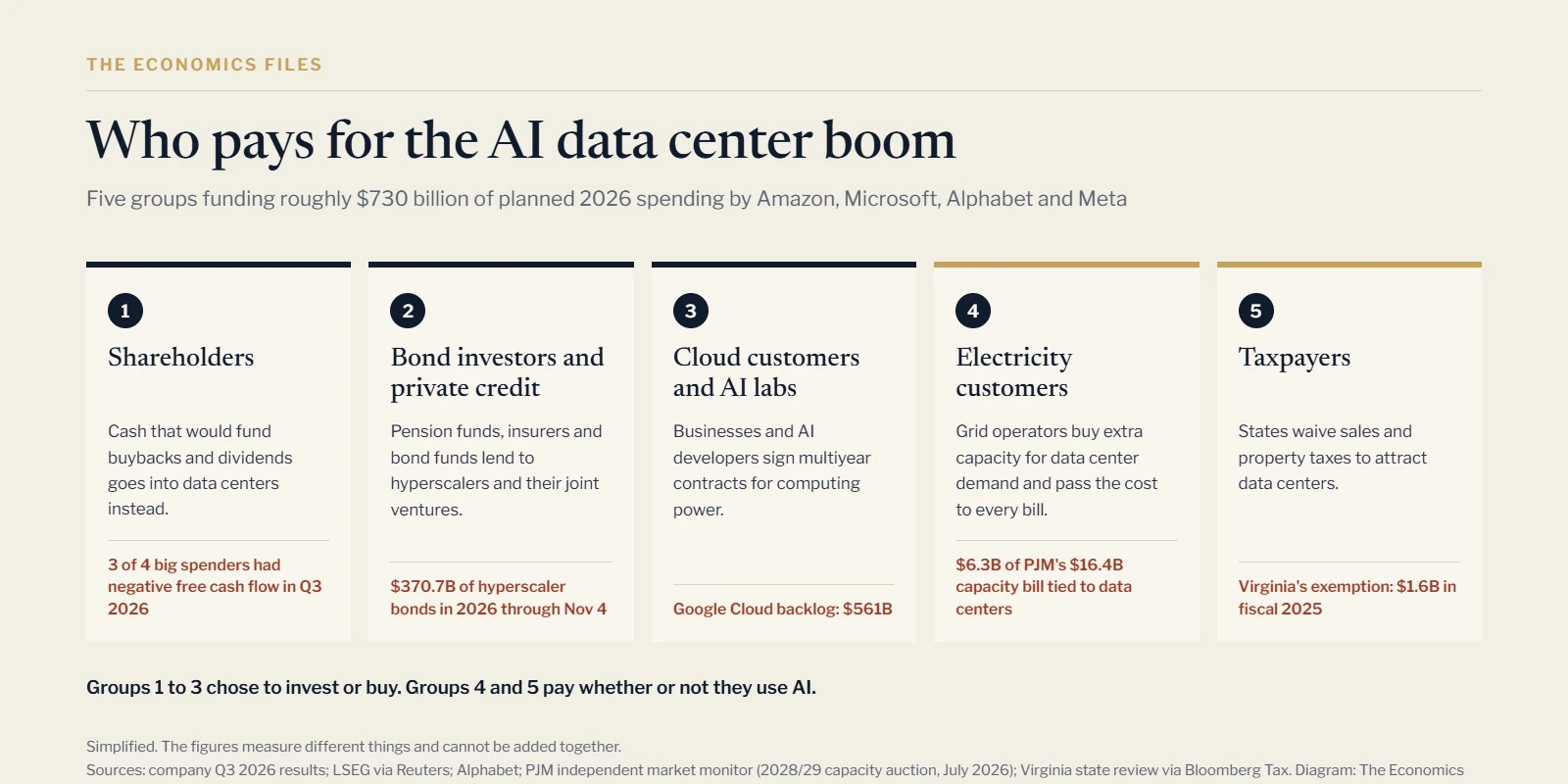
The short answer: most of the bill still falls on the companies’ shareholders, through cash that would otherwise go to buybacks and dividends. A fast-growing share now comes from bond investors and private credit funds, which means pension funds, insurers and bond funds. Cloud customers and AI labs pay through rising contracts. And a smaller but visible share lands on electricity customers and state taxpayers, through higher grid costs and sales tax exemptions.
AI Capex: How Big the Bill Has Become
Amazon, Microsoft, Alphabet and Meta spent about $251 billion on capital expenditure in 2024 and about $416 billion in 2025, according to company filings compiled by the research site Platformonomics. Their guidance for 2026 adds up to roughly $730 billion: about $220 billion at Amazon, $195 billion to $205 billion at Alphabet, about $170 billion at Microsoft for the calendar year and $135 billion to $145 billion at Meta.
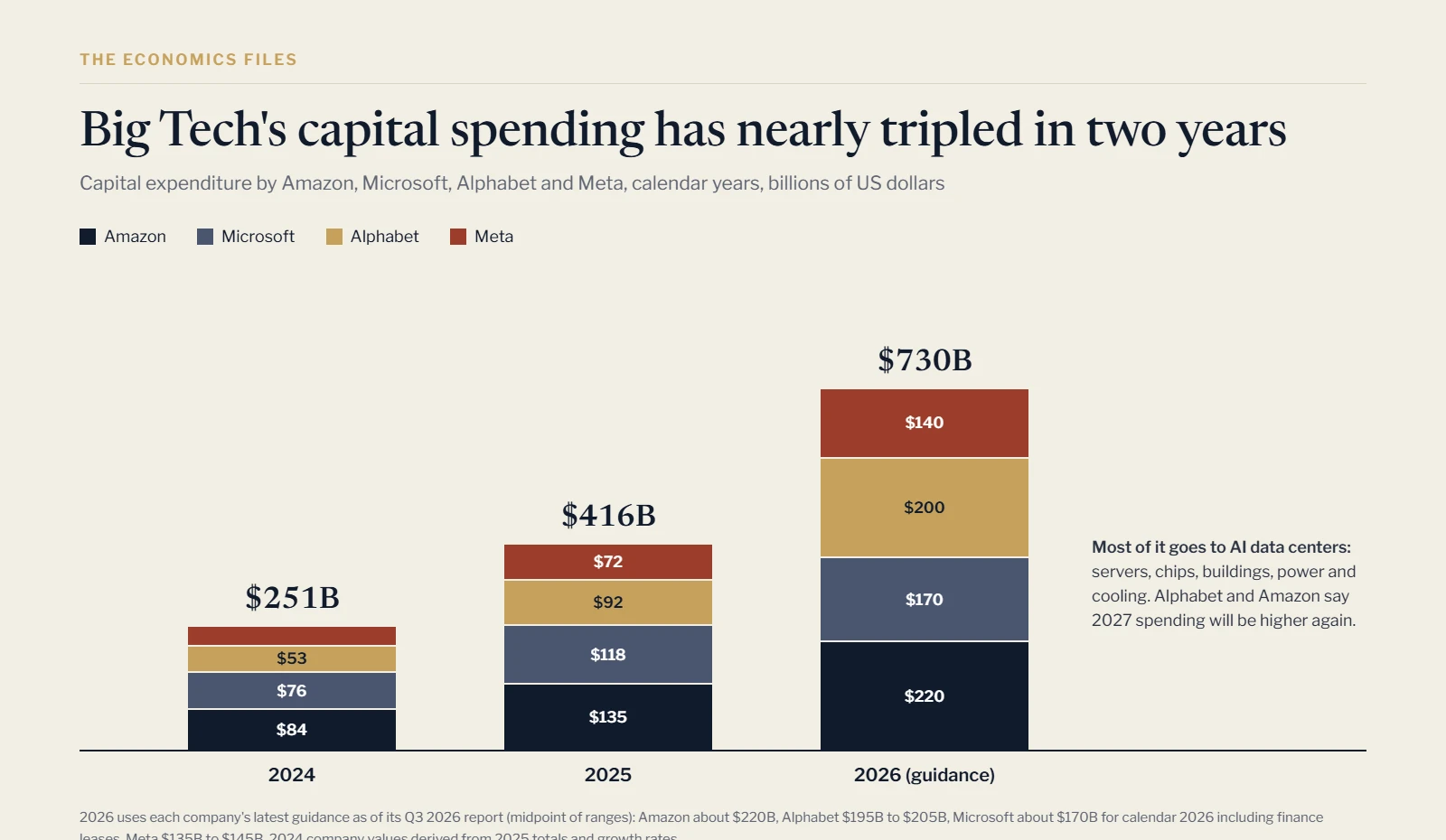
The two largest spenders have already said the number will rise. Alphabet’s finance chief told investors in October that capital spending would increase “significantly” in 2027, and Amazon chief executive Andy Jassy said the company expects to spend meaningfully more next year as well. Meta said it expects to keep investing aggressively.
What the money buys
Most AI capex is not concrete. Microsoft said in July that about two-thirds of its quarterly spending went to short-lived assets, mainly CPUs and GPUs. That matters for the economics. A data center building can last 20 years or more, but servers are typically written off over five to six years, and chipmakers release faster generations more often than that. The companies must earn back the cost of the chips quickly and then buy them again.
The spending also shows up in national accounts. In the third quarter of 2026, US business investment in information processing equipment rose at a 37.4% annual rate and software investment at 9.6%, according to the Bureau of Economic Analysis’s advance estimate, helping push GDP growth to 3.4%. Part of that boost leaks abroad, because many servers and chips are imported, and imports are subtracted when GDP is calculated.
Hyperscalers and Their Cash Flow
The companies at the center of this are called hyperscalers: firms that run cloud computing networks large enough to rent processing power to millions of customers. Amazon Web Services, Microsoft Azure and Google Cloud are the three biggest. Meta runs data centers of a similar size but uses them for its own apps and AI models. Oracle has joined the group more recently.
For a decade these were the most reliable cash machines in corporate history. That has changed.
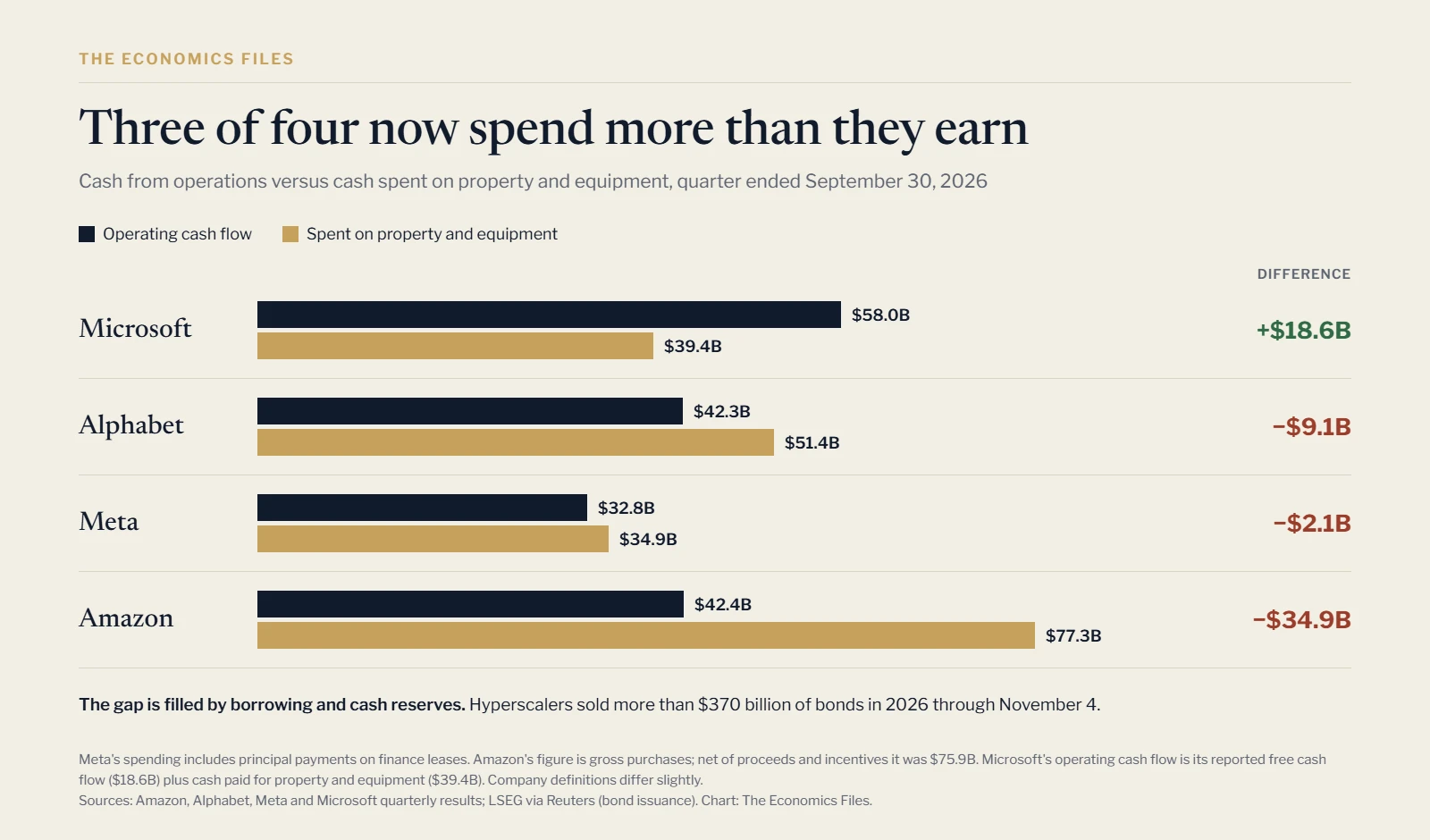
Free cash flow, the cash left after capital spending, turned negative in the third quarter at Amazon, Alphabet and Meta. Over the 12 months to September, Amazon’s free cash flow was an outflow of $42.4 billion, compared with an inflow of $14.8 billion a year earlier. Microsoft is the exception so far: it generated $58.0 billion of operating cash and kept $18.6 billion after capital spending, and its finance chief says it will stay free-cash-flow positive this fiscal year.
When free cash flow shrinks, shareholders pay first. Cash that could fund buybacks or dividends goes into data centers instead, and the bet only pays off if those data centers later produce enough profit. Investors have been reacting to each earnings report accordingly: Amazon shares fell about 5% to 7% in after-hours trading on October 29 after it reported its third-quarter spending.
AI Infrastructure Financing: Bonds, Private Credit and Off-Balance-Sheet Deals
The rest of the money is borrowed, and the scale of AI infrastructure financing has no precedent. US companies sold a record $1.88 trillion of investment-grade bonds in 2026 through November 4, according to LSEG data reported by Reuters, beating the previous record set in 2020. Amazon, Alphabet, Meta, Microsoft and Oracle accounted for more than $370.7 billion of that, about a fifth of all issuance. Goldman Sachs expects bonds to fund about 35% of hyperscaler capital spending in 2027, roughly the same share as this year.
The balance sheets show it. Meta’s long-term debt rose to $80.9 billion at the end of September from $58.7 billion at the end of 2025. Alphabet ended the quarter with $125.1 billion of long-term debt, though it also held $265.1 billion in cash and securities.
Borrowing also happens off the companies’ books. The template is Hyperion, Meta’s data center campus in Louisiana. In October 2025, Meta formed a joint venture with funds managed by Blue Owl Capital to pay for its roughly $27 billion development cost. Blue Owl’s funds own 80% and Meta 20%, and most of the money came from bonds sold to investors such as Pimco and BlackRock. Meta leases the campus on an initial four-year term and has guaranteed payments to the venture for 16 years if it walks away, so much of the risk still traces back to Meta even though the debt does not sit on its balance sheet.
Why borrow when you have cash?
Alphabet alone held more than $265 billion in cash and securities at the end of September, so the borrowing is a choice as much as a necessity. Debt is cheap for companies with top credit ratings, and interest payments are tax-deductible, which makes a bond often less costly than spending cash or issuing new shares. Borrowing also keeps reserves available for acquisitions, legal settlements and downturns. Meta, for example, recorded a $9.9 billion legal charge in the third quarter alone.
The trade-off is that the cost of the boom becomes harder to see. A joint venture’s debt or a long-term lease does not appear in the headline capex figure, and analysts have to piece together the full commitment from footnotes. Bond investors have started to charge for the uncertainty: in late 2025, Bank of America noted that spreads on hyperscaler bonds had widened by more than the broader investment-grade index.
Further down the credit ladder, data center developers without hyperscaler credit ratings are paying more. High-yield bonds for US AI infrastructure projects reached $26.6 billion in the first four months of 2026, more than double the total for all of 2025, according to PitchBook data cited by the law firm White & Case.
The buyers of this debt are the pension funds, insurers and bond funds that hold most American savings. When a credit market leans this heavily on one theme, ordinary portfolios carry concentrated exposure, and a sudden repricing of AI risk would show up as falling bond prices, the mechanism explained in our article on why bond prices fall when interest rates rise.
Cloud Customers and AI Labs
In the long run, the only payer that justifies the spending is the customer. Here the numbers are large too. Google Cloud’s revenue doubled from a year earlier to $30.7 billion in the third quarter, and its backlog of signed contracts reached $561 billion. Microsoft reported a commercial cloud backlog of $678 billion when it announced results for the quarter ended June 30. Amazon Web Services grew 39% to $46 billion, its fastest pace in nearly five years.
Many of the biggest customers are AI developers that raise money from investors to buy computing power. Some of those investors are the hyperscalers themselves: Amazon, Microsoft and Alphabet own stakes in AI labs that also rent their cloud capacity. Critics see a loop in which cloud providers fund the customers that fill their data centers. Supporters point out that the labs are now raising large sums from outside investors too. Anthropic’s $81.3 billion public offering in November, covered in our explainer on how the stock market works, is the largest example so far.
Businesses that buy AI services, and eventually consumers who use them through subscriptions and advertising, sit at the end of this chain. Whether their spending grows fast enough to cover hundreds of billions in annual depreciation is the open question of the boom. The evidence on whether AI raises workers’ output enough to justify that spending is still early, as we describe in how AI is affecting jobs.
Electricity Customers and Taxpayers
Some costs land on people who never signed a cloud contract. Data centers need enormous amounts of electricity, and the US accounted for 45% of global data center power use in 2024, according to the International Energy Agency. The IEA expects data centers to account for nearly half of US electricity demand growth through 2030.
The clearest evidence comes from PJM, the grid operator serving 13 states and Washington, D.C. Its July 2026 capacity auction set $16.4 billion in payments to power plants for the year starting June 2028. PJM’s independent market monitor attributed about $6.3 billion of that to data center demand, and those charges flow through to every household and business bill in the region. The monitor also estimated that data center load raised PJM’s average wholesale power cost in the third quarter of 2026 by 9.8%.
Regulators are starting to push back. Some utilities now require large new customers to sign long-term contracts or pay upfront for grid connections, so that households are not left with the bill if a data center leaves early. PJM’s market monitor has argued that data centers should bring their own generation or face separate capacity auctions.
Taxpayers contribute through incentives. Nearly three-quarters of states offer tax breaks for data centers. Virginia’s sales tax exemption cost the state $1.6 billion in fiscal 2025, about 16 times what officials projected a few years earlier, according to the state’s own review reported by Bloomberg Tax. Several states, including Ohio, are now debating whether to scale these breaks back or make data centers pay more of their grid costs directly.
What If the Returns Don’t Arrive?
The optimistic case for AI data center investment rests on demand. All three cloud providers say they are short of capacity, cloud revenue is growing faster than at any time in years, and Google Cloud’s operating margin rose to 36.2% in the third quarter from 23.7% a year earlier. If that continues, today’s borrowing looks like a sensible way to fund profitable growth.
The skeptical case rests on timing and depreciation. Chips lose value fast, spending is now outrunning operating cash at three of the four biggest buyers, and a growing share of the financing sits with lenders who have less cushion than Big Tech itself. The comparison skeptics reach for is the late-1990s telecom boom, when companies borrowed heavily to lay fiber that took years to fill and many lenders lost money even though the internet itself succeeded.
If returns disappoint, the losses would arrive in a predictable order. Shareholders of the hyperscalers would take the first hit through lower valuations. Lenders to smaller developers and specialist AI cloud firms would come next. Electricity customers could be left paying for grid upgrades built for demand that never fully arrives. And because AI investment now accounts for a large share of US growth, a sharp pullback would weigh on GDP itself, a risk we cover in our guide to what a recession is.
Three dates will show which case is gaining ground: BEA’s second estimate of third-quarter GDP on November 25, PJM’s next capacity auction in December, and the fourth-quarter earnings reports in late January and early February 2027, when the four companies are expected to put numbers on their 2027 budgets.
Frequently Asked Questions
What is a hyperscaler?
A hyperscaler is a company that runs cloud computing networks large enough to rent storage and processing power to millions of customers, and can add capacity quickly. Amazon Web Services, Microsoft Azure and Google Cloud are the largest. Meta and Oracle are often included because they build data centers on a similar scale.
How much are tech companies spending on AI data centers in 2026?
Amazon, Microsoft, Alphabet and Meta have guided to roughly $730 billion of capital spending in 2026, most of it for AI data centers, servers and chips. That compares with about $416 billion in 2025 and $251 billion in 2024. Alphabet and Amazon have said 2027 spending will be higher still.
Are AI data centers raising electricity bills?
In some regions, yes. In the PJM grid, which serves 13 states and Washington, D.C., the independent market monitor attributed about $6.3 billion of a $16.4 billion capacity bill to data center demand. Those costs are spread across household and business bills. The effect varies widely by state and utility.
Why are profitable tech companies borrowing to build data centers?
Because their spending now exceeds the cash their businesses generate. Their high credit ratings let them borrow cheaply, and debt lets them keep cash reserves for flexibility. Some also use joint ventures that keep the debt off their own balance sheets, such as Meta’s Hyperion project with Blue Owl.
Is the AI data center boom a bubble?
Economists disagree. Supporters point to fast-growing cloud revenue, large contract backlogs and capacity shortages. Skeptics point to negative free cash flow, rapid depreciation of chips and rising debt, and compare it with the telecom boom of the late 1990s. The fourth-quarter 2026 earnings reports and 2027 budgets will be the next test.
Sources
- Amazon, “Amazon.com Announces Third Quarter Results,” October 29, 2026
- Meta, “Meta Reports Third Quarter 2026 Results,” October 21, 2026
- Alphabet Q3 2026 earnings release and call, summary via Quartr
- Fortune, “Microsoft’s cloud growth accelerates, and so too does the spending,” October 28, 2026
- WinBuzzer, “Microsoft’s Free Cash Flow Beats Forecasts Despite Massive AI Spending,” October 29, 2026
- Nasdaq, “Microsoft Q4 Earnings Call Highlights” (fiscal 2026)
- Platformonomics, “Follow the CAPEX: 2025 Retrospective”
- Reuters, “Big Tech drives US corporate bond sales to annual record high, data shows,” November 6, 2026
- Data Center Dynamics, “Meta forms $27 billion joint venture with Blue Owl to fund AI data center campus in Louisiana”
- White & Case, “High yield bond markets ride the data center boom”
- Investing.com, “Hyperscaler bond spreads widen as tech giants issue $121bn in debt” (Bank of America report)
- Bureau of Economic Analysis, “GDP (Advance Estimate), 3rd Quarter 2026,” October 29, 2026
- Associated Press via ITV News, “US economy grows at brisk 3.4% pace in third quarter,” October 29, 2026
- International Energy Agency, Energy and AI, executive summary
- Industrial Info Resources, “Data Centers Create About US$6.3 Billion in Electric Costs for PJM Customers,” July 17, 2026
- S&P Global Commodity Insights, PJM data center cost analysis, November 12, 2026
- Bloomberg Tax, “Data Centers Won Billions in Tax Breaks. Some States Are Balking”
- Fortune, data center tax incentives, September 2, 2026
- Business Insider via Let’s Data Science, “Amazon CEO Says 2027 Spending Will Be Meaningfully Higher”
Method: Company capex figures for 2024 and 2025 are calendar-year totals compiled by Platformonomics from company filings; 2024 values for individual companies are derived from its reported 2025 totals and growth rates. 2026 figures are each company’s latest guidance (midpoints where a range is given) as of its third-quarter 2026 report; Microsoft’s is for calendar 2026 and includes finance leases. Quarterly cash flow figures are from each company’s results for the quarter ended September 30, 2026, using each company’s own definitions, which differ slightly. Data as of November 23, 2026.