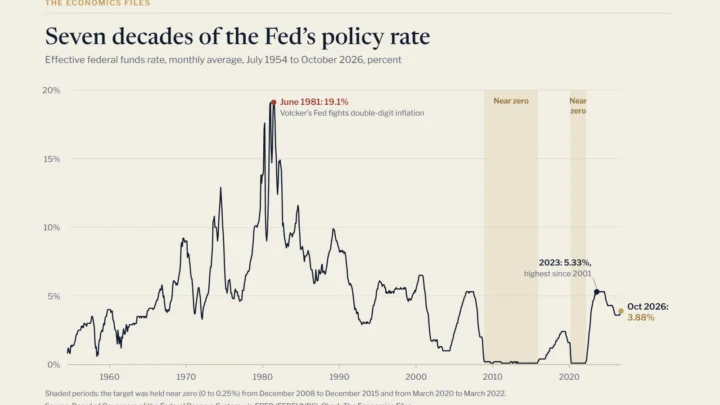
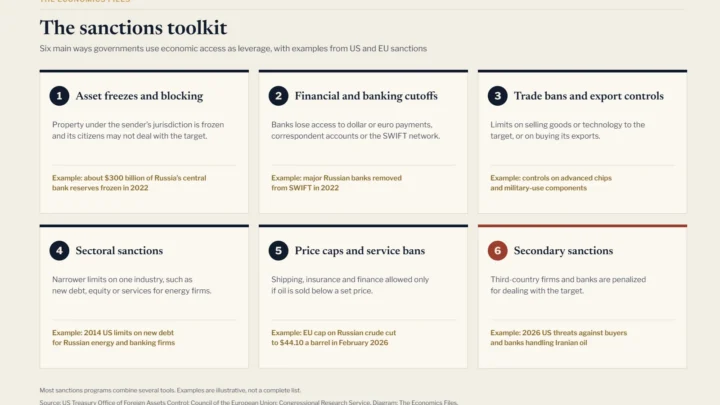
On September 16, 2026, the Federal Reserve raised its benchmark interest rate for the first time since 2023, lifting the target range for the federal funds rate to 3.75% to 4.00%. The European Central Bank had already moved twice, in June and September, taking its deposit rate to 2.50%. On November 5, the Bank of England raised Bank Rate to 4%. The ECB and the Bank of England both pointed to energy prices driven up by conflict in the Middle East.
Those decisions change what millions of people pay on mortgages and car loans and what they earn on savings. They are also only the most visible part of a central bank’s work.
Short answer: A central bank manages a country’s money and banking system. It sets short-term interest rates to keep inflation low and stable, issues banknotes, holds accounts for commercial banks and the government, lends to banks when their funding dries up, and supervises the financial system to head off crises.
This explainer takes the question “What does a central bank do?” one job at a time, using the Federal Reserve, the ECB and the Bank of England as examples and their own data for the figures.
What Is a Central Bank?
A central bank is a public institution at the top of a country’s monetary system. Commercial banks hold accounts with it, the government banks with it, and the money it creates (banknotes and bank reserves) is the base on which all other money rests.
The idea is old. Sweden’s Riksbank, founded in 1668, is generally counted as the oldest central bank still operating, and the Bank of England followed in 1694. The United States created the Federal Reserve in 1913, after the Panic of 1907 showed how much the country needed an institution that could stop bank runs. The European Central Bank was set up in 1998 and took charge of the euro when it launched in 1999.
Today, 63 central banks and monetary authorities are members of the Bank for International Settlements in Basel, often described as the bank for central banks. Its members represent countries that produce about 95% of world GDP.
Most central banks in advanced economies are operationally independent. Elected governments or legislatures set their goals, such as an inflation target, and appoint their leaders. The central bank then decides how to reach those goals without seeking approval for each rate decision.
The Six Core Central Bank Functions
Central bank functions vary from country to country, but most fall into six jobs.
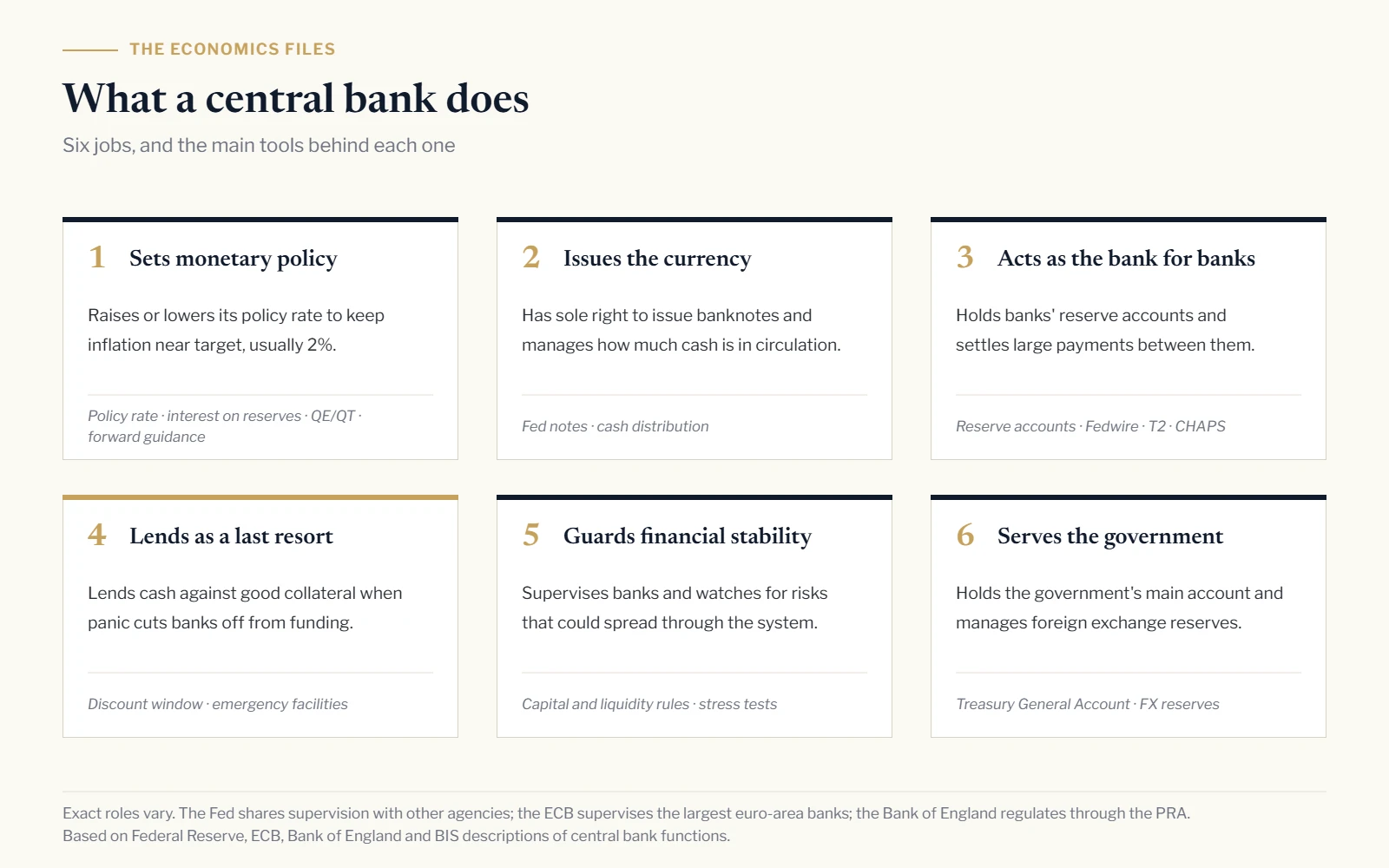
Setting interest rates gets the headlines. Lending in a crisis and keeping payments flowing are what stop a bad week in markets from becoming a depression.
How Monetary Policy Works
The main job of a modern central bank is to keep inflation low and stable. Congress gave the Fed a dual mandate of maximum employment and stable prices, and the Fed defines price stability as 2% inflation over the longer run, measured by the personal consumption expenditures (PCE) price index. The ECB aims for 2% inflation over the medium term. The Bank of England’s 2% target is set by the UK government.
A central bank cannot set prices directly. It works through interest rates, which change how much households and businesses borrow, spend and invest. Higher rates cool demand and, over a year or two, bring inflation down. Lower rates do the opposite. (See what causes inflation for why demand matters so much.)
The Policy Rate
In the US, rate decisions are made by the Federal Open Market Committee (FOMC), which holds eight scheduled meetings a year. It has 12 voting members: the seven governors of the Federal Reserve Board, the president of the New York Fed, and four of the other 11 regional Reserve Bank presidents, who take turns.
The FOMC does not set one interest rate. It sets a target range for the federal funds rate, the rate banks charge each other for overnight loans of reserves, and then uses rates it controls to keep the market rate inside that range. After the October 28, 2026 meeting, the settings were:
- Interest on reserve balances: 3.90%. Banks will not lend reserves to each other for much less than they can earn by leaving them at the Fed.
- Overnight reverse repo rate: 3.75%. This gives money market funds and other non-banks a floor at the bottom of the range.
- Standing repo rate and discount window primary credit rate: 4.00%. Banks can borrow cash at this rate against collateral, which acts as a ceiling.
In October 2026, the effective federal funds rate averaged 3.88%, inside the 3.75% to 4.00% range. The ECB and the Bank of England work in a similar way. The ECB’s key rate is its deposit facility rate, the rate banks earn on overnight deposits at the central bank. The Bank of England pays Bank Rate on the reserves that commercial banks hold with it.
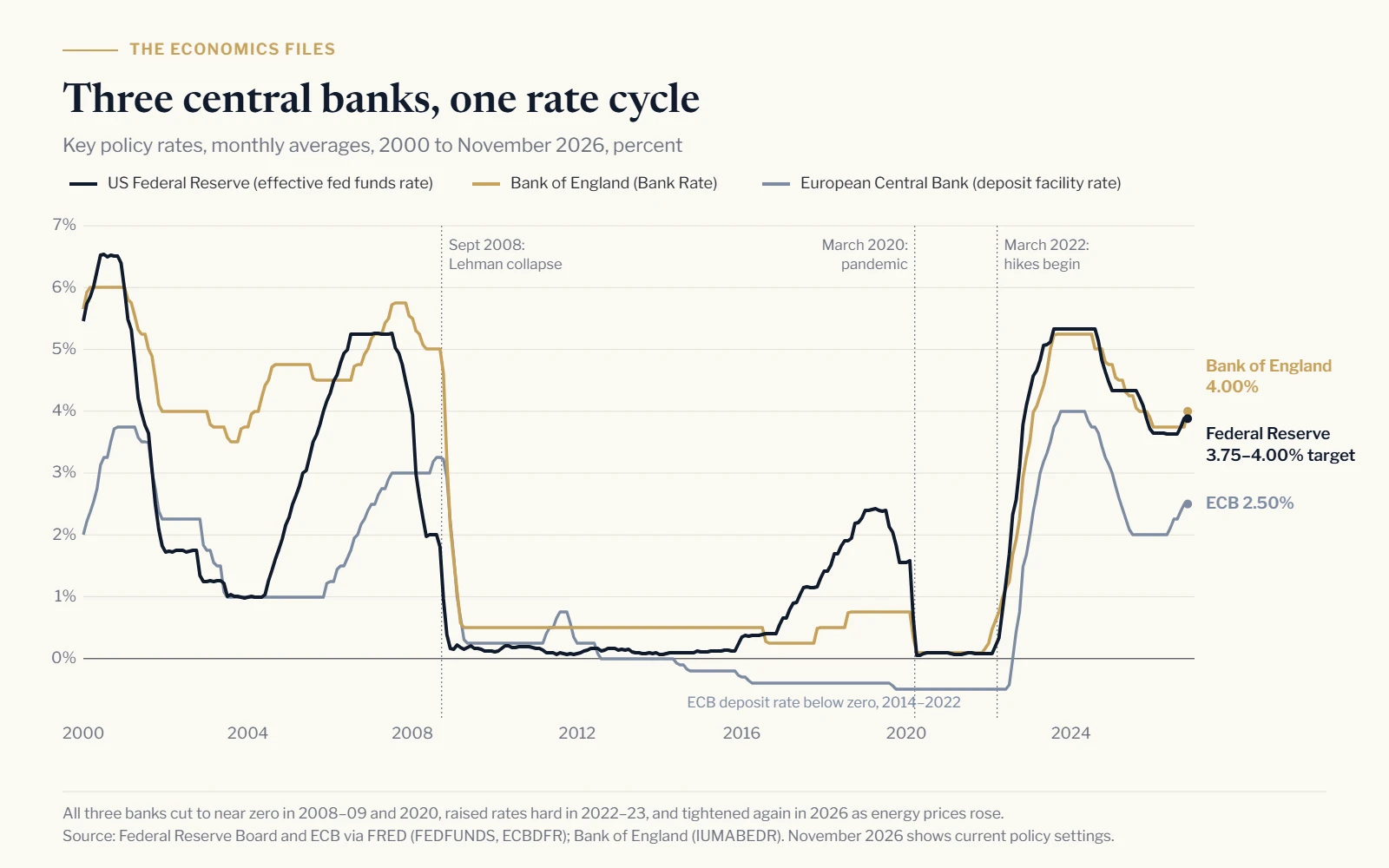
The three banks have moved closely together. All of them cut rates to near zero after the 2008 crisis and again in March 2020. The ECB went further, holding its deposit rate below zero from mid-2014 until 2022. Then inflation surged, and the effective federal funds rate went from 0.08% in February 2022 to 5.33% by August 2023, the fastest rise since the early 1980s.
Quantitative Easing and Tightening
When the policy rate is already near zero, a central bank can still push down longer-term interest rates by buying government bonds and other securities in large amounts. This is quantitative easing (QE). The central bank pays for the bonds by creating new reserves. Because bond prices and yields move in opposite directions, heavy buying pushes yields down. Letting the bonds mature without replacing them shrinks the balance sheet again, which is called quantitative tightening (QT).
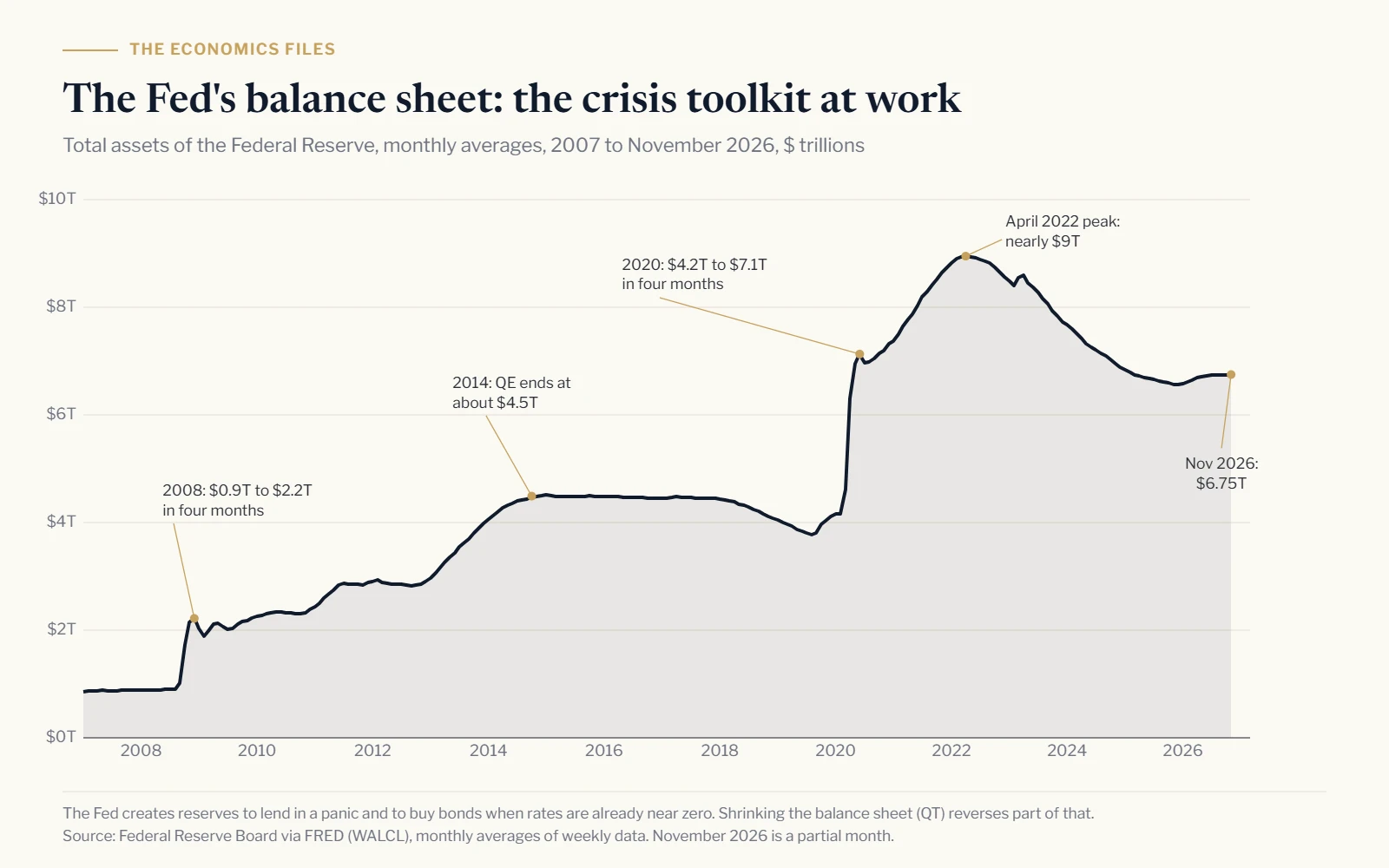
The Fed’s total assets were about $0.9 trillion in the summer of 2008. Crisis lending and three rounds of QE took them to about $4.5 trillion by late 2014. In 2020 they jumped from about $4.2 trillion to $7.1 trillion in four months, and they peaked at nearly $9 trillion in April 2022. QT brought them down to about $6.6 trillion by late 2025. Since then the Fed has been buying Treasury bills to keep bank reserves at what it calls an ample level, and total assets were about $6.75 trillion in November 2026.
Forward Guidance
Central banks also steer rates by talking. When a central bank signals how long it expects to keep rates high or low, investors build that path into longer-term borrowing costs today. The Fed publishes a statement after every FOMC meeting, the chair holds a press conference, and four times a year officials publish their projections for the federal funds rate.
Together, the policy rate, balance sheet operations and forward guidance make up monetary policy.
The Central Bank as Lender of Last Resort
Banks fund long-term loans with deposits that customers can withdraw at any moment. That works until too many customers want their money at once. Even a healthy bank cannot sell its loans fast enough to pay everyone. (Our guide to how banks create money explains why deposits and loans are so closely linked.)
A central bank can always create money in its own currency, which makes it the natural lender of last resort. The classic rule comes from Walter Bagehot’s 1873 book Lombard Street: in a panic, lend freely to solvent banks, against good collateral, at a high rate. The high rate discourages everyday use; the collateral protects the central bank.
The Discount Window and Emergency Programs
The Fed’s standing tool is the discount window, where banks can borrow against collateral at the primary credit rate, 4.00% as of November 2026. In a wider crisis the Fed can also set up emergency programs. Since the Dodd-Frank Act of 2010, those programs must be open to a broad group of firms rather than a single company, and they need the Treasury Secretary’s approval.
What Happened in March 2023
The failure of Silicon Valley Bank showed the system under strain. Customers tried to withdraw $42 billion from SVB on March 9, 2023, and regulators closed it the next day. Signature Bank was closed on March 12. That Sunday evening, the Fed announced the Bank Term Funding Program, which lent to banks against government bonds valued at face value rather than their lower market price.
Banks also turned to the discount window. Borrowing there rose from $4.58 billion to a record $152.85 billion in the week ended March 15, well above the previous peak of about $111 billion in 2008. First Republic Bank still failed in May, but the run did not turn into a system-wide panic.
The trade-off is moral hazard. If banks expect to be rescued, they may take bigger risks. That is why central banks pair emergency lending with supervision and capital rules.
Banker to Banks and to the Government
Commercial banks hold reserve accounts at the central bank, and payments between banks settle by moving reserves from one account to another. In the US, large payments run through the Fed’s Fedwire service; in the euro area through T2; in the UK through the Bank of England’s RTGS system, which settles CHAPS payments.
The central bank also issues physical cash. In the US, the Bureau of Engraving and Printing prints the notes, but they are Federal Reserve notes, and they enter circulation through the Reserve Banks as commercial banks order them. Cash is a small share of money: about $2.4 trillion of the $23.4 trillion US M2 money supply in September 2026.
Governments bank with their central bank too. The US Treasury keeps its main operating cash in the Treasury General Account at the Fed. Many central banks also manage foreign exchange reserves and help the government sell its debt.
Financial Stability and Bank Supervision
Central banks watch for risks that could spread across the financial system, such as heavy borrowing, inflated asset prices or banks that rely on funding that can vanish overnight. Their powers to act on those risks differ:
- Federal Reserve: supervises bank holding companies and state-chartered banks that are members of the Fed, shares bank oversight with the OCC and the FDIC, and runs annual stress tests on the largest banks.
- European Central Bank: directly supervises the euro area’s largest banks, with 110 significant institutions on its list in August 2026. National supervisors oversee smaller banks under ECB coordination.
- Bank of England: supervises banks and insurers through the Prudential Regulation Authority, while its Financial Policy Committee looks at risks to the system as a whole.
Good supervision is meant to make emergency lending rarer. Capital requirements force banks to absorb more of their own losses, and liquidity rules make them hold assets they can sell quickly when deposits leave.
How the Fed, ECB and Bank of England Compare
| Feature | Federal Reserve | European Central Bank | Bank of England |
|---|---|---|---|
| Founded | 1913 | 1998 | 1694 |
| Main goal | Maximum employment and stable prices | Price stability | Price stability, then support for the government’s economic policy |
| Inflation target | 2% (PCE index) | 2% over the medium term | 2% (CPI), set by the government |
| Rate-setting body | FOMC, 12 voting members | Governing Council | Monetary Policy Committee, 9 members |
| Key rate (November 2026) | Fed funds target 3.75% to 4.00% | Deposit facility rate 2.50% | Bank Rate 4.00% |
| Scheduled rate meetings a year | 8 | 8 | 8 |
Why Central Banks Matter to You
A central bank decision reaches households within days. Banks reprice variable-rate loans and savings accounts. Fixed mortgage rates move with bond yields, which already reflect where investors expect the policy rate to go. The exchange rate shifts as investors compare returns across countries.
That is why the 2026 rate rises matter. On November 5, the Bank of England said energy costs had pushed UK inflation to 3.5% and that it expected inflation to reach about 5% by mid-2027. Raising rates in that situation is a judgment that letting high inflation settle in would cost more later than slower growth costs now.
So, what does a central bank do? It manages the price of money, keeps the payment system running, and stands behind the banking system when confidence breaks. Most of the time the last two jobs go unnoticed, which is a sign they are working.
Key Takeaways
- A central bank sets the policy rate, issues currency, banks for commercial banks and the government, lends in a crisis and supervises the financial system.
- Its main tool is the short-term interest rate. In November 2026 the Fed’s target range was 3.75% to 4.00%, the ECB deposit rate was 2.50% and Bank Rate was 4.00%.
- When rates are near zero, central banks buy bonds. The Fed’s balance sheet grew from about $0.9 trillion in 2008 to nearly $9 trillion in 2022.
- After Silicon Valley Bank failed in March 2023, discount window borrowing hit a record $152.85 billion in a single week.
Frequently Asked Questions
Who owns the Federal Reserve?
The Board of Governors in Washington is a federal government agency. The 12 regional Reserve Banks are set up like private corporations, and commercial banks that join the Federal Reserve System must buy stock in them. That stock cannot be sold or traded and pays a capped dividend, so it carries none of the control or profit rights of ordinary shares. The Fed sends most of its earnings to the US Treasury.
Can a central bank run out of money?
Not in its own currency, because it can create reserves. It can make losses: from late 2022 the Fed paid more interest on reserves than it earned on its bonds and recorded the shortfall as a deferred asset to be repaid from future earnings. The real limit is inflation. Creating money to cover losses or fund a government would undercut the central bank’s main job.
Does the central bank print money?
It creates reserves electronically when it buys assets or lends to banks. Physical banknotes are only a small part of the money supply. Most money held by the public is bank deposits, which commercial banks create when they make loans.
How often does the Fed change interest rates?
The Federal Open Market Committee holds eight scheduled meetings a year and can meet in between when markets are under stress, as it did in March 2020. It does not move rates at every meeting. After the 2008 crisis it kept its target near zero for seven years, from December 2008 to December 2015.
What is the difference between monetary and fiscal policy?
Monetary policy is the central bank’s management of interest rates and the money supply. Fiscal policy is government spending and taxation, which in the US is decided by Congress and the president. The two interact: heavy government borrowing during a period of strong demand can add to inflation, which the central bank may then answer with higher rates.
Sources and Method
- Board of Governors of the Federal Reserve System, FOMC statements of September 16, 2026 and October 28, 2026, and the implementation note of October 28, 2026.
- Federal Reserve, “What economic goals does the Federal Reserve seek to achieve through its monetary policy?” and Federal Open Market Committee.
- Federal Reserve, press release of March 12, 2023, and Congressional Research Service, “Bank Term Funding Program (BTFP) and Other Federal Reserve Support to Banking System in Turmoil”, March 31, 2023.
- European Central Bank, monetary policy decisions of September 10, 2026, and ECB Banking Supervision, list of supervised entities, August 2026.
- Bank of England, “Interest rates and Bank Rate”, decision of November 5, 2026.
- Bank for International Settlements, “BIS member central banks”.
- Walter Bagehot, Lombard Street: A Description of the Money Market, 1873.
- Data via FRED: FEDFUNDS, ECBDFR and WALCL; Bank of England Database, series IUMABEDR.
Method: policy rates are monthly averages of daily rates (Bank Rate uses the Bank of England’s monthly average series). November 2026 values show the policy settings in force on November 21, 2026. Fed total assets are monthly averages of weekly data; November 2026 is a partial month. Discount window figures are as reported in the Fed’s weekly H.4.1 release for the week ended March 15, 2023. Charts are by The Economics Files.