US startups raised $515.8 billion of venture capital in the first nine months of 2026, about 44% more than in any previous full year, according to the PitchBook-NVCA Venture Monitor. Artificial intelligence companies took 82.7% of it. Yet the same report found that the number of new venture funds raised by first-time managers was on pace for its lowest level in a decade, and that investors in older funds were still waiting for cash to come back.
Both facts come from the way the industry is built. So how does venture capital work? In short, a venture capital firm raises a fund from institutions such as pension funds and university endowments, invests that money in young private companies in exchange for shares, and tries to sell those shares years later through an acquisition or a stock market listing. Most of the companies fail or return little. A handful return many times the money invested, and those few winners decide whether the whole fund makes money.
Who Supplies the Money
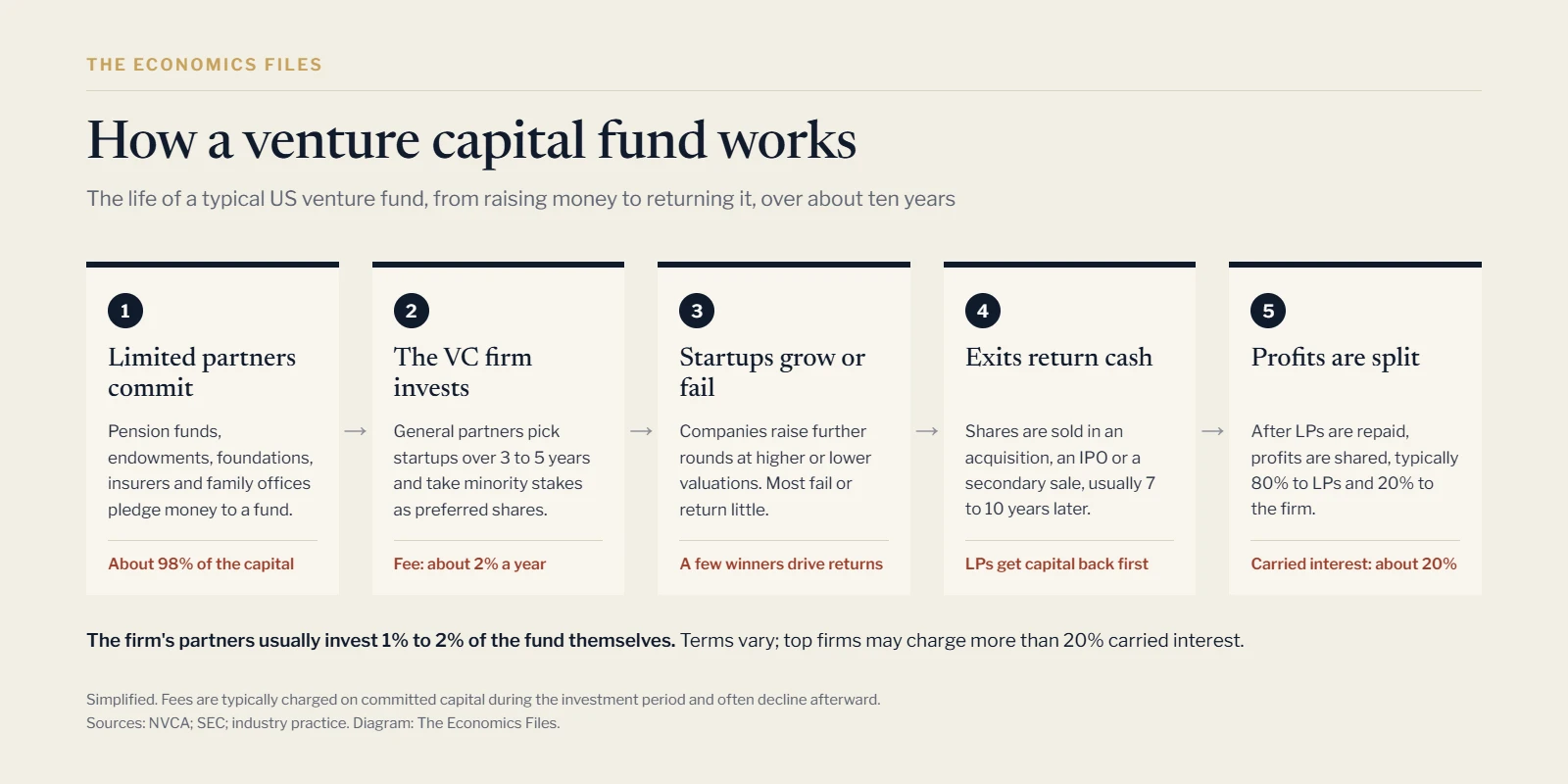
Venture capitalists mostly invest other people’s money. The firm’s partners, called general partners (GPs), set up a fund as a limited partnership. Outside investors, the limited partners (LPs), commit capital to it: pension funds, endowments, foundations, insurance companies, sovereign wealth funds, family offices and funds of funds. The GPs usually put in about 1% to 2% themselves.
A typical fund lasts about ten years. The GPs spend the first three to five years making new investments and the rest supporting the companies and selling stakes. LPs do not hand over their full commitment on day one; the fund “calls” the money as it needs it.
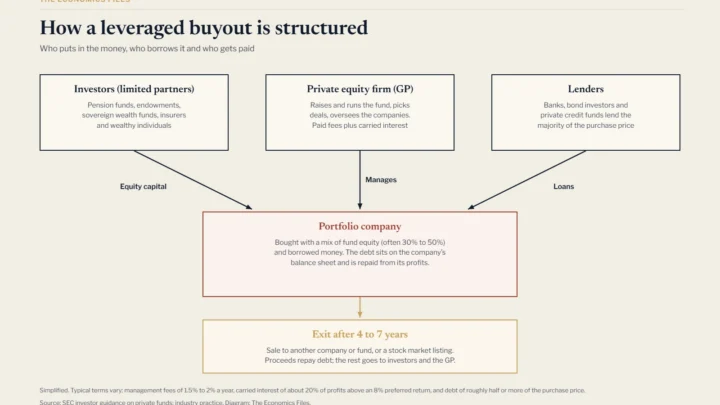
The standard pay structure is known as “2 and 20.” The firm charges an annual management fee of around 2% of committed capital to cover salaries and costs, and keeps about 20% of the fund’s profits, called carried interest, once LPs have their money back. Top firms sometimes take 25% or 30%. Carried interest works the same way in private equity, but venture funds buy minority stakes in young companies rather than control of mature ones, and they use almost no debt.
Fundraising has become very concentrated. US venture funds raised $108.5 billion in the first three quarters of 2026. Funds of $500 million or more took 78.1% of that money while making up only 6% of funds closed, and first-time funds received about 4.5%.
VC Funding Stages
Startups raise money in rounds, each meant to fund the company until it reaches the next milestone. The names are informal, but the sequence is broadly standard.
- Pre-seed and seed: the first outside money, often from angel investors and small funds, to build a product and find early customers.
- Series A and B (early stage): money to prove the business model and start scaling sales.
- Series C and later (late stage): money to expand fast, enter new markets or buy competitors.
- Venture growth: very large rounds for mature private companies, often from crossover funds, sovereign funds or corporations, sometimes shortly before a listing.
What investors look for at each stage
Early investors mostly bet on people and markets, because there is little else to judge. A seed investor wants a team that can build a product and a market large enough to support a big company if things go right. By Series A, investors want evidence that customers keep coming back and paying, often called product-market fit. Later rounds are priced more on numbers: revenue growth, gross margins, the cost of acquiring each customer and how fast the company burns cash. At the growth stage, investors often compare the company with listed peers, since an IPO or a sale may be only a year or two away.
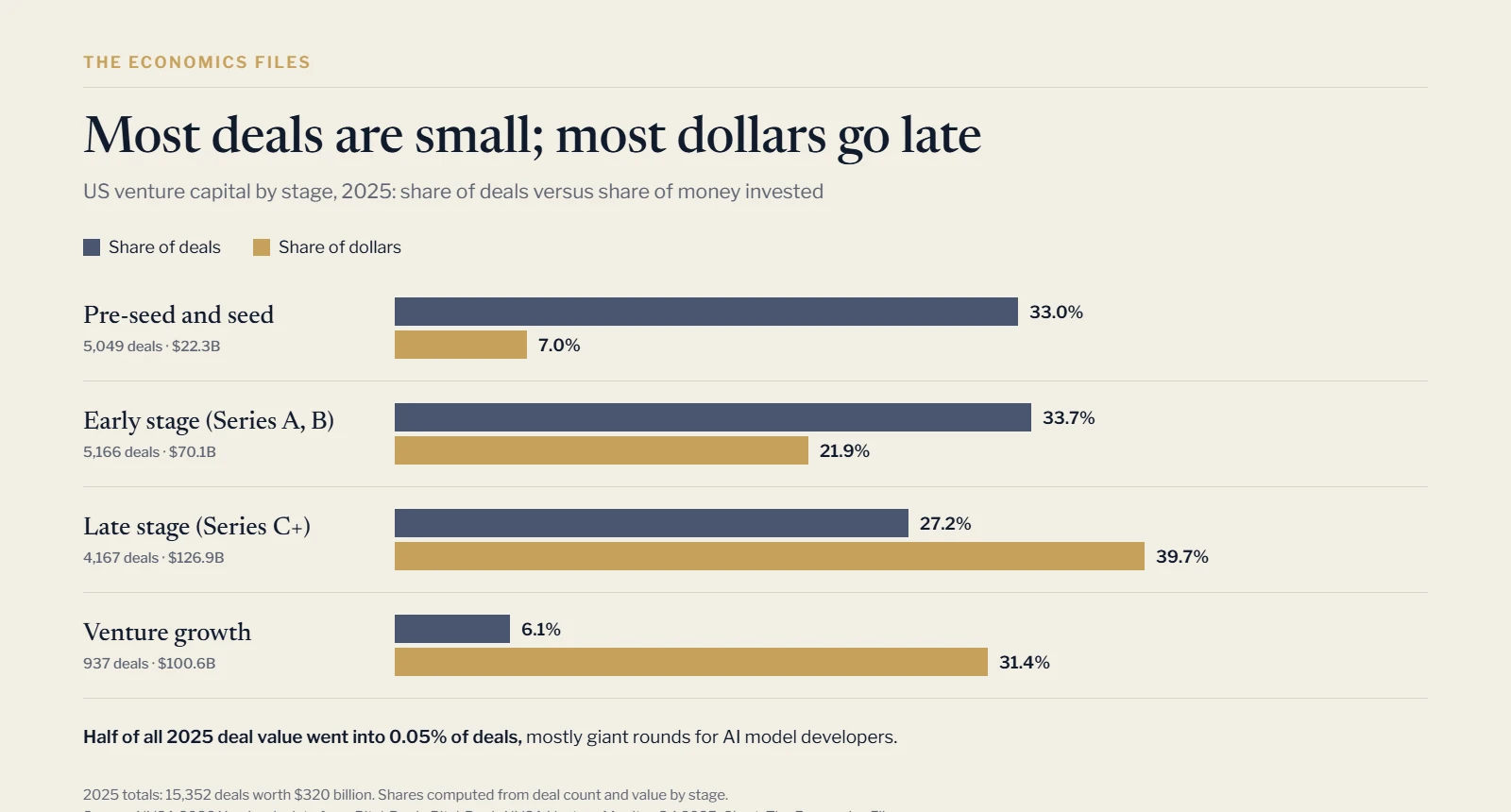
The stages look very different in money terms. In 2025, seed and pre-seed rounds made up about a third of all US deals but only 7% of the dollars, according to the NVCA’s 2026 Yearbook. Late-stage and growth rounds, with about a third of deals, took more than 70% of the money. That gap has widened with AI: half of all 2025 deal value went into just 0.05% of deals, the largest of them the multibillion-dollar rounds for AI model developers.
Startup Valuation: How the Price Is Set
A young startup usually has little revenue and no profit, so it cannot be valued the way a listed company is valued on its earnings. The price is negotiated, and it is expressed as a valuation before the new money arrives (pre-money) and after (post-money).
Take a seed round at the 2025 median pre-money valuation of $16 million. If investors put in $4 million, the post-money valuation is $20 million, and the new investors own 20% of the company. The founders and earlier shareholders are diluted from 100% to 80% of a larger company. Each later round dilutes them again, which is why founders often end up owning a minority of the company they started.
Investors work backward from the exit. An early-stage investor might ask what the company could be worth if it succeeds, say $1 billion in ten years, and what ownership it needs at that point to return a large multiple on the investment after later dilution. Competition matters as much as arithmetic: when many funds chase the same AI startups, prices rise regardless of the model.
The headline valuation can also overstate what common shares are worth. Venture investors buy preferred stock with protections, such as a liquidation preference that returns their money first if the company is sold. A startup “valued at $1 billion” may be worth far less to employees holding common stock if it is later sold for less than investors paid.
How Venture Capital Firms Make Money
The part of how does venture capital work that outsiders most often miss is the exit. A fund makes money only when it sells. There are three main ways out: an acquisition by a larger company, an initial public offering, which we explain in how the stock market works, or a sale of shares to another investor on the secondary market. Until then, gains exist only on paper.
That is the industry’s current problem. Investors measure funds by two ratios: TVPI, the total value of the fund relative to the money paid in, including unrealized gains, and DPI, the cash actually distributed relative to the money paid in. Among funds on Carta’s platform, every vintage from 2017 through 2023 had a median TVPI of at least 1x at mid-2026, but most of those gains were unrealized. For 2019 and 2020 funds, median DPI was still barely above zero, and fewer than half had returned any capital at all.
The slow return of cash feeds back into fundraising. LPs that have not been paid back are reluctant to commit to new funds, which helps explain why money is flowing to a small number of established firms.
VC Returns and the Power Law
Venture returns do not follow a bell curve. They follow a power law, in which a tiny share of investments produces most of the gains.
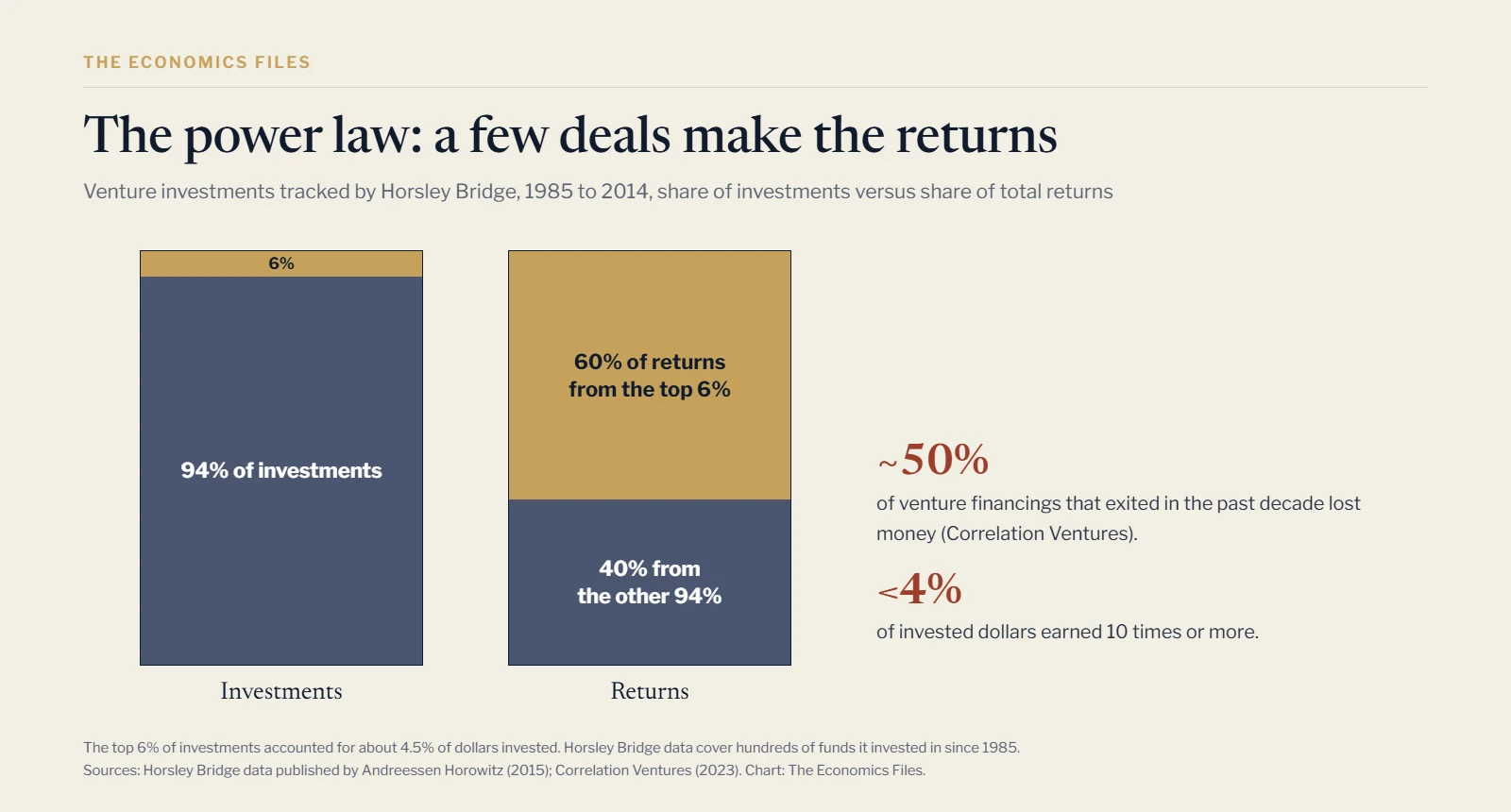
Horsley Bridge, an investor in hundreds of venture funds, found that about 6% of the investments it tracked from 1985 to 2014, representing 4.5% of the dollars invested, produced about 60% of total returns. Correlation Ventures found that nearly half of venture financings that exited over the past decade lost money, and that less than 4% of invested dollars earned ten times or more.
This shapes how venture capitalists behave. A fund needs at least one company that can return the entire fund on its own, so investors favor startups that could become very large, accept that most bets will fail, and often push companies to grow fast rather than steadily. A company that becomes a solid, modestly profitable business can be a disappointment for its VC backers.
For the industry as a whole, returns have been strong but uneven. The Cambridge Associates US Venture Capital Index returned 21.1% in 2025 and 14.9% a year over the ten years to December 2025, close to the 15.1% an investor would have earned in the S&P 500 with the same cash flows. Over 25 years, a period that includes the dot-com bust, venture returned 8.1% a year against 10.0% for the S&P 500 comparison. The averages hide a wide spread: top-quartile funds have historically done far better than the median, and the best firms tend to keep access to the best deals.
The same skew applies to the investors themselves. A study of more than 100,000 US venture capitalists by Blake Jackson and Ilya Strebulaev, published by the National Bureau of Economic Research in 2026, found that the top 5% accounted for 90% of the industry’s net profits, while most generated zero or negative net profits.
Why Venture Capital Matters for the Economy
Venture capital is small next to the stock or bond markets, but its reach is large. Companies originally backed by venture investors accounted for 41% of total US stock market value and 62% of public companies’ research and development spending, according to research by Will Gornall and Ilya Strebulaev of the University of British Columbia and Stanford. Among public companies founded in the last 50 years, they made up about half by number and three-quarters by value.
The authors also found that the US produced twice as many top public companies after 1970s pension reforms allowed retirement funds to invest in venture capital. That is why pension rules, tax treatment of carried interest and the health of the IPO market are policy questions, not only matters for investors.
Venture Capital in 2026: An AI Market
AI has turned venture capital into two markets. AI companies took 65.4% of US deal value in 2025, up from about 10% a decade earlier, and 82.7% in the first nine months of 2026. A small group of model developers raised rounds of tens of billions of dollars, often from large technology companies that also sell them cloud computing, a loop we describe in our article on who pays for the AI data center boom.
Outside that group, conditions are tighter. There were 992 active US unicorns, private companies valued at $1 billion or more, at the end of September, with a combined valuation of $5.7 trillion, according to PitchBook. At the end of 2025, about 41% of unicorns had not raised new money since at least 2022. Their investors need exits to return cash, and the next year of IPOs and acquisitions will decide how many of those paper valuations become real money.
Venture capital also matters beyond the funds themselves. Many of the largest US companies by market value, including Apple, Microsoft, Alphabet, Amazon and Nvidia, were backed by venture investors early on. Whether today’s AI startups follow that path, or whether the current wave ends like the dot-com boom, is the bet LPs are making with every new fund.
Frequently Asked Questions
What is the difference between venture capital and private equity?
Venture capital buys minority stakes in young, fast-growing private companies and uses almost no debt. Private equity usually buys control of mature companies, often with borrowed money, and tries to raise their profits before selling. Both use a fund structure with limited partners, management fees and carried interest.
How do venture capitalists get paid?
VC firms typically charge a management fee of about 2% of committed capital a year and keep about 20% of profits, called carried interest, after investors get their money back. Partners also invest 1% to 2% of the fund themselves and share in its gains.
What percentage of venture-backed startups fail?
Most do not return the money invested in them. Correlation Ventures found that nearly half of venture financings that exited over the past decade lost money, and less than 4% of invested dollars earned ten times or more. A small number of large successes drive most returns.
What is a unicorn?
A unicorn is a private company valued at $1 billion or more. There were 992 active US unicorns at the end of September 2026, with a combined valuation of $5.7 trillion, according to PitchBook. A unicorn valuation is set in a funding round and may not match what shares fetch in a sale.
Can ordinary investors invest in venture capital?
Direct investment in venture funds is mostly limited to institutions and accredited investors under SEC rules. Individuals get indirect exposure through pension funds and endowments, through listed companies that invest in startups, and in some cases through registered funds or crowdfunding platforms, which carry high risk.
Sources
- PitchBook-NVCA Venture Monitor, Q3 2026
- NVCA, “NVCA Releases 2026 Yearbook,” April 13, 2026
- NVCA 2026 Yearbook summary, data from PitchBook
- PitchBook-NVCA Venture Monitor, Q4 2025
- Cambridge Associates, “US PE/VC Benchmark Commentary: Calendar Year 2025”
- Carta, “VC fund managers face an uphill battle to turn paper profits into concrete returns,” October 26, 2026
- Carta, “VC Fund Performance: Q1 2026”
- Chris Dixon, Andreessen Horowitz, “Performance Data and the ‘Babe Ruth’ Effect in Venture Capital,” 2015
- Correlation Ventures, “Venture Capital: We’re Still Not Normal,” 2023
- Will Gornall and Ilya Strebulaev, “The Economic Impact of Venture Capital: Evidence from Public Companies,” 2021
- NBER, “Who Gets Ahead in Venture Capital: New Evidence from 100,000 Investors’ Careers,” October 2026
Method: Deal, fundraising and unicorn figures are from the PitchBook-NVCA Venture Monitor (Q3 2026, data through September 30, 2026) and the NVCA 2026 Yearbook (2025 data). Stage shares are computed from the Yearbook’s 2025 deal value and count by stage. Return figures are pooled net returns from Cambridge Associates for periods ending December 31, 2025, compared with its modified public market equivalent for the S&P 500. Power-law figures are from Horsley Bridge data published by Andreessen Horowitz (2015) and Correlation Ventures (2023). The seed round example is illustrative. Data as of November 23, 2026.